
Level:
Correct: 0
Incorrect: 0
Marks: 0/0
Exam Practice
Course:
Topics:
OCR GCSE Maths (Foundation calculator) Smart practice A mixed round aimed at your weak spots
Unit 1
Number Operations and Integers
Unit 2
Fractions, Decimals and Percentages
Unit 3
Indices and Surds
Unit 4
Approximation and Estimation
Unit 5
Ratio, Proportion and Rates of Change
Unit 6
Algebra
Unit 7
Graphs of Equations and Functions
Unit 8
Basic Geometry
Unit 9
Congruence and Similarity
Unit 10
Mensuration
Unit 11
Probability
Unit 12
Statistics
Avg
score:
–
Topics
done:
0/100

Similar shapes

Practise 15 exam-style questions on Similar shapes for OCR GCSE Maths (Foundation calculator). Write your answer as you would in the exam and get it marked in seconds against the mark scheme, point by point, with the Study Helper on hand if you get stuck.

  • 15 questions
  • 1–4 marks each
  • Instant marking
  • No sign-up needed
15 questions, marked as you go

Sample questions with model answers

Here are 4 of the questions in this topic, each with a model answer, an explanation of why it earns the marks and the mark scheme an examiner would use.

Question 1

1 mark

Two similar shapes have matching sides of length 4.5 cm and 7.2 cm.

Write the ratio 4.5 : 7.2 in the form 1 : n.

Model answer

Divide both parts by 4.5.
\(4.5 \div 4.5 = 1\) and \(7.2 \div 4.5 = 1.6\)
1 : 1.6

Explanation

To write a ratio in the form 1 : n, divide both parts by the first number. Here n = 1.6 is the scale factor from the smaller shape to the larger shape. A common error is to divide 4.5 by 7.2 instead.

Mark scheme
  1. 1 mark

    B1 for 1 : 1.6

    Exact value. Accept \(n = 1.6\). 5 : 8 (simplest whole-number form) scores 0. 1 : 0.625 scores 0.
Question 2

2 marks

Mira has two photos.
One photo is 15 cm by 10 cm. The other photo is 18 cm by 13 cm.

Mira says,

'These photos are similar rectangles, because each one is 5 cm longer than it is wide.'

Is Mira correct?
Show how you decide.

Model answer

For similar rectangles, both sides must be multiplied by the same scale factor.
Length: \(18 \div 15 = 1.2\)
Width: \(13 \div 10 = 1.3\)
The scale factors are different, so the photos are not similar.
No, Mira is not correct.

Explanation

Similar shapes have matching lengths in the same ratio: it is multiplying, not adding, that keeps the shape the same. Here the length grows by a factor of 1.2 but the width by 1.3, so the larger photo is a slightly different shape. Mira's reason compares differences, which does not test for similarity.

Mark scheme
  1. 1 mark

    M1 for comparing ratios, e.g. \(18 \div 15 = 1.2\) and \(13 \div 10 = 1.3\), or \(15 \div 10 = 1.5\) and \(18 \div 13 = 1.38...\)

    Exact values from the question; accept 1.38 or 1.385 for \(18 \div 13\). Accept the reciprocal ratios.

  2. 1 mark

    A1 for No, because the scale factors (or ratios) are different oe

    'No' with no correct supporting calculation scores 0. 'No, because adding 5 does not make similar shapes' alone scores M0 A0.

Question 3

2 marks

Ben has two cubes.
The small cube has edges of 2 cm. The large cube has edges of 6 cm.

Ben says,

'The edges of the large cube are 3 times as long, so its volume is 3 times as big.'

Is Ben correct?
Show how you decide.

Model answer

Volume of the small cube \(= 2 \times 2 \times 2 = 8\) cm\(^3\)
Volume of the large cube \(= 6 \times 6 \times 6 = 216\) cm\(^3\)
\(216 \div 8 = 27\)
No, the volume is 27 times as big, not 3 times.

Explanation

All three dimensions of the cube are multiplied by 3, so the volume is multiplied by 3 × 3 × 3 = 27. For similar solids, volumes are multiplied by the cube of the length scale factor. Ben has used the length scale factor for a volume.

Mark scheme
  1. 1 mark

    B1 for volumes 8 (cm\(^3\)) and 216 (cm\(^3\)), or for \(3^3 = 27\)

    Exact values.

  2. 1 mark

    B1 for No, the volume is 27 times as big oe

    'No' with no correct supporting values scores 0.

Question 4

4 marks

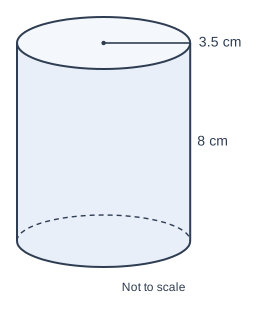
Two cylindrical tins are similar.
The diagram shows the small tin, which has radius 3.5 cm and height 8 cm.

The large tin has height 12 cm.

Calculate the volume of the large tin.
Give your answer correct to 3 significant figures.

A cylinder drawn in 3D (hidden edges dashed). The radius is labelled 3.5 cm (on a line from the centre of the flat top face to its edge). The height is labelled 8 cm (beside the vertical side of the cylinder). The diagram is labelled "Not to scale".

Model answer

Scale factor \(= 12 \div 8 = 1.5\)
Radius of the large tin \(= 3.5 \times 1.5 = 5.25\) cm
Volume \(= \pi \times 5.25^2 \times 12 = 1039.08...\) cm\(^3\)
1040 cm\(^3\)

Explanation

Similar cylinders have both the radius and the height multiplied by the same scale factor, so first find the radius of the large tin. Then use the volume of a cylinder, πr²h (the volume of a prism from the formulae sheet). Alternatively, multiply the small tin's volume by 1.5³. A common error is to change only the height.

Mark scheme
  1. 1 mark

    M1 for scale factor \(12 \div 8\) (\(= 1.5\))

    Exact values from the question; correct answer with no working scores full marks

  2. 1 mark

    M1 for radius of the large tin \(3.5 \times 1.5 = 5.25\), or volume of the small tin \(\pi \times 3.5^2 \times 8\) (\(= 307.87...\))

    Exact values (5.25 is exact). Accept 307.8 to 307.9 for the small tin (307.916 with \(\pi = 3.142\)).

  3. 1 mark

    M1 for \(\pi \times 5.25^2 \times 12\) or their \(307.87... \times 1.5^3\)

    Implied by 1039 to 1039.3.

  4. 1 mark

    A1 for 1040 (cm\(^3\))

    Calculator value 1039.08...; \(\pi = 3.142\) gives 1039.21... Accept 1040, or 1039 to 1039.3. Using radius 3.5 with height 12 gives 461.8: M1 M0 M0 A0. Using \(307.87... \times 1.5 = 461.8\) scores M1 M1 M0 A0. If 0 scored, SC1 for their answer to more than 3 figures correctly rounded to 3 significant figures.

Ready to try the rest? Every answer you write is marked against the mark scheme, so you can see exactly where the marks are.

Study Helper Hints first, answers after you try

Stuck on this one? Ask for a hint and I’ll point you in the right direction, without giving the answer away. Once you’ve checked your answer, I’ll show you how the marks are awarded.