
Level:
Correct: 0
Incorrect: 0
Marks: 0/0
Exam Practice
Course:
Topics:
OCR GCSE Maths (Foundation calculator) Smart practice A mixed round aimed at your weak spots
Unit 1
Number Operations and Integers
Unit 2
Fractions, Decimals and Percentages
Unit 3
Indices and Surds
Unit 4
Approximation and Estimation
Unit 5
Ratio, Proportion and Rates of Change
Unit 6
Algebra
Unit 7
Graphs of Equations and Functions
Unit 8
Basic Geometry
Unit 9
Congruence and Similarity
Unit 10
Mensuration
Unit 11
Probability
Unit 12
Statistics
Avg
score:
–
Topics
done:
0/100

Factors, multiples, squares and cubes

Practise 15 exam-style questions on Factors, multiples, squares and cubes for OCR GCSE Maths (Foundation calculator). Write your answer as you would in the exam and get it marked in seconds against the mark scheme, point by point, with the Study Helper on hand if you get stuck.

  • 15 questions
  • 1–4 marks each
  • Instant marking
  • No sign-up needed
15 questions, marked as you go

Sample questions with model answers

Here are 4 of the questions in this topic, each with a model answer, an explanation of why it earns the marks and the mark scheme an examiner would use.

Question 1

1 mark

Write these numbers in order of size, starting with the smallest.

0.407   0.47   0.4071   0.074

Model answer

Compare the tenths first: 0.074 has 0 tenths, the others have 4 tenths.
Then the hundredths: 0.407 and 0.4071 have 0 hundredths, 0.47 has 7 hundredths.
0.407 = 0.4070, which is smaller than 0.4071.
0.074, 0.407, 0.4071, 0.47

Explanation

Compare decimals place by place from the left: tenths, then hundredths, then thousandths. Writing them with the same number of decimal places (0.0740, 0.4070, 0.4071, 0.4700) makes this easier. A common error is to think a number with more digits is larger, such as putting 0.4071 after 0.47.

Mark scheme
  1. 1 mark

    B1 for 0.074, 0.407, 0.4071, 0.47

    Do not accept the reverse order. 0.074, 0.47, 0.407, 0.4071 (ordering by the number of digits) scores 0.
Question 2

2 marks

Ahmed says,

'15 is a common factor of 375 and 1035.'

Is Ahmed correct?
Show how you decide.

Model answer

\(375 \div 15 = 25\)
\(1035 \div 15 = 69\)
Both answers are whole numbers, so 15 is a factor of both numbers.
Yes, Ahmed is correct.

Explanation

A common factor of two numbers divides exactly into both of them. Dividing each number by 15 gives a whole number (25 and 69), so 15 is a factor of both. You must check both numbers: a number can be a factor of one and not the other.

Mark scheme
  1. 1 mark

    M1 for \(375 \div 15\) or \(1035 \div 15\)

    May be implied by 25 or 69 seen. Also award for \(15 \times 25 = 375\) or \(15 \times 69 = 1035\).

  2. 1 mark

    A1 for Yes with 25 and 69

    Both divisions must be shown to give whole numbers. 'Yes' with only one division checked scores M1 A0. Alternative: both 375 and 1035 shown to be multiples of 3 and of 5.

Question 3

2 marks

Ruby says,

'I can find three consecutive whole numbers that add up to 4573.'

Is Ruby correct?
Show how you decide.

Model answer

Three consecutive numbers add up to 3 times the middle number, so the total must be a multiple of 3.
\(4573 \div 3 = 1524.333...\), which is not a whole number.
Check: \(1523 + 1524 + 1525 = 4572\) and \(1524 + 1525 + 1526 = 4575\).
No, Ruby is not correct.

Explanation

In three consecutive numbers, the first is one less than the middle and the last is one more, so the total is always 3 times the middle number, a multiple of 3. 4573 is not a multiple of 3, because \(4573 \div 3\) is not a whole number. Trying numbers near \(4573 \div 3\) shows the totals jump from 4572 to 4575.

Mark scheme
  1. 1 mark

    M1 for \(4573 \div 3\) or for a trial of three consecutive numbers with a total within 10 of 4573

    \(4573 \div 3 = 1524.33...\). Trials: \(1523 + 1524 + 1525 = 4572\) and \(1524 + 1525 + 1526 = 4575\).

  2. 1 mark

    A1 for No with a correct reason

    e.g. '4573 is not a multiple of 3 (the total of three consecutive numbers is 3 times the middle number)', or both totals 4572 and 4575 shown, so 4573 is missed. 'No' with no working scores 0.

Question 4

4 marks

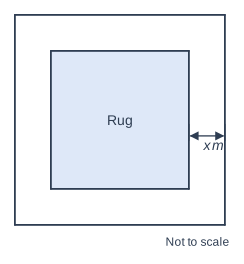
The diagram shows a square rug in the middle of a square room.

The area of the rug is 5.29 m².
The area of the floor of the room is 12.25 m².

The width of the strip of floor between each edge of the rug and the wall is \(x\) m.

Work out the value of \(x\).

Geometry diagram, marked "Not to scale". A square (the room) (its vertices are not labelled). A square (the rug) (its vertices are not labelled) (shaded). The text "Rug" is written inside the shape. A double-headed dimension arrow alongside an unlabelled line going to the right (the distance from an unlabelled point to an unlabelled point) is labelled x m.

Model answer

Side of the rug \(= \sqrt{5.29} = 2.3\) m
Side of the room \(= \sqrt{12.25} = 3.5\) m
The gaps on the two sides add up to \(3.5 - 2.3 = 1.2\) m
\(x = 1.2 \div 2 = 0.6\)

Explanation

The side of a square is the square root of its area, so the rug is 2.3 m wide and the room is 3.5 m wide. Across the room there is a strip on each side of the rug, so the 1.2 m difference is shared between two strips. Common errors are forgetting to halve and subtracting the areas instead of the lengths.

Mark scheme
  1. 1 mark

    M1 for \(\sqrt{5.29}\)

    May be implied by 2.3 (side of the rug); correct answer with no working scores full marks

  2. 1 mark

    M1 for \(\sqrt{12.25}\)

    May be implied by 3.5 (side of the room).

  3. 1 mark

    M1 for (their \(3.5 -\) their 2.3) \(\div 2\)

    Their values must come from square roots.

  4. 1 mark

    A1 for 0.6

    Exact value. A correct answer with no working scores 4 marks. 1.2 (not halved) scores M1 M1 M0 A0. 3.48 (from \((12.25 - 5.29) \div 2\)) scores M0 M0 M0 A0.

Ready to try the rest? Every answer you write is marked against the mark scheme, so you can see exactly where the marks are.

Study Helper Hints first, answers after you try

Stuck on this one? Ask for a hint and I’ll point you in the right direction, without giving the answer away. Once you’ve checked your answer, I’ll show you how the marks are awarded.