Practise 15 exam-style questions on Powers and roots for OCR GCSE Maths (Foundation calculator). Write your answer as you would in the exam and get it marked in seconds against the mark scheme, point by point, with the Study Helper on hand if you get stuck.
15 questions
1–4 marks each
Instant marking
No sign-up needed
15 questions, marked as you go
Sample questions with model answers
Here are 4 of the questions in this topic, each with a model answer, an explanation of why it earns the marks and the mark scheme an examiner would use.
The cube root of a number is the value that, multiplied by itself three times, gives the number. A negative number cubed is negative, so negative numbers do have cube roots (unlike square roots). Use the cube root key on your calculator; it accepts negative numbers.
Mark scheme
1 mark
B1 for −6
6 (sign lost) scores 0. −72 (dividing by 3) scores 0. 'No answer, because you cannot find the cube root of a negative number' scores 0.
Work out the bracket first, then square it, then subtract the square root. On a calculator, type the bracket before pressing the square key, or the calculator squares only 1.7. Squaring each number separately (\(3.2^2 + 1.7^2\)) is a common error: \((a + b)^2\) is not \(a^2 + b^2\).
Mark scheme
1 mark
M1 for 24.01 or 4.3 seen
Exact values: \(4.9^2\) = 24.01 and \(\sqrt{18.49}\) = 4.3; correct answer with no working scores full marks
1 mark
A1 for 19.71
Exact value. Correct answer with no working scores 2 marks. 8.83 (from \(3.2^2 + 1.7^2\) − 4.3) scores M1 A0.
Question 3
2 marks
Find the whole number n for which \(3^n\) is closest to 1000. Show how you decide.
Model answer
\(3^6\) = 729 and \(3^7\) = 2187 1000 − 729 = 271 and 2187 − 1000 = 1187 729 is closer to 1000, so n = 6.
Explanation
List the powers of 3 (3, 9, 27, 81, 243, 729, 2187) until you pass 1000, then compare the two powers on either side of 1000. The first power bigger than 1000 is not necessarily the closest: 2187 is much further from 1000 than 729 is.
Mark scheme
1 mark
M1 for \(3^6\) = 729 and \(3^7\) = 2187 seen
Or a list of powers of 3 reaching at least 2187 with no errors.
1 mark
A1 for n = 6, with 729 and 2187 compared with 1000
e.g. '729 is 271 away from 1000 and 2187 is 1187 away, so n = 6'. Answer only scores 0 (show how you decide). n = 7 (first power over 1000) scores M1 A0.
Question 4
4 marks
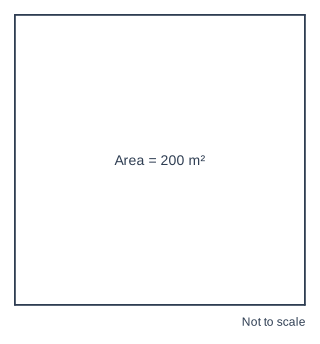
The diagram shows a square garden. The area of the garden is 200 m².
Fencing costs £8.95 per metre.
Work out the cost of fencing to go all the way round the edge of the garden. Give your answer to the nearest penny.
Model answer
Side of the square = \(\sqrt{200}\) = 14.1421... m Perimeter = \(4 \times 14.1421... = 56.5685...\) m Cost = \(56.5685... \times 8.95 = 506.288...\) The fencing costs £506.29
Explanation
The area of a square is its side length squared, so the side length is the square root of the area. Multiply by 4 for the perimeter and then by the price per metre. Keep the full calculator value of \(\sqrt{200}\) until the end: rounding it to 14.14 gives £506.21, which is wrong.
Mark scheme
1 mark
M1 for \(\sqrt{200}\)
May be implied by 14.1... seen; correct answer with no working scores full marks
1 mark
A1 for 14.14... (m)
Accept 14.1 to 14.15 (the calculator value is 14.142...).
1 mark
M1 for 4 × their \(14.14 \times 8.95\)
FT their side length. Implied by 56.56... (perimeter; accept 56.4 to 56.6) × 8.95.
1 mark
A1 for £506.29
Accept 506.28 to 506.29 (the calculator value is 506.288...). Correct answer with no working scores 4 marks. Premature rounding: 14.14 m gives £506.21 and 14.1 m gives £504.78, M1 A1 M1 A0. £447.50 (perimeter taken as 50, from \(200 \div 4\)) scores M0 A0 M1 A0. £1790 \((200 \times 8.95)\) scores 0.
Ready to try the rest? Every answer you write is marked against the mark scheme, so you can see exactly where the marks are.
Ctrl + Enter to check
Study HelperHints first, answers after you try
Stuck on this one? Ask for a hint and I’ll point you in the right direction, without giving the answer away. Once you’ve checked your answer, I’ll show you how the marks are awarded.