
Level:
Correct: 0
Incorrect: 0
Marks: 0/0
Exam Practice
Course:
Topics:
OCR GCSE Maths (Foundation calculator) Smart practice A mixed round aimed at your weak spots
Unit 1
Number Operations and Integers
Unit 2
Fractions, Decimals and Percentages
Unit 3
Indices and Surds
Unit 4
Approximation and Estimation
Unit 5
Ratio, Proportion and Rates of Change
Unit 6
Algebra
Unit 7
Graphs of Equations and Functions
Unit 8
Basic Geometry
Unit 9
Congruence and Similarity
Unit 10
Mensuration
Unit 11
Probability
Unit 12
Statistics
Avg
score:
–
Topics
done:
0/100

Angles in polygons

Practise 15 exam-style questions on Angles in polygons for OCR GCSE Maths (Foundation calculator). Write your answer as you would in the exam and get it marked in seconds against the mark scheme, point by point, with the Study Helper on hand if you get stuck.

  • 15 questions
  • 1–4 marks each
  • Instant marking
  • No sign-up needed
15 questions, marked as you go

Sample questions with model answers

Here are 4 of the questions in this topic, each with a model answer, an explanation of why it earns the marks and the mark scheme an examiner would use.

Question 1

1 mark

A polygon has 15 sides.

What is the sum of its exterior angles?

Choose your answer.

  • 24°
  • 180°
  • 360°
  • 2340°

Model answer

360°

Explanation

The exterior angles of any polygon add up to 360°, however many sides it has: walking once round the polygon turns you through one full turn. 24° is one exterior angle of a regular 15-sided polygon, and 2340° is the sum of the interior angles.

Mark scheme
  1. 1 mark

    B1 for 360°

    Only this option. Do not accept more than one option chosen.
Question 2

2 marks

Mia says,

"Each exterior angle of a regular hexagon is 120°."

Explain Mia's mistake.
Work out the correct size of each exterior angle.

Model answer

120° is the size of each interior angle of a regular hexagon, not the exterior angle.
Each exterior angle = \(360 \div 6 = 60^\circ\) (or \(180 - 120 = 60^\circ\)).

Explanation

The exterior angles of any polygon add up to 360°, so each exterior angle of a regular hexagon is 360° ÷ 6. Each interior angle is 180° − 60° = 120°, which is the angle Mia gave.

Mark scheme
  1. 1 mark

    B1 for 120° is the interior angle (of a regular hexagon) oe

    Accept 'she has found the interior angle, not the exterior angle'.

  2. 1 mark

    B1 for 60°

    From 360 ÷ 6 or 180 − 120. Independent of the first mark.

Question 3

3 marks

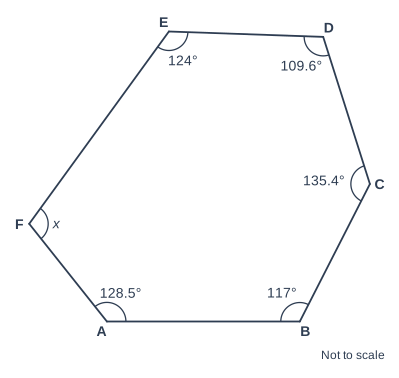
The diagram shows a hexagon ABCDEF.
Five of its interior angles are

128.5°   117°   135.4°   109.6°   124°

Work out the size of the sixth interior angle, marked \(x\).

Geometry diagram, marked "Not to scale". Hexagon ABCDEF. Angle FAB is marked 128.5°. Angle ABC is marked 117°. Angle BCD is marked 135.4°. Angle CDE is marked 109.6°. Angle DEF is marked 124°. Angle EFA is marked x.

Model answer

Sum of the interior angles of a hexagon = \((6 - 2) \times 180 = 720^\circ\)
Sum of the five angles = \(128.5 + 117 + 135.4 + 109.6 + 124 = 614.5^\circ\)
Sixth angle = \(720 - 614.5 = 105.5^\circ\)

Explanation

A hexagon can be split into 4 triangles, so its interior angles add up to 4 × 180° = 720°. Subtract the total of the five known angles. A common error is to use 6 × 180° for the angle sum.

Mark scheme
  1. 1 mark

    M1 for (6 − 2) × 180 or 720

    Sum of the interior angles of a hexagon. Accept 4 × 180; correct answer with no working scores full marks

  2. 1 mark

    M1 for their 720 − (128.5 + 117 + 135.4 + 109.6 + 124) or their 720 − 614.5

    Their 720 must be from a method for the angle sum of a polygon (not 360).

  3. 1 mark

    A1 for 105.5

    Accept 105.5°. Using 1080 (from 6 × 180) gives 465.5 and scores M0 M1 A0.

Question 4

4 marks

A regular nonagon (9 sides) and a regular polygon with 15 sides share the side AB.
The two polygons are on opposite sides of AB and do not overlap.

C is the vertex of the nonagon next to A.
D is the vertex of the 15-sided polygon next to A.

Work out the size of angle CAD, the angle at A that is outside both polygons.

Model answer

Interior angle of a regular nonagon = \(180 - 360 \div 9 = 180 - 40 = 140^\circ\)
Interior angle of a regular 15-sided polygon = \(180 - 360 \div 15 = 180 - 24 = 156^\circ\)
Angles at a point add up to 360°:
Angle CAD = \(360 - 140 - 156 = 64^\circ\)

Explanation

At A there are three angles: the interior angle of each polygon and the gap between them. They add up to 360° because they are angles at a point. Find each interior angle from the exterior angle (360° ÷ number of sides), then subtract both from 360°.

Mark scheme
  1. 1 mark

    M1 for 180 − 360 ÷ 9 or (9 − 2) × 180 ÷ 9

    correct answer with no working scores full marks

  2. 1 mark

    A1 for 140

    Interior angle of the regular nonagon.

  3. 1 mark

    M1 for 180 − 360 ÷ 15 or (15 − 2) × 180 ÷ 15, or 156

    Interior angle of the regular 15-sided polygon.

  4. 1 mark

    A1 for 64

    From 360 − 140 − 156. FT 360 − their 140 − their 156 for this mark only if both interior angles come from correct methods. 296 as the final answer scores M1 A1 M1 A0.

Ready to try the rest? Every answer you write is marked against the mark scheme, so you can see exactly where the marks are.

Study Helper Hints first, answers after you try

Stuck on this one? Ask for a hint and I’ll point you in the right direction, without giving the answer away. Once you’ve checked your answer, I’ll show you how the marks are awarded.