
Level:
Correct: 0
Incorrect: 0
Marks: 0/0
Exam Practice
Course:
Topics:
OCR GCSE Maths (Foundation calculator) Smart practice A mixed round aimed at your weak spots
Unit 1
Number Operations and Integers
Unit 2
Fractions, Decimals and Percentages
Unit 3
Indices and Surds
Unit 4
Approximation and Estimation
Unit 5
Ratio, Proportion and Rates of Change
Unit 6
Algebra
Unit 7
Graphs of Equations and Functions
Unit 8
Basic Geometry
Unit 9
Congruence and Similarity
Unit 10
Mensuration
Unit 11
Probability
Unit 12
Statistics
Avg
score:
–
Topics
done:
0/100

Relative frequency

Practise 14 exam-style questions on Relative frequency for OCR GCSE Maths (Foundation calculator). Write your answer as you would in the exam and get it marked in seconds against the mark scheme, point by point, with the Study Helper on hand if you get stuck.

  • 14 questions
  • 1–4 marks each
  • Instant marking
  • No sign-up needed
14 questions, marked as you go

Sample questions with model answers

Here are 4 of the questions in this topic, each with a model answer, an explanation of why it earns the marks and the mark scheme an examiner would use.

Question 1

2 marks

During one season, a tennis player's first serve landed in on 137 of her 214 first serves.

Work out the relative frequency of her first serve landing in.
Give your answer correct to 2 decimal places.

Model answer

Relative frequency = \(\dfrac{137}{214} = 0.640186...\)
Relative frequency = 0.64 to 2 decimal places

Explanation

Divide the number of first serves that landed in by the total number of first serves. The calculator gives 0.640186..., and the third decimal place is 0, so this rounds to 0.64. A common error is to divide the numbers the wrong way round, giving an answer greater than 1, which cannot be a relative frequency.

Mark scheme
  1. 1 mark

    M1 for \(\dfrac{137}{214}\)

    Implied by 0.640..; correct answer with no working scores full marks

  2. 1 mark

    A1 for 0.64

    Accept 0.64 to 0.6402 (calculator value 0.640186...). \(\dfrac{137}{214}\) not changed to a decimal scores M1 A0. 1.56 (from \(214 \div 137\)) scores M0 A0.
Question 2

2 marks

A bus company checked 380 buses leaving a bus station.
57 of these buses left late.

Next month, 1000 buses will leave the bus station.

Use these results to estimate how many of the 1000 buses will leave late.

Model answer

Relative frequency of leaving late = \(\dfrac{57}{380} = 0.15\)
Estimate = \(0.15 \times 1000 = 150\) buses

Explanation

Use the relative frequency from the check as an estimate of the probability that a bus leaves late, then multiply by the number of buses. This is only an estimate: the actual number next month may be a little different.

Mark scheme
  1. 1 mark

    M1 for \(\dfrac{57}{380} \times 1000\) oe

    Implied by 0.15 × 1000.

  2. 1 mark

    A1 for 150

    Exact value: no rounding needed. 850 (the number not late) scores M1 A0. 57 or 0.15 as the final answer scores M0 A0.

Question 3

2 marks

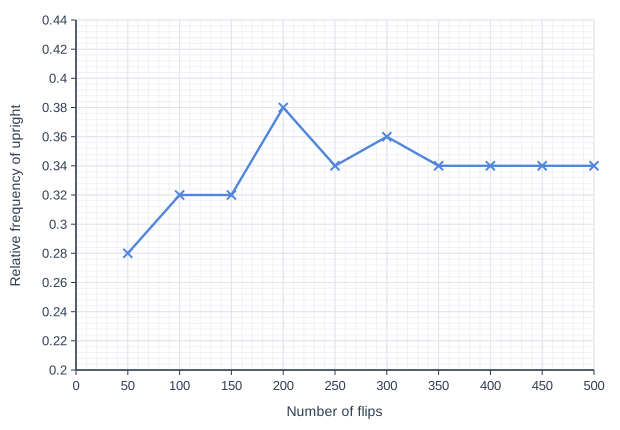
Lena flips a plastic bottle 500 times.
After every 50 flips she works out the relative frequency of the bottle landing upright so far.

The graph shows her results.

Work out the number of times the bottle landed upright in the first 200 flips.

Line graph of relative frequency of upright (y-axis, 0.2 to 0.44) against number of flips (x-axis, 0 to 500). The line joins the points (50, 0.28), (100, 0.32), (150, 0.32), (200, 0.38), (250, 0.34), (300, 0.36), (350, 0.34), (400, 0.34), (450, 0.34), (500, 0.34).

Model answer

From the graph, the relative frequency after 200 flips is 0.38.
Number of times upright = \(0.38 \times 200 = 76\)

Explanation

Relative frequency = number of times upright ÷ number of flips, so the number of times upright = relative frequency × number of flips. Read the value at 200 flips, not the final value. The graph also shows the relative frequency settling down near 0.34 as the number of flips increases.

Mark scheme
  1. 1 mark

    M1 for \(0.38 \times 200\)

    The relative frequency after 200 flips, 0.38, must be read from the graph; correct answer with no working scores full marks

  2. 1 mark

    A1 for 76

    Exact value: no rounding needed. 170 (\(0.34 \times 500\), the total after 500 flips) or 68 (\(0.34 \times 200\)) scores M0 A0.

Question 4

4 marks

A factory makes 4500 bolts each day.

In a quality check of 250 of the bolts, 7 were faulty.

Each faulty bolt costs the factory 18p.
The factory makes bolts on 5 days each week.

Use the quality check to estimate the total cost of faulty bolts in one week.
Give your answer in pounds.

Model answer

Relative frequency of a faulty bolt = \(\dfrac{7}{250} = 0.028\)
Bolts made in a week = \(4500 \times 5 = 22\,500\)
Estimated faulty bolts = \(0.028 \times 22\,500 = 630\)
Cost = \(630 \times 18 = 11\,340\)p = £113.40

Explanation

The relative frequency from the quality check, 0.028, is used as an estimate of the probability that a bolt is faulty. Multiply it by the number of bolts made in a week to estimate the number of faulty bolts, then by the cost of each. Remember the cost is in pence, so divide by 100 for pounds.

Mark scheme
  1. 1 mark

    M1 for \(\dfrac{7}{250}\) oe

    Implied by 0.028 or 2.8%.

  2. 1 mark

    M1 for their \(0.028 \times 4500\) or their \(0.028 \times 22\,500\)

    Implied by 126 (faulty bolts in a day) or 630 (faulty bolts in a week).

  3. 1 mark

    M1 for their \(126 \times 5 \times 18\) or their \(630 \times 0.18\) oe

    Implied by 11 340 (pence).

  4. 1 mark

    A1 for £113.40

    Exact values: no rounding needed. Accept 113.4. 11 340 with no conversion to pounds scores M1 M1 M1 A0. £22.68 (one day only) scores M1 M1 M0 A0.

Ready to try the rest? Every answer you write is marked against the mark scheme, so you can see exactly where the marks are.

Study Helper Hints first, answers after you try

Stuck on this one? Ask for a hint and I’ll point you in the right direction, without giving the answer away. Once you’ve checked your answer, I’ll show you how the marks are awarded.