
Level:
Correct: 0
Incorrect: 0
Marks: 0/0
Exam Practice
Course:
Topics:
OCR GCSE Maths (Foundation calculator) Smart practice A mixed round aimed at your weak spots
Unit 1
Number Operations and Integers
Unit 2
Fractions, Decimals and Percentages
Unit 3
Indices and Surds
Unit 4
Approximation and Estimation
Unit 5
Ratio, Proportion and Rates of Change
Unit 6
Algebra
Unit 7
Graphs of Equations and Functions
Unit 8
Basic Geometry
Unit 9
Congruence and Similarity
Unit 10
Mensuration
Unit 11
Probability
Unit 12
Statistics
Avg
score:
–
Topics
done:
0/100

Sequences and the nth term

Practise 16 exam-style questions on Sequences and the nth term for OCR GCSE Maths (Foundation calculator). Write your answer as you would in the exam and get it marked in seconds against the mark scheme, point by point, with the Study Helper on hand if you get stuck.

  • 16 questions
  • 1–4 marks each
  • Instant marking
  • No sign-up needed
16 questions, marked as you go

Sample questions with model answers

Here are 4 of the questions in this topic, each with a model answer, an explanation of why it earns the marks and the mark scheme an examiner would use.

Question 1

1 mark

Here are the first five terms of a sequence.

0.5   1   1.5   2   2.5

Write down an expression for the \(n\)th term of the sequence.

Model answer

Each term is half of its position number: 1st term \(= 0.5 \times 1\), 2nd term \(= 0.5 \times 2\), ...
\(n\)th term \(= 0.5n\)

Explanation

The terms go up by 0.5 each time, so the \(n\)th term starts with \(0.5n\). Check the first term: \(0.5 \times 1 = 0.5\), which matches, so nothing needs adding. Writing \(n + 0.5\) gives 1.5, 2.5, 3.5, ..., which is a different sequence.

Mark scheme
  1. 1 mark

    B1 for \(0.5n\)

    Accept \(\dfrac{n}{2}\), \(\dfrac{1}{2}n\) or \(n \div 2\). Do not accept \(n + 0.5\) or 'add 0.5'.
Question 2

2 marks

Here are the first four terms of an arithmetic sequence.

3.2   5.7   8.2   10.7

Work out the 50th term of the sequence.

Model answer

Common difference \(= 5.7 - 3.2 = 2.5\)
\(n\)th term \(= 2.5n + 0.7\) (check: \(n = 1\) gives 3.2)
50th term \(= 2.5 \times 50 + 0.7 = 125 + 0.7 = 125.7\)

Explanation

Find the \(n\)th term first: the terms go up by 2.5, so it starts \(2.5n\), and \(2.5 \times 1 = 2.5\) needs 0.7 added to make 3.2. Then substitute \(n = 50\). Another method: from the 1st to the 50th term is 49 steps, so \(3.2 + 49 \times 2.5\). Using 50 steps is a common error.

Mark scheme
  1. 1 mark

    M1 for \(2.5n + 0.7\) or \(3.2 + 49 \times 2.5\)

    Exact values from the question. Or for \(2.5 \times 50\) plus a constant; correct answer with no working scores full marks

  2. 1 mark

    A1 for 125.7

    128.2 (from \(3.2 + 50 \times 2.5\)) and 125 (from \(50 \times 2.5\)) score M0 A0.

Question 3

2 marks

The \(n\)th term of a sequence is \(5n + 3\).

Explain why 2027 cannot be a term of this sequence.

Model answer

\(5n\) is always a multiple of 5, so it ends in 0 or 5.
Adding 3 means every term ends in 3 or 8.
2027 ends in 7, so it cannot be a term.
(Or: \(5n + 3 = 2027\) gives \(n = 2024 \div 5 = 404.8\), which is not a whole number.)

Explanation

Look at the last digit: multiples of 5 end in 0 or 5, so the terms end in 3 or 8. A number ending in 7 can never appear. Solving the equation also works, because the position of a term must be a whole number.

Mark scheme
  1. 1 mark

    M1 for '\(5n\) is a multiple of 5, so it ends in 0 or 5', or for \(5n + 3 = 2027\) leading to \(5n = 2024\)

    Or for listing terms showing they end in 3 or 8 (8, 13, 18, 23, ...).

  2. 1 mark

    A1 for a complete explanation

    e.g. 'every term ends in 3 or 8, but 2027 ends in 7', or '\(n = 404.8\), which is not a whole number'. Listing terms alone without a general reason scores M1 A0.

Question 4

4 marks

Kemi stacks identical plastic cups one inside another.
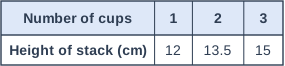
The table shows the height of a stack of cups for different numbers of cups.

The pattern continues in the same way.

Kemi puts a stack of cups on a shelf.
The gap between this shelf and the shelf above it is 55 cm.

What is the greatest number of cups Kemi can put in one stack so that it fits in the gap?

Table with columns "Number of cups", "1", "2", "3". Number of cups: Height of stack (cm); 1: 12; 2: 13.5; 3: 15.

Model answer

The height goes up by 1.5 cm for each extra cup.
Height of \(n\) cups \(= 1.5n + 10.5\) cm (check: \(n = 1\) gives 12)
\(1.5n + 10.5 = 55\)
\(1.5n = 44.5\)
\(n = 29.66...\)
29 cups: \(1.5 \times 29 + 10.5 = 54\) cm, which fits.
30 cups: \(1.5 \times 30 + 10.5 = 55.5\) cm, which is too tall.
The greatest number of cups is 29.

Explanation

Only the first cup adds its full height; each extra cup adds 1.5 cm, so the heights form an arithmetic sequence with \(n\)th term \(1.5n + 10.5\). Solving gives 29.66..., and the stack must fit, so round down to 29. Checking 29 and 30 cups confirms the answer.

Mark scheme
  1. 1 mark

    B1 for \(1.5n + 10.5\) oe

    The height of a stack of \(n\) cups. Or for '1.5 cm for each extra cup' with 12 for the first cup, e.g. \(12 + 1.5(n - 1)\); correct answer with no working scores full marks

  2. 1 mark

    M1 for \(1.5n + 10.5 = 55\) or \(1.5n + 10.5 \leqslant 55\) or \((55 - 10.5) \div 1.5\)

    FT their \(n\)th term of the form \(1.5n + k\). Or for continuing the sequence to near 55.

  3. 1 mark

    A1 for 29.6... or for 29 cups 54 cm and 30 cups 55.5 cm

    \(44.5 \div 1.5 = 29.666...\); accept 29.6 to 29.67.

  4. 1 mark

    A1 for 29 (cups)

    30 (rounding up) scores B1 M1 A1 A0. 36 (from \(55 \div 1.5\), ignoring the first cup) scores B0 M0 A0 A0.

Ready to try the rest? Every answer you write is marked against the mark scheme, so you can see exactly where the marks are.

Study Helper Hints first, answers after you try

Stuck on this one? Ask for a hint and I’ll point you in the right direction, without giving the answer away. Once you’ve checked your answer, I’ll show you how the marks are awarded.