
Level:
Correct: 0
Incorrect: 0
Marks: 0/0
Exam Practice
Course:
Topics:
OCR GCSE Maths (Foundation calculator) Smart practice A mixed round aimed at your weak spots
Unit 1
Number Operations and Integers
Unit 2
Fractions, Decimals and Percentages
Unit 3
Indices and Surds
Unit 4
Approximation and Estimation
Unit 5
Ratio, Proportion and Rates of Change
Unit 6
Algebra
Unit 7
Graphs of Equations and Functions
Unit 8
Basic Geometry
Unit 9
Congruence and Similarity
Unit 10
Mensuration
Unit 11
Probability
Unit 12
Statistics
Avg
score:
–
Topics
done:
0/100

Direct proportion

Practise 15 exam-style questions on Direct proportion for OCR GCSE Maths (Foundation calculator). Write your answer as you would in the exam and get it marked in seconds against the mark scheme, point by point, with the Study Helper on hand if you get stuck.

  • 15 questions
  • 1–4 marks each
  • Instant marking
  • No sign-up needed
15 questions, marked as you go

Sample questions with model answers

Here are 4 of the questions in this topic, each with a model answer, an explanation of why it earns the marks and the mark scheme an examiner would use.

Question 1

1 mark

Hamid uses the formula

\(E = 1.16P\)

to change \(P\) pounds into \(E\) euros.

Explain how the formula shows that \(E\) is directly proportional to \(P\).

Model answer

The formula has the form \(E = kP\), where \(k = 1.16\) is a constant.
\(E\) is always 1.16 times \(P\), with nothing added, so \(E\) is directly proportional to \(P\).

Explanation

If \(y = kx\) for a constant \(k\), then \(y\) is directly proportional to \(x\): doubling \(x\) doubles \(y\), and \(x = 0\) gives \(y = 0\). Here the constant of proportionality is the exchange rate, 1.16. Saying only that \(E\) increases when \(P\) increases is not enough, because that is also true when a number is added.

Mark scheme
  1. 1 mark

    B1 for the formula is of the form \(E = kP\) (where \(k\) is a constant) oe

    Accept e.g. 'E is always 1.16 times P', 'P is multiplied by a fixed number and nothing is added', 'it is like y = kx with k = 1.16'. Do not accept 'when P goes up, E goes up' on its own (also true for formulas such as E = P + 5).
Question 2

2 marks

Two shops print photos.
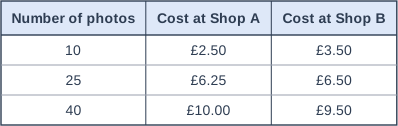
The table shows the cost of printing different numbers of photos at each shop.

At one of the shops, the cost is directly proportional to the number of photos.

Which shop is this?
Give a reason for your answer.

Table with columns "Number of photos", "Cost at Shop A", "Cost at Shop B". Number of photos: 10; Cost at Shop A: £2.50; Cost at Shop B: £3.50 | Number of photos: 25; Cost at Shop A: £6.25; Cost at Shop B: £6.50 | Number of photos: 40; Cost at Shop A: £10.00; Cost at Shop B: £9.50.

Model answer

Shop A: \(2.50 \div 10 = 0.25\), \(6.25 \div 25 = 0.25\), \(10.00 \div 40 = 0.25\)
Every photo costs 25p, so the cost is directly proportional to the number of photos.
Shop B: \(3.50 \div 10 = 0.35\) but \(9.50 \div 40 = 0.2375\), so the cost per photo is not the same.
The answer is Shop A.

Explanation

When one quantity is directly proportional to another, dividing one by the other always gives the same number (the constant of proportionality). At Shop A this is always £0.25 per photo. At Shop B the cost goes up steadily, but there is a fixed charge as well (£1.50 plus 20p per photo), so it is not directly proportional.

Mark scheme
  1. 1 mark

    B1 for Shop A

  2. 1 mark

    B1 for a correct reason, e.g. at Shop A every photo costs 25p (\(2.50 \div 10 = 6.25 \div 25 = 10 \div 40 = 0.25\)), but at Shop B the cost per photo changes (35p, 26p, 23.75p)

    The reason must use values from the table for at least Shop A, e.g. cost ÷ number is 0.25 each time, or 4 times as many photos (10 to 40) costs 4 times as much (£2.50 to £10). Do not accept 'Shop A goes up by the same amount each time' (Shop B also goes up by £3 for every 15 photos).

Question 3

3 marks

A doctor works out the dose of a medicine for a child.
The dose, \(d\) ml, is directly proportional to the child's mass, \(m\) kg.

A child with a mass of 14 kg is given a dose of 3.5 ml.

Write a formula for \(d\) in terms of \(m\).
Work out the mass of a child who is given a dose of 6.25 ml.

Model answer

\(d = km\)
\(3.5 = 14k\), so \(k = 3.5 \div 14 = 0.25\)
\(d = 0.25m\)
When \(d = 6.25\): \(6.25 = 0.25m\)
\(m = 6.25 \div 0.25 = 25\)
The child's mass is 25 kg.

Explanation

Write the proportion as \(d = km\) and use the values you know to find \(k = 0.25\) (0.25 ml for each kilogram). To find the mass, substitute \(d = 6.25\) and divide by 0.25. Check: a larger dose than 3.5 ml should belong to a heavier child than 14 kg.

Mark scheme
  1. 1 mark

    M1 for \(3.5 = 14k\) or \(3.5 \div 14\)

    Exact values from the question; correct answer with no working scores full marks

  2. 1 mark

    A1 for \(d = 0.25m\) oe

    Accept \(d = \dfrac{1}{4}m\) or \(d = \dfrac{m}{4}\). \(d = 4m\) scores M0 A0.

  3. 1 mark

    B1 for 25 (kg)

    Exact answer. FT their formula of the form \(d = km\). Also B1 for 25 from \(6.25 \div 3.5 \times 14\). \(0.25 \times 6.25 = 1.5625\) scores B0.

Question 4

4 marks

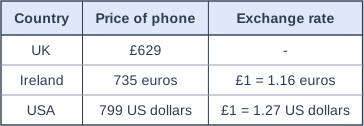
The table shows the price of the same mobile phone in three countries.
It also shows the exchange rates.

In which country is the phone cheapest?
Show how you decide.

Table with columns "Country", "Price of phone", "Exchange rate". Country: UK; Price of phone: £629; Exchange rate: - | Country: Ireland; Price of phone: 735 euros; Exchange rate: £1 = 1.16 euros | Country: USA; Price of phone: 799 US dollars; Exchange rate: £1 = 1.27 US dollars.

Model answer

UK: £629
Ireland: \(735 \div 1.16 = 633.62...\), so £633.62
USA: \(799 \div 1.27 = 629.13...\), so £629.13
£629 is less than £629.13 and £633.62, so the phone is cheapest in the UK.

Explanation

To compare prices they must all be in the same currency, so change the euros and the dollars into pounds by dividing by the exchange rates. The USA price is only 13p more than the UK price, so do not round to the nearest pound. Changing the UK price into euros and into dollars is an equally good method.

Mark scheme
  1. 1 mark

    M1 for \(735 \div 1.16\) or \(799 \div 1.27\)

    Exact values from the question. Also M1 for changing £629 into euros (\(629 \times 1.16 = 729.64\)) or dollars (\(629 \times 1.27 = 798.83\)).

  2. 1 mark

    M1 for both foreign prices changed into pounds (or the UK price changed into both currencies)

    Values must be comparable.

  3. 1 mark

    A1 for 633.6... (Ireland) and 629.1... (USA) in pounds

    Calculator values 633.62... and 629.13... Accept 633.6 to 633.63 and 629.1 to 629.14. Or 729.64 euros (compared with 735) and 798.83 dollars (compared with 799).

  4. 1 mark

    A1 for UK

    Depends on correct values for both. Rounding the USA price to £629 and saying it is the same as the UK scores M1 M1 A1 A0. UK with no valid working scores 0. Multiplying instead of dividing (852.60 and 1014.73) scores M0 M0 A0 A0.

Ready to try the rest? Every answer you write is marked against the mark scheme, so you can see exactly where the marks are.

Study Helper Hints first, answers after you try

Stuck on this one? Ask for a hint and I’ll point you in the right direction, without giving the answer away. Once you’ve checked your answer, I’ll show you how the marks are awarded.