Practise 14 exam-style questions on Properties of triangles for OCR GCSE Maths (Foundation calculator). Write your answer as you would in the exam and get it marked in seconds against the mark scheme, point by point, with the Study Helper on hand if you get stuck.
14 questions
1–4 marks each
Instant marking
No sign-up needed
14 questions, marked as you go
Sample questions with model answers
Here are 4 of the questions in this topic, each with a model answer, an explanation of why it earns the marks and the mark scheme an examiner would use.
Question 1
1 mark
A road sign is in the shape of a regular polygon with 8 sides.
Write down the mathematical name of this shape.
Model answer
A regular octagon.
Explanation
A polygon with 8 sides is an octagon. It is regular because all its sides are equal and all its angles are equal. A pentagon has 5 sides and a hexagon has 6.
Mark scheme
1 mark
B1 for (regular) octagon
Condone poor spelling if the word is clear. Do not accept 'hexagon' or 'pentagon'.
Question 2
2 marks
An isosceles triangle has a perimeter of 31.4 cm. The side that is a different length from the other two is 9.6 cm.
Work out the length of each of the other two sides.
Model answer
The two equal sides add up to \(31.4 - 9.6 = 21.8\) cm. Each equal side = \(21.8 \div 2 = 10.9\) cm
Explanation
An isosceles triangle has two equal sides. Take the different side away from the perimeter to leave the total of the two equal sides, then halve it. Dividing the perimeter by 3 would only work for an equilateral triangle.
Mark scheme
1 mark
M1 for (31.4 − 9.6) ÷ 2 or 21.8 ÷ 2
Implied by 21.8 seen with an intention to halve; correct answer with no working scores full marks
1 mark
A1 for 10.9 (cm)
Exact values from the question; the answer is exactly 10.9. 21.8 as the final answer scores M1 A0. 10.47 (31.4 ÷ 3) scores 0.
Question 3
2 marks
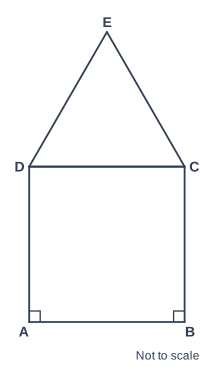
The diagram shows a shape made from a square and an equilateral triangle. One side of the triangle is also a side of the square.
The perimeter of the shape is 43.5 cm.
Work out the length of one side of the square.
Model answer
The sides of the equilateral triangle are the same length as the sides of the square. The perimeter is made of 5 of these sides (the shared side is inside the shape). \(43.5 \div 5 = 8.7\) cm
Explanation
All the sides of the equilateral triangle equal the side of the square, because they share a side. The shared side is not on the outside, so the perimeter is 3 sides of the square plus 2 sides of the triangle. A common error is to count 7 sides.
Mark scheme
1 mark
M1 for 43.5 ÷ 5
The perimeter is made of 5 equal sides; correct answer with no working scores full marks
1 mark
A1 for 8.7 (cm)
Exact values from the question; the answer is exactly 8.7. 6.21... (43.5 ÷ 7) or 7.25 (43.5 ÷ 6) scores 0.
Question 4
4 marks
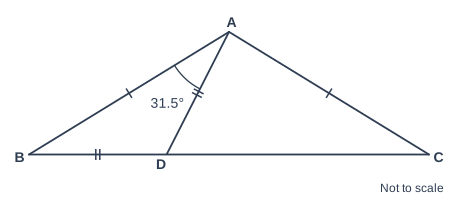
The diagram shows triangle ABC with AB = AC. D is a point on BC with AD = BD.
Angle BAD = 31.5°.
Work out the size of angle DAC.
Model answer
AD = BD, so triangle ABD is isosceles and angle ABD = angle BAD = 31.5°. AB = AC, so triangle ABC is isosceles and angle ACB = angle ABC = 31.5°. Angle BAC = \(180 - 31.5 - 31.5 = 117^\circ\) Angle DAC = \(117 - 31.5 = 85.5^\circ\)
Explanation
There are two isosceles triangles: ABD (equal sides AD and BD, so equal angles at A and B) and ABC (equal sides AB and AC, so equal angles at B and C). Find angle BAC from the angle sum, then take away angle BAD. Be careful to match each pair of equal angles to the correct equal sides.
Mark scheme
1 mark
B1 for angle ABC = 31.5
Triangle ABD is isosceles with AD = BD. May be seen on the diagram; correct answer with no working scores full marks
1 mark
M1 for angle ACB = their 31.5, or 180 − 2 × their 31.5
Triangle ABC is isosceles with AB = AC. 180 − 2 × 31.5 = 117 is angle BAC.
1 mark
M1 for their 117 − 31.5, or 180 − 63 − their 31.5 in triangle ADC
Any complete method for angle DAC, e.g. angle ADC = 31.5 + 31.5 = 63 (exterior angle of triangle ABD), then 180 − 63 − 31.5 in triangle ADC.
1 mark
A1 for 85.5
Accept 85.5°. 117 (angle BAC) as the final answer scores B1 M1 M0 A0.
Ready to try the rest? Every answer you write is marked against the mark scheme, so you can see exactly where the marks are.
Ctrl + Enter to check
Study HelperHints first, answers after you try
Stuck on this one? Ask for a hint and I’ll point you in the right direction, without giving the answer away. Once you’ve checked your answer, I’ll show you how the marks are awarded.