
Level:
Correct: 0
Incorrect: 0
Marks: 0/0
Exam Practice
Course:
Topics:
OCR GCSE Maths (Foundation calculator) Smart practice A mixed round aimed at your weak spots
Unit 1
Number Operations and Integers
Unit 2
Fractions, Decimals and Percentages
Unit 3
Indices and Surds
Unit 4
Approximation and Estimation
Unit 5
Ratio, Proportion and Rates of Change
Unit 6
Algebra
Unit 7
Graphs of Equations and Functions
Unit 8
Basic Geometry
Unit 9
Congruence and Similarity
Unit 10
Mensuration
Unit 11
Probability
Unit 12
Statistics
Avg
score:
–
Topics
done:
0/100

Area of composite shapes

Practise 13 exam-style questions on Area of composite shapes for OCR GCSE Maths (Foundation calculator). Write your answer as you would in the exam and get it marked in seconds against the mark scheme, point by point, with the Study Helper on hand if you get stuck.

  • 13 questions
  • 2–5 marks each
  • Instant marking
  • No sign-up needed
13 questions, marked as you go

Sample questions with model answers

Here are 4 of the questions in this topic, each with a model answer, an explanation of why it earns the marks and the mark scheme an examiner would use.

Question 1

2 marks

The diagram shows a metal bracket in the shape of the letter U.
All the corners are right angles.
The bracket is a 12 cm by 9.5 cm rectangle with a 5 cm by 6.5 cm rectangle cut out of it.

Work out the area of the bracket.
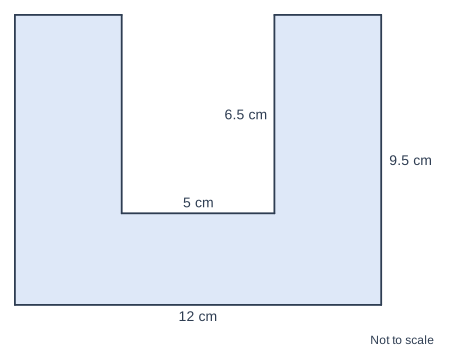
Geometry diagram, marked "Not to scale". An octagon (its vertices are not labelled) (shaded). The unlabelled side going to the right is labelled 12 cm. The unlabelled side going upwards is labelled 9.5 cm. The unlabelled side going downwards is labelled 6.5 cm. The unlabelled side going to the left is labelled 5 cm.

Model answer

Area of the whole rectangle = \(12 \times 9.5 = 114\) cm²
Area of the cut-out = \(5 \times 6.5 = 32.5\) cm²
Area of the bracket = \(114 - 32.5 = 81.5\) cm²

Explanation

It is quickest to work out the area of the whole rectangle and subtract the rectangle that has been cut out. You could also split the U into three rectangles: two sides 3.5 cm by 9.5 cm and a bottom piece 5 cm by 3 cm, which also gives 81.5 cm².

Mark scheme
  1. 1 mark

    M1 for \(12 \times 9.5 - 5 \times 6.5\) oe

    114 − 32.5 (exact values from the question). Or a correct split into rectangles, e.g. \(2 \times 3.5 \times 9.5 + 5 \times 3\) (66.5 + 15); correct answer with no working scores full marks

  2. 1 mark

    A1 for 81.5

    Exact answer; accept 81.5 cm². 114 (the cut-out not taken away) scores M0 A0. 146.5 (the cut-out added) scores M0 A0. A correct answer of 81.5 with no working scores 2 marks.
Question 2

3 marks

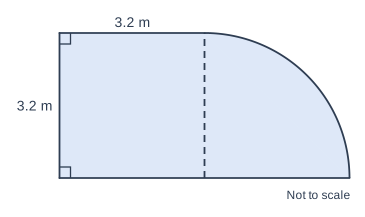
The diagram shows the plan of a patio.
The patio is made from a square with sides of length 3.2 m and a quarter circle with radius 3.2 m.
The dashed line shows where the square meets the quarter circle.

Work out the area of the patio.
Give your answer correct to 1 decimal place.

Geometry diagram, marked "Not to scale". A patio (its vertices are not labelled) (shaded); side an unlabelled line going up and to the left is not drawn (the outline is open there). A minor arc from an unlabelled point to an unlabelled point (the region between the arc and the straight line joining its ends is shaded). A dashed vertical line with no labelled ends is drawn. The unlabelled side going downwards is labelled 3.2 m. The unlabelled side going to the left is labelled 3.2 m. The angle at an unlabelled point is marked as a right angle (90°). The angle at an unlabelled point is marked as a right angle (90°).

Model answer

Area of the square = \(3.2 \times 3.2 = 10.24\) m²
Area of the quarter circle = \(\dfrac{1}{4} \times \pi \times 3.2^2 = 8.0424...\) m²
Area of the patio = \(10.24 + 8.0424... = 18.282...\) m²
= 18.3 m² (to 1 d.p.)

Explanation

Split the patio into its two parts. The quarter circle is \(\dfrac{1}{4}\) of a circle with radius 3.2 m, so its area is \(\dfrac{1}{4}\pi r^2\). Add the two areas and only round at the end. Using \(2\pi r\) (the circumference formula) instead of \(\pi r^2\) is a common error.

Mark scheme
  1. 1 mark

    B1 for 10.24 as the area of the square

    Accept \(3.2^2\) evaluated (exact value); correct answer with no working scores full marks

  2. 1 mark

    M1 for \(\dfrac{1}{4} \times \pi \times 3.2^2\) oe

    The quarter circle, 8.04... (accept 8.04 to 8.044; 8.0435 from \(\pi = 3.142\)).

  3. 1 mark

    A1 for 18.3

    Accept 18.3 m², or any value from 18.27 to 18.29 (calculator value 18.282...; 18.2835 from \(\pi = 3.142\); 18.2784 from \(\pi = 3.14\)). 26.3 (a semicircle used) scores B1 M0 A0. 15.3 (\(\dfrac{1}{4} \times 2 \times \pi \times 3.2\), the arc length, added) scores B1 M0 A0. A correct answer of 18.3 with no working scores 3 marks.

Question 3

3 marks

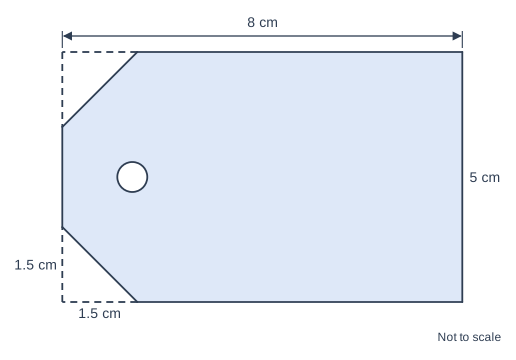
The diagram shows a gift tag.
The tag is a rectangle 8 cm long and 5 cm wide with two corners cut off.
Each corner cut off is a right-angled triangle with two sides of 1.5 cm, shown dashed.
There is a circular hole with diameter 0.6 cm in the tag.

Work out the area of the gift tag.
Give your answer correct to 1 decimal place.

Geometry diagram, marked "Not to scale". A circle (filled white, so the inside of the circle is not shaded). A hexagon (its vertices are not labelled) (shaded). A dashed path (unlabelled point) to (unlabelled point) to (unlabelled point) is drawn (not closed). A dashed path (unlabelled point) to (unlabelled point) to (unlabelled point) is drawn (not closed). An unlabelled line going to the right is labelled 1.5 cm. An unlabelled line going downwards is labelled 1.5 cm. The unlabelled side going upwards is labelled 5 cm. A double-headed dimension arrow alongside an unlabelled line going to the right (the distance from an unlabelled point to an unlabelled point) is labelled 8 cm.

Model answer

Area of the rectangle = \(8 \times 5 = 40\) cm²
Area of the two corners = \(2 \times \dfrac{1}{2} \times 1.5 \times 1.5 = 2.25\) cm²
Area of the hole = \(\pi \times 0.3^2 = 0.2827...\) cm²
Area of the tag = \(40 - 2.25 - 0.2827... = 37.467...\) cm²
= 37.5 cm² (to 1 d.p.)

Explanation

Start with the whole rectangle and take away the parts that are missing: the two triangular corners and the circular hole. Each corner is half of a 1.5 cm square, and the hole has radius 0.3 cm. Forgetting to subtract the hole, or using its diameter as the radius, are the common errors.

Mark scheme
  1. 1 mark

    M1 for \(2 \times \dfrac{1}{2} \times 1.5 \times 1.5\) oe or 2.25 seen

    The two corners cut off (exact values from the question). Accept 1.125 for one corner; correct answer with no working scores full marks

  2. 1 mark

    M1 for \(\pi \times 0.3^2\) oe

    The hole, 0.282... or 0.283 (accept 0.282 to 0.283; 0.28278 from \(\pi = 3.142\)). \(\pi \times 0.6^2\) scores M0.

  3. 1 mark

    A1 for 37.5

    Accept 37.5 cm², or any value from 37.46 to 37.47 (calculator value 37.467...; 37.4672 from \(\pi = 3.142\)). Needs \(8 \times 5 = 40\) with both parts subtracted. 37.75 or 37.8 (hole not subtracted) scores M1 M0 A0. 35.2 (corners not halved) scores M0 M1 A0. A correct answer of 37.5 with no working scores 3 marks.

Question 4

4 marks

A rectangular garden is 18 m long and 11 m wide.
In the garden there is a circular pond with radius 2.5 m and a rectangular patio 6 m long and 4.5 m wide.
The rest of the garden is lawn.

Jade says,
"More than 75% of the garden is lawn."

Is Jade correct?
Show how you decide.

Model answer

Area of the garden = \(18 \times 11 = 198\) m²
Area of the pond = \(\pi \times 2.5^2 = 19.634...\) m²
Area of the patio = \(6 \times 4.5 = 27\) m²
Area of the lawn = \(198 - 19.634... - 27 = 151.365...\) m²
Percentage of lawn = \(151.365... \div 198 \times 100 = 76.4\)% (to 1 d.p.)
76.4% is more than 75%, so Jade is correct.

Explanation

Take the areas of the pond and the patio away from the area of the whole garden to find the lawn, then write the lawn as a percentage of the garden. Alternatively compare the lawn with 75% of 198 m², which is 148.5 m². It is close, so do not round too early.

Mark scheme
  1. 1 mark

    M1 for \(\pi \times 2.5^2\) oe

    The pond, 19.6... (accept 19.6 to 19.64; 19.6375 from \(\pi = 3.142\)).

  2. 1 mark

    M1 for \(18 \times 11\) − their pond − \(6 \times 4.5\) oe

    198 − 19.63... − 27 = 151.36... (accept 151.3 to 151.4).

  3. 1 mark

    M1 for their lawn \(\div 198 \times 100\), or \(0.75 \times 198\) or 148.5 seen

    Percentage of lawn 76.4... (accept 76.4 to 76.45). Or 75% of the garden = 148.5 m² (exact).

  4. 1 mark

    A1 for Yes, with a correct comparison

    For example 'Yes, 76.4% > 75%' or 'Yes, the lawn is 151.4 m², which is more than 148.5 m²'. Needs the decision (Yes oe) and correct values. Also accept 'Yes, the pond and patio cover 23.6% (46.6 m²), which is less than 25% (49.5 m²)'. 'Yes' with no working scores 0.

Ready to try the rest? Every answer you write is marked against the mark scheme, so you can see exactly where the marks are.

Study Helper Hints first, answers after you try

Stuck on this one? Ask for a hint and I’ll point you in the right direction, without giving the answer away. Once you’ve checked your answer, I’ll show you how the marks are awarded.