
Level:
Correct: 0
Incorrect: 0
Marks: 0/0
Exam Practice
Course:
Topics:
OCR GCSE Maths (Foundation calculator) Smart practice A mixed round aimed at your weak spots
Unit 1
Number Operations and Integers
Unit 2
Fractions, Decimals and Percentages
Unit 3
Indices and Surds
Unit 4
Approximation and Estimation
Unit 5
Ratio, Proportion and Rates of Change
Unit 6
Algebra
Unit 7
Graphs of Equations and Functions
Unit 8
Basic Geometry
Unit 9
Congruence and Similarity
Unit 10
Mensuration
Unit 11
Probability
Unit 12
Statistics
Avg
score:
–
Topics
done:
0/100

Enlargement

Practise 13 exam-style questions on Enlargement for OCR GCSE Maths (Foundation calculator). Write your answer as you would in the exam and get it marked in seconds against the mark scheme, point by point, with the Study Helper on hand if you get stuck.

  • 13 questions
  • 1–4 marks each
  • Instant marking
  • No sign-up needed
13 questions, marked as you go

Sample questions with model answers

Here are 4 of the questions in this topic, each with a model answer, an explanation of why it earns the marks and the mark scheme an examiner would use.

Question 1

1 mark

Shape B is an enlargement of shape A with scale factor \(\dfrac{1}{3}\).

Which one of these statements is true?

Choose your answer.

  • Each side of B is 3 times as long as the matching side of A.
  • Each side of B is \(\dfrac{1}{3}\) of the length of the matching side of A.
  • Each angle of B is \(\dfrac{1}{3}\) of the size of the matching angle of A.
  • Each side of B is 3 cm shorter than the matching side of A.

Model answer

A scale factor of \(\dfrac{1}{3}\) multiplies every length by \(\dfrac{1}{3}\), so B is smaller than A.
Angles do not change in an enlargement.
Each side of B is \(\dfrac{1}{3}\) of the length of the matching side of A.

Explanation

An enlargement with a fractional scale factor between 0 and 1 makes the shape smaller: every length is multiplied by the scale factor. The angles stay the same, so the shape does not change. Subtracting a fixed amount from every side would change the shape.

Mark scheme
  1. 1 mark

    B1 for: Each side of B is \(\dfrac{1}{3}\) of the length of the matching side of A.

    Choice must be clear; accept the second statement identified by its position.
Question 2

2 marks

A model of a car is 12.4 cm long.
The real car is 4.34 m long.

The real car is an enlargement of the model.

Work out the scale factor of the enlargement.

Model answer

Change both lengths to the same unit: \(4.34\) m \(= 434\) cm.
Scale factor \(= 434 \div 12.4 = 35\)

Explanation

The scale factor is the length of the image divided by the length of the original, and both must be in the same unit. The real car is the enlargement, so divide the real length by the model length. Forgetting to convert metres to centimetres gives 0.35, which would make the real car smaller than the model.

Mark scheme
  1. 1 mark

    M1 for \(434 \div 12.4\) or \(4.34 \div 0.124\) oe

    Exact values from the question; the units must be the same; correct answer with no working scores full marks

  2. 1 mark

    A1 for 35

    0.35 (from \(4.34 \div 12.4\), units not changed) scores M0 A0. \(\dfrac{1}{35}\) scores M1 A0. A correct answer with no working scores 2.

Question 3

3 marks

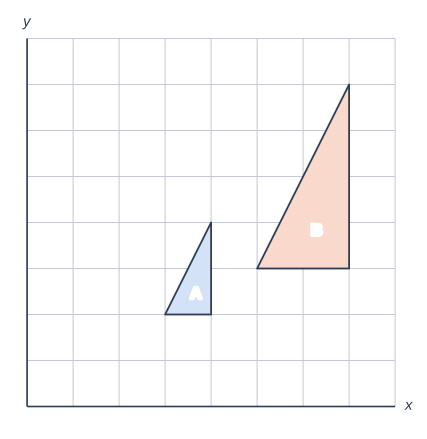
The diagram shows triangle A and triangle B on a coordinate grid.
Triangle B is an enlargement of triangle A with scale factor 2.

Zoe says that the centre of enlargement is \((0, 0)\).

Show that Zoe is wrong, and find the coordinates of the centre of enlargement.

A coordinate grid with x from 0 to 8 and y from 0 to 8; each grid square is 1 unit across, and the axes cross at the origin O. Shape A is a shaded triangle with vertices (3, 2), (4, 2) and (4, 4). Shape B is a shaded triangle with vertices (5, 3), (7, 3) and (7, 7).

Model answer

If the centre were \((0, 0)\), the vertex \((3, 2)\) would go to \((6, 4)\). But the matching vertex of B is \((5, 3)\), so Zoe is wrong.
From \((3, 2)\) to its image \((5, 3)\) is 2 right and 1 up.
With scale factor 2, the image is twice as far from the centre as the original, so the centre is the same distance again in the other direction: 2 left and 1 down from \((3, 2)\).
Centre \(= (1, 1)\)
Check: \((4, 4)\) is 3 right and 3 up from \((1, 1)\); doubled gives \((7, 7)\), which is a vertex of B.

Explanation

The centre of enlargement lies on every straight line joining a vertex to its image. With scale factor 2 the original vertex is exactly halfway between the centre and the image vertex. Always check your centre with a second pair of vertices.

Mark scheme
  1. 1 mark

    B1 for showing Zoe is wrong, e.g. scale factor 2 with centre \((0, 0)\) would map \((3, 2)\) to \((6, 4)\), but the matching vertex of B is \((5, 3)\)

    Accept any correct check of a vertex, or 'the lines joining matching vertices do not pass through (0, 0)' with one line identified.

  2. 1 mark

    M1 for a correct method for the centre, e.g. lines through matching vertices drawn back and meeting, or \((3, 2)\) to \((5, 3)\) is 2 right 1 up, so the centre is 2 left and 1 down from \((3, 2)\)

  3. 1 mark

    A1 for \((1, 1)\)

    Condone missing brackets.

Question 4

4 marks

Kamal draws a plan of a triangular flower bed.
On the plan, the sides of the triangle are 4.5 cm, 6 cm and 7.5 cm.

The real flower bed is an enlargement of the plan with scale factor 80.

Fencing costs £12.95 per metre.

Work out the cost of fencing all the way round the real flower bed.

Model answer

Perimeter on the plan \(= 4.5 + 6 + 7.5 = 18\) cm
Real perimeter \(= 18 \times 80 = 1440\) cm \(= 14.4\) m
Cost \(= 14.4 \times 12.95 = £186.48\)

Explanation

The fence goes round the perimeter, and the perimeter is multiplied by the scale factor like every other length. Change centimetres to metres before using the price per metre. A common error is to multiply 1440 by £12.95 without converting, which gives a cost 100 times too big.

Mark scheme
  1. 1 mark

    M1 for \(4.5 + 6 + 7.5\) (\(= 18\)) or for one side multiplied by 80

    Exact values from the question; correct answer with no working scores full marks

  2. 1 mark

    M1 for their \(18 \times 80\) (\(= 1440\) cm), or all three sides multiplied by 80 and added

    Exact values.

  3. 1 mark

    M1 for their \(1440 \div 100 \times 12.95\) oe

    Conversion to metres must be correct. \(1440 \times 12.95\) (no conversion) scores M0 for this mark.

  4. 1 mark

    A1 for (£) 186.48

    Exact value. A correct answer with no working scores 4.

Ready to try the rest? Every answer you write is marked against the mark scheme, so you can see exactly where the marks are.

Study Helper Hints first, answers after you try

Stuck on this one? Ask for a hint and I’ll point you in the right direction, without giving the answer away. Once you’ve checked your answer, I’ll show you how the marks are awarded.