Practise 14 exam-style questions on Calculating with decimals for OCR GCSE Maths (Foundation calculator). Write your answer as you would in the exam and get it marked in seconds against the mark scheme, point by point, with the Study Helper on hand if you get stuck.
14 questions
1–4 marks each
Instant marking
No sign-up needed
14 questions, marked as you go
Sample questions with model answers
Here are 4 of the questions in this topic, each with a model answer, an explanation of why it earns the marks and the mark scheme an examiner would use.
Question 1
1 mark
The height of a diver is −12.6 m (12.6 m below sea level). The height of a seagull directly above the diver is 4.35 m (4.35 m above sea level).
Work out the vertical distance between the diver and the seagull.
Model answer
Distance = 4.35 − (−12.6) = 4.35 + 12.6 = 16.95 m
Explanation
The distance between two heights is the higher one minus the lower one. Subtracting a negative number is the same as adding, so 4.35 − (−12.6) = 16.95. You can also think of it as 12.6 m down to sea level plus 4.35 m up to the seagull. Subtracting 4.35 from 12.6 ignores the fact that the two heights are on opposite sides of sea level.
Mark scheme
1 mark
B1 for 16.95 m
Exact value. Accept −16.95 only if it is clearly given as the distance. 8.25 (12.6 − 4.35) scores 0. 17.01 or 12.995 (place value errors) score 0.
Question 2
2 marks
Petrol costs 142.9p per litre. Dan buys 38.5 litres of petrol.
Work out how much Dan pays, in pounds. Give your answer to the nearest penny.
Model answer
Cost = \(38.5 \times 142.9 = 5501.65\)p 5501.65p = £55.0165 To the nearest penny: £55.02
Explanation
Multiply the number of litres by the price per litre. The price is in pence, so the answer is in pence and must be divided by 100 to give pounds. 55.0165 rounds to 55.02 because the third decimal place, 6, is 5 or more. Petrol prices are often given to a tenth of a penny like this.
Mark scheme
1 mark
M1 for \(38.5 \times 142.9\) or \(38.5 \times 1.429\)
Implied by 5501.65 (pence) or 55.0165 seen. Exact values from the question; correct answer with no working scores full marks
1 mark
A1 for £55.02
Accept 55.0165 to 55.02 (the calculator value is 55.0165). Correct answer with no working scores 2 marks. £5501.65 or 5502 (not changed to pounds) scores M1 A0. £55.01 (truncated) scores M1 A0.
Question 3
3 marks
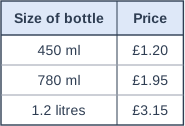
The table shows the sizes and prices of three bottles of washing-up liquid.
Which size of bottle is the best value for money? You must show your working.
Model answer
Cost per litre: 450 ml: \(1.20 \div 0.45\) = £2.666... per litre 780 ml: \(1.95 \div 0.78\) = £2.50 per litre 1.2 litres: \(3.15 \div 1.2\) = £2.625 per litre The 780 ml bottle has the lowest cost per litre, so it is the best value.
Explanation
To compare value, work out the same kind of value for each bottle: the cost of 1 litre (or 1 ml), or the amount you get for 1p. Make sure all the sizes are in the same units first (1.2 litres = 1200 ml). The largest bottle is not always the best value: here the 780 ml bottle is cheapest per litre.
Mark scheme
1 mark
M1 for a correct comparable value for one bottle
e.g. cost per ml (\(1.20 \div 450 = 0.266...\)p or £0.00266...), cost per litre (£2.66... or £2.67), ml per penny \((450 \div 120 = 3.75)\), or the cost of the same amount such as 2.34 litres (5.2 small bottles £6.24, 3 medium bottles £5.85, 1.95 large bottles £6.14...).
1 mark
M1 for correct comparable values for all three bottles
e.g. 0.266...p, 0.25p and 0.2625p per ml; or £2.66..., £2.50 and £2.625 per litre; or 3.75, 4 and 3.80... ml per penny. Allow values rounded or truncated to 2 significant figures if they still show which is cheapest.
1 mark
A1 for 780 ml, with correct values for all three bottles
Answer only scores 0 (working is demanded). 1.2 litres (largest bottle assumed best) with no correct values scores 0.
Question 4
4 marks
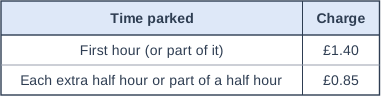
The table shows the charges at a car park.
Sam parks his car from 09:40 to 13:15.
How much does Sam pay?
Model answer
Time parked: 09:40 to 13:40 is 4 hours, so 09:40 to 13:15 is 3 hours 35 minutes. After the first hour: 2 hours 35 minutes = 5 half hours and 5 minutes. The 5 minutes is part of a half hour, so Sam pays for 6 extra half hours. Charge = \(1.40 + 6 \times 0.85 = 1.40 + 5.10\) = £6.50
Explanation
First find how long Sam is parked: 3 hours 35 minutes. The first hour costs £1.40; the remaining 2 hours 35 minutes contain 5 whole half hours plus 5 minutes, and the table says part of a half hour is charged as a whole half hour, so there are 6 charges of 85p. Forgetting to count the part half hour gives £5.65.
Mark scheme
1 mark
B1 for 3 hours 35 minutes or 215 minutes
The time Sam is parked. Accept 3.58... hours; correct answer with no working scores full marks
1 mark
M1 for 6 extra half hours
From 2 hours 35 minutes (155 minutes) after the first hour: 5 whole half hours and part of a sixth. FT their time parked. Implied by \(6 \times 0.85 = 5.10\).
1 mark
M1 for 1.40 + their \(6 \times 0.85\)
FT their number of extra half hours (a whole number).
1 mark
A1 for £6.50
Exact value. Correct answer with no working scores 4 marks. £5.65 (5 extra half hours, part ignored) scores B1 M0 M1 A0. £6.80 (all 3 hours 35 minutes charged as 8 half hours at 85p, with no first-hour charge) scores B1 M0 M0 A0.
Ready to try the rest? Every answer you write is marked against the mark scheme, so you can see exactly where the marks are.
Ctrl + Enter to check
Study HelperHints first, answers after you try
Stuck on this one? Ask for a hint and I’ll point you in the right direction, without giving the answer away. Once you’ve checked your answer, I’ll show you how the marks are awarded.