Practise 14 exam-style questions on Circumference and arc length for OCR GCSE Maths (Foundation calculator). Write your answer as you would in the exam and get it marked in seconds against the mark scheme, point by point, with the Study Helper on hand if you get stuck.
14 questions
1–4 marks each
Instant marking
No sign-up needed
14 questions, marked as you go
Sample questions with model answers
Here are 4 of the questions in this topic, each with a model answer, an explanation of why it earns the marks and the mark scheme an examiner would use.
Question 1
2 marks
A clock has a circular face with diameter 17 cm.
Work out the circumference of the clock face. Give your answer correct to 1 decimal place.
Model answer
Circumference = \(\pi \times d\) = \(\pi \times 17\) = 53.407... cm = 53.4 cm (to 1 d.p.)
Explanation
The circumference of a circle is \(\pi\) times the diameter, so multiply 17 by \(\pi\) using the \(\pi\) button on your calculator, then round to 1 decimal place. Common mistakes are to treat 17 cm as the radius and double it, or to use the area formula \(\pi r^2\) instead.
Mark scheme
1 mark
M1 for \(\pi \times 17\) oe
Accept \(2 \times \pi \times 8.5\). Award M1 for 53.40... or 53.41... seen (53.414 from \(\pi = 3.142\)); correct answer with no working scores full marks
1 mark
A1 for 53.4
Accept 53.4 cm, or any value from 53.40 to 53.42 (calculator value 53.407...; 53.414 from \(\pi = 3.142\)). 106.8 (17 used as the radius) scores M0 A0. 907.9 (\(\pi \times 17^2\)) scores M0 A0. 26.7 (\(\pi \times 8.5\)) scores M0 A0. A correct answer of 53.4 with no working scores 2 marks.
Question 2
2 marks
A hula hoop is a circle. The circumference of the hula hoop is 210 cm.
Work out the radius of the hula hoop. Give your answer correct to 1 decimal place.
Work backwards from the circumference: since circumference = \(2\pi r\), divide 210 by \(2\pi\). Alternatively divide by \(\pi\) to get the diameter (66.8 cm) and then halve it. A common mistake is to stop at the diameter, or to multiply by \(\pi\) instead of dividing.
Mark scheme
1 mark
M1 for \(210 \div (2 \times \pi)\) oe
Accept \(210 \div \pi \div 2\), or \(2 \times \pi \times r = 210\) with a correct first step such as \(r = \dfrac{210}{2\pi}\). Award M1 for 66.8... (the diameter) seen and then halved; correct answer with no working scores full marks
1 mark
A1 for 33.4
Accept 33.4 cm, or any value from 33.41 to 33.43 (calculator value 33.422...; 33.418... from \(\pi = 3.142\)). 66.8 (the diameter, \(210 \div \pi\)) scores M0 A0. 659.7 (\(210 \times \pi\)) or 105 (\(210 \div 2\)) scores M0 A0. A correct answer of 33.4 with no working scores 2 marks.
Question 3
3 marks
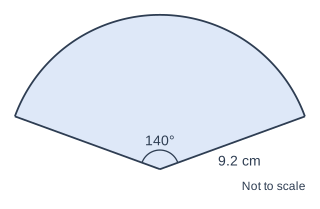
The diagram shows a logo in the shape of a sector of a circle. The radius of the circle is 9.2 cm and the angle of the sector is 140°.
Work out the perimeter of the logo. Give your answer correct to 1 decimal place.
Model answer
Arc length = \(\dfrac{140}{360} \times 2 \times \pi \times 9.2\) = 22.479... cm Perimeter = arc + two radii = \(22.479... + 9.2 + 9.2\) = 40.879... cm = 40.9 cm (to 1 d.p.)
Explanation
The perimeter of a sector is made of the curved arc and the two straight radii. The arc is \(\dfrac{140}{360}\) of the circumference \(2\pi r\). Keep the full calculator value of the arc until the end, then round. The most common mistake is to give the arc length on its own and forget the two straight edges.
Mark scheme
1 mark
M1 for \(\dfrac{140}{360} \times 2 \times \pi \times 9.2\) oe
The arc length, 22.47... or 22.48... (accept 22.47 to 22.49; 22.4827... from \(\pi = 3.142\)); correct answer with no working scores full marks
1 mark
M1 for their arc length + 9.2 + 9.2
FT their arc length, provided it is not an area. The radius 9.2 is one of the exact values from the question; the perimeter is 40.879... (accept 40.86 to 40.89).
1 mark
A1 for 40.9
Accept 40.9 cm, or any value from 40.86 to 40.89 (calculator value 40.879...; 40.8827... from \(\pi = 3.142\)). 22.5 (arc length only) scores M1 M0 A0. 31.7 (only one radius added) scores M1 M0 A0. 103.4 (\(\dfrac{140}{360} \times \pi \times 9.2^2\), the area) as the final answer scores 0. A correct answer of 40.9 with no working scores 3 marks.
Question 4
4 marks
The wheels of Ade's bicycle each have diameter 68 cm. When Ade cycles at a steady speed, each wheel makes 210 complete turns every minute.
Work out Ade's speed in kilometres per hour. Give your answer correct to 1 decimal place.
Model answer
In one turn the bicycle moves one circumference of the wheel. Circumference = \(\pi \times 68 = 213.628...\) cm Distance in 1 minute = \(210 \times 213.628... = 44\,861.9...\) cm = 448.619... m Distance in 1 hour = \(60 \times 448.619... = 26\,917.1...\) m = 26.917... km Speed = 26.9 km/h (to 1 d.p.)
Explanation
Each complete turn of a wheel moves the bicycle forward by the wheel's circumference, \(\pi d\). Multiply by 210 to get the distance in one minute, then by 60 for one hour, and change centimetres to kilometres (divide by 100 000). Keep full calculator values until the end. Common errors are using 68 cm as the radius and mixing up the unit conversions.
Mark scheme
1 mark
M1 for \(\pi \times 68\) oe
The circumference, 213.6... cm (accept 213.6 to 213.66; 213.656 from \(\pi = 3.142\)), or \(\pi \times 0.68\) = 2.136... m; correct answer with no working scores full marks
1 mark
M1 for their circumference \(\times 210\)
Distance in one minute: 44 862 cm or 448.6 m or 0.4486 km (accept 448.6 to 448.7 m).
1 mark
M1 for their distance in one minute \(\times 60\) and a correct conversion to kilometres
Award for 26.9... km seen, or 26 917 m, or for \(\times 60 \div 1000\) applied to their distance in metres (or \(\times 60 \div 100\,000\) to centimetres). Also award for a correct conversion of their speed in m/s (7.48 m/s) \(\times 3.6\).
1 mark
A1 for 26.9
Accept 26.9 km/h, or any value from 26.91 to 26.93 (calculator value 26.917...; 26.9207 from \(\pi = 3.142\)). 53.8 (68 used as the radius) scores M0 M1 M1 A0. 0.45 or 448.6 (no conversion to an hour) scores M1 M1 M0 A0. A correct answer of 26.9 with no working scores 4 marks.
Ready to try the rest? Every answer you write is marked against the mark scheme, so you can see exactly where the marks are.
Ctrl + Enter to check
Study HelperHints first, answers after you try
Stuck on this one? Ask for a hint and I’ll point you in the right direction, without giving the answer away. Once you’ve checked your answer, I’ll show you how the marks are awarded.