
Level:
Correct: 0
Incorrect: 0
Marks: 0/0
Exam Practice
Course:
Topics:
OCR GCSE Maths (Foundation calculator) Smart practice A mixed round aimed at your weak spots
Unit 1
Number Operations and Integers
Unit 2
Fractions, Decimals and Percentages
Unit 3
Indices and Surds
Unit 4
Approximation and Estimation
Unit 5
Ratio, Proportion and Rates of Change
Unit 6
Algebra
Unit 7
Graphs of Equations and Functions
Unit 8
Basic Geometry
Unit 9
Congruence and Similarity
Unit 10
Mensuration
Unit 11
Probability
Unit 12
Statistics
Avg
score:
–
Topics
done:
0/100

Estimation

Practise 14 exam-style questions on Estimation for OCR GCSE Maths (Foundation calculator). Write your answer as you would in the exam and get it marked in seconds against the mark scheme, point by point, with the Study Helper on hand if you get stuck.

  • 14 questions
  • 1–4 marks each
  • Instant marking
  • No sign-up needed
14 questions, marked as you go

Sample questions with model answers

Here are 4 of the questions in this topic, each with a model answer, an explanation of why it earns the marks and the mark scheme an examiner would use.

Question 1

1 mark

Which one of these is the best estimate for \(0.48 \times 61.7\)?

Choose your answer.

  • 0.3
  • 3
  • 30
  • 300

Model answer

\(0.48 \approx 0.5\) and \(61.7 \approx 60\)
\(0.5 \times 60 = 30\)
The best estimate is 30.

Explanation

0.48 is close to 0.5, which is a half, and half of 60 is 30. Multiplying by a number less than 1 makes the answer smaller than 61.7, but not as small as 3. Checking the size of an answer like this helps you spot place-value mistakes.

Mark scheme
  1. 1 mark

    B1 for 30

    More than one answer chosen scores 0. From \(0.5 \times 60 = 30\) (the exact value is 29.616). 3 and 300 come from place-value errors.
Question 2

2 marks

Without using a calculator, estimate the value of

\(41.2 \div 0.19\)

Show your working.

Model answer

\(41.2 \approx 40\) and \(0.19 \approx 0.2\)
\(40 \div 0.2 = 400 \div 2 = 200\)
\(41.2 \div 0.19 \approx 200\)

Explanation

Dividing by a number less than 1 gives an answer bigger than the number you started with. To work out \(40 \div 0.2\), multiply both numbers by 10: \(400 \div 2 = 200\). A common error is to multiply instead and get 8.

Mark scheme
  1. 1 mark

    M1 for \(40 \div 0.2\)

    Or \(41 \div 0.2\) or another sensible rounding.

  2. 1 mark

    A1 for 200

    Accept 205 from \(41 \div 0.2\). Accept answers from 200 to 210 from a correct estimation method. 8 (from \(40 \times 0.2\)) or 20 scores M1 A0 if \(40 \div 0.2\) is seen. 216.84... (the exact value) with no estimate seen scores 0.

Question 3

2 marks

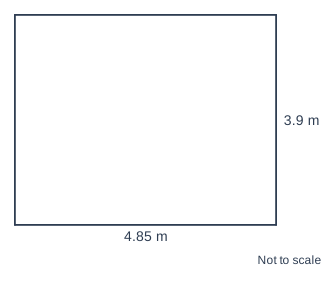
The diagram shows the plan of a rectangular room.

Omar uses his calculator to work out the area of the room.
He gets 189.15 m².

Without using a calculator, use an estimate to show that Omar's answer must be wrong.

Geometry diagram, marked "Not to scale". A rectangle (its vertices are not labelled). The unlabelled side going to the right is labelled 4.85 m. The unlabelled side going upwards is labelled 3.9 m.

Model answer

\(4.85 \approx 5\) and \(3.9 \approx 4\)
Area \(\approx 5 \times 4 = 20\) m²
189.15 m² is about 10 times bigger than 20 m², so Omar's answer must be wrong.

Explanation

A quick estimate tells you the size of the answer: about 20 m². Omar's answer is nearly ten times too big, so he has probably put the decimal point in the wrong place (the correct area is 18.915 m²). Estimating is a fast way to check any calculator answer.

Mark scheme
  1. 1 mark

    M1 for \(5 \times 4\)

    Or another sensible rounding, e.g. \(5 \times 3.9\).

  2. 1 mark

    A1 for 20 (or their estimate from a sensible rounding, e.g. 19.5 from \(5 \times 3.9\)) and a comparison showing 189.15 is far too big

    e.g. 'the area should be about 20 m², but 189.15 is about 10 times bigger'. The exact value (18.915) on its own, without an estimate, scores 0.

Question 4

4 marks

A flat roof is a rectangle 12.3 m long and 7.8 m wide.

During a storm, 41 mm of rain falls on the roof.
All the rain that falls on the roof is collected in a tank.

1 m³ = 1000 litres

Without using a calculator, estimate the volume of rain collected, in litres.

Model answer

41 mm = 0.041 m \(\approx\) 0.04 m
12.3 m \(\approx\) 10 m and 7.8 m \(\approx\) 8 m
Volume \(\approx 10 \times 8 \times 0.04 = 80 \times 0.04 = 3.2\) m³
In litres: \(3.2 \times 1000 = 3200\)
About 3200 litres of rain is collected.

Explanation

The rain forms a very thin cuboid on the roof, so volume = length \(\times\) width \(\times\) depth, with all lengths in metres: 41 mm is 0.041 m. Rounding to 1 significant figure makes the multiplication easy, and \(80 \times 0.04 = 3.2\). Each cubic metre is 1000 litres. The real volume is about 3900 litres, so the estimate is in the right range.

Mark scheme
  1. 1 mark

    M1 for 41 mm changed to metres, e.g. 0.041 m or 0.04 m

    Or all lengths changed to millimetres or centimetres consistently.

  2. 1 mark

    M1 for a volume from rounded values, e.g. \(10 \times 8 \times 0.04\)

    May be implied by 3.2 (m³). Other sensible roundings, e.g. \(12 \times 8 \times 0.04 = 3.84\).

  3. 1 mark

    M1 for their volume in m³ \(\times 1000\)

    Or a correct conversion from their consistent units to litres.

  4. 1 mark

    A1 for 3200

    Accept answers from 3000 to 4000 from a correct estimation method (the exact value is 3933.54 litres). 3 200 000 or 3.2 (wrong unit conversion) scores M1 M1 M0 A0. The exact value with no estimate seen scores 0.

Ready to try the rest? Every answer you write is marked against the mark scheme, so you can see exactly where the marks are.

Study Helper Hints first, answers after you try

Stuck on this one? Ask for a hint and I’ll point you in the right direction, without giving the answer away. Once you’ve checked your answer, I’ll show you how the marks are awarded.