Level:
Correct: 0
Incorrect: 0
Marks: 0/0
Exam Practice
Course:
Topics:
OCR GCSE Maths (Foundation calculator) Smart practice A mixed round aimed at your weak spots
Unit 1
Number Operations and Integers
Unit 2
Fractions, Decimals and Percentages
Unit 3
Indices and Surds
Unit 4
Approximation and Estimation
Unit 5
Ratio, Proportion and Rates of Change
Unit 6
Algebra
Unit 7
Graphs of Equations and Functions
Unit 8
Basic Geometry
Unit 9
Congruence and Similarity
Unit 10
Mensuration
Unit 11
Probability
Unit 12
Statistics
Avg
score:
–
Topics
done:
0/100

Angles and parallel lines

Practise 14 exam-style questions on Angles and parallel lines for OCR GCSE Maths (Foundation calculator). Write your answer as you would in the exam and get it marked in seconds against the mark scheme, point by point, with the Study Helper on hand if you get stuck.

  • 14 questions
  • 1–4 marks each
  • Instant marking
  • No sign-up needed
14 questions, marked as you go

Sample questions with model answers

Here are 4 of the questions in this topic, each with a model answer, an explanation of why it earns the marks and the mark scheme an examiner would use.

Question 1

2 marks

Two straight roads cross at a junction.
One of the angles between the roads is 58.5°.

Work out the sizes of the other three angles between the roads.

Model answer

The angle opposite 58.5° is also 58.5° (vertically opposite angles are equal).
The angles next to it are \(180 - 58.5 = 121.5^\circ\) (angles on a straight line add up to 180°).
The other three angles are 58.5°, 121.5° and 121.5°.

Explanation

When two straight lines cross, opposite angles are equal and neighbouring angles add up to 180°. So two of the angles are 58.5° and the other two are 121.5°. Check: 58.5 + 121.5 + 58.5 + 121.5 = 360.

Mark scheme
  1. 1 mark

    B1 for 58.5

    The angle vertically opposite the given angle; correct answer with no working scores full marks

  2. 1 mark

    B1 for 121.5 and 121.5

    Both needed. 121.5 given once only, with 58.5, scores B1 B0.
Question 2

2 marks

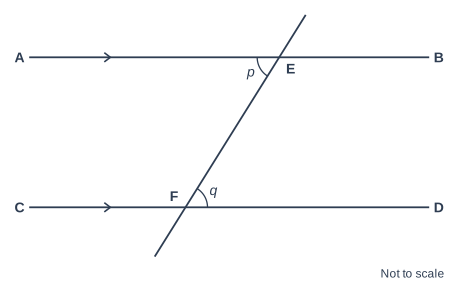
In the diagram, AB is parallel to CD.
A straight line crosses AB at E and CD at F.

Lucy says,

"The angles marked \(p\) and \(q\) are corresponding angles."

Is Lucy correct?
Give a reason for your answer.

Geometry diagram, marked "Not to scale". Line segments AB and CD are drawn. A sloping line with no labelled ends is drawn; it crosses AB and crosses CD. E lies on AB and an unlabelled line going down and to the left. F lies on CD and an unlabelled line going down and to the left. Angle AEF is marked p. Angle EFD is marked q. AB and CD are each marked with an arrowhead (parallel lines).

Model answer

No.
p and q are on opposite sides of the line EF, both between the parallel lines, so they are alternate angles, not corresponding angles.

Explanation

Corresponding angles are in matching positions at the two crossings (for example, both above their parallel line and on the right of the crossing line). Angles p and q are between the parallel lines on opposite sides of EF, which makes them alternate angles. They are still equal, but the name is wrong.

Mark scheme
  1. 1 mark

    B1 for No

  2. 1 mark

    B1 for p and q are alternate angles oe

    Dependent on No. Accept 'they are on opposite sides of the line EF, between the parallel lines, so they are alternate' or 'corresponding angles are on the same side of the crossing line'. 'They are Z angles' alone scores 0.

Question 3

3 marks

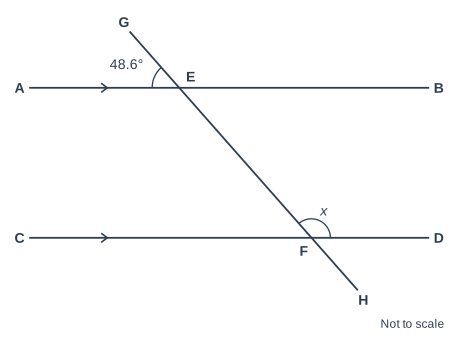
The diagram shows a straight path GH crossing two parallel hedges, AB and CD.
The path crosses AB at E and CD at F.

Angle GEA = 48.6°.

Work out the size of angle EFD, marked \(x\).
Give a reason for each step of your working.

Geometry diagram, marked "Not to scale". Line segments AB, CD and GH are drawn. E lies on AB and GH. F lies on CD and GH. Angle GEA is marked 48.6°. Angle EFD is marked x. AB and CD are each marked with an arrowhead (parallel lines).

Model answer

Angle BEF = 48.6° (vertically opposite angles are equal).
Angle EFC = 48.6° (alternate angles are equal).
\(x = 180 - 48.6 = 131.4^\circ\) (angles on a straight line add up to 180°).

Explanation

Move the 48.6° angle step by step towards x, giving the reason for each step: across the crossing at E (vertically opposite), then between the parallel lines (alternate), then along the straight line CD. Other routes, such as using corresponding angles, are equally good if each step has its reason.

Mark scheme
  1. 1 mark

    B1 for 131.4

    Accept 131.4° or x = 131.4.

  2. 2 marks

    B2 for two correct reasons for a complete method

    For example: angle BEF = 48.6 (vertically opposite angles are equal), then x = 180 − 48.6 (co-interior angles add up to 180°); or angle GEB = 131.4 (angles on a straight line add up to 180°), then x = 131.4 (corresponding angles are equal); or angle BEF = 48.6 (vertically opposite), angle EFC = 48.6 (alternate angles are equal), x = 180 − 48.6 (angles on a straight line). B1 for one correct reason linked to a correct angle. Do not accept 'Z', 'F' or 'C angles'.

Question 4

4 marks

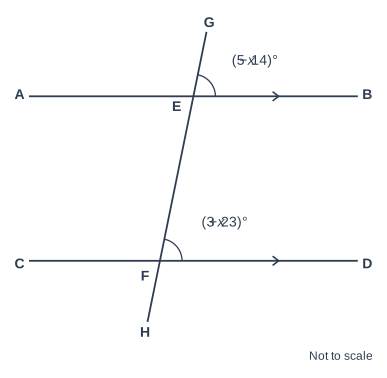
In the diagram, AB is parallel to CD.
The straight line GH crosses AB at E and CD at F.

Angle GEB = \((5x - 14)^\circ\) and angle EFD = \((3x + 23)^\circ\).

Work out the size of angle BEF.

Geometry diagram, marked "Not to scale". Line segments AB, CD and GH are drawn. E lies on AB and GH. F lies on CD and GH. Angle GEB is marked (5x − 14)°. Angle EFD is marked (3x + 23)°. AB and CD are each marked with an arrowhead (parallel lines).

Model answer

Angle GEB = angle EFD (corresponding angles are equal).
So \(5x - 14 = 3x + 23\)
\(2x = 37\)
\(x = 18.5\)
Angle GEB = \(5 \times 18.5 - 14 = 78.5^\circ\)
Angle BEF = \(180 - 78.5 = 101.5^\circ\) (angles on a straight line add up to 180°)

Explanation

First link the two given angles: both are above their parallel line and to the right of GH, so they are corresponding angles and the two expressions are equal. Solve the equation, substitute to get 78.5°, then use the straight line AB. A common error is to stop at x = 18.5 or at 78.5°.

Mark scheme
  1. 1 mark

    M1 for 5x − 14 = 3x + 23

    The two angles are equal because they are corresponding angles (or via angle AEF: vertically opposite, then alternate). Reasons are not required for this mark; correct answer with no working scores full marks

  2. 1 mark

    M1 for 2x = 37 oe

    Correct rearrangement of their equation to ax = b.

  3. 1 mark

    A1 for x = 18.5

  4. 1 mark

    B1FT for 101.5

    FT 180 − (5 × their x − 14) where their x came from solving an equation. 78.5 as the final answer scores M1 M1 A1 B0. Answer 101.5 with no working scores 4.

Ready to try the rest? Every answer you write is marked against the mark scheme, so you can see exactly where the marks are.

Study Helper Hints first, answers after you try

Stuck on this one? Ask for a hint and I’ll point you in the right direction, without giving the answer away. Once you’ve checked your answer, I’ll show you how the marks are awarded.