
Level:
Correct: 0
Incorrect: 0
Marks: 0/0
Exam Practice
Course:
Topics:
OCR GCSE Maths (Foundation calculator) Smart practice A mixed round aimed at your weak spots
Unit 1
Number Operations and Integers
Unit 2
Fractions, Decimals and Percentages
Unit 3
Indices and Surds
Unit 4
Approximation and Estimation
Unit 5
Ratio, Proportion and Rates of Change
Unit 6
Algebra
Unit 7
Graphs of Equations and Functions
Unit 8
Basic Geometry
Unit 9
Congruence and Similarity
Unit 10
Mensuration
Unit 11
Probability
Unit 12
Statistics
Avg
score:
–
Topics
done:
0/100

Converting and ordering fractions, decimals and percentages

Practise 15 exam-style questions on Converting and ordering fractions, decimals and percentages for OCR GCSE Maths (Foundation calculator). Write your answer as you would in the exam and get it marked in seconds against the mark scheme, point by point, with the Study Helper on hand if you get stuck.

  • 15 questions
  • 1–4 marks each
  • Instant marking
  • No sign-up needed
15 questions, marked as you go

Sample questions with model answers

Here are 4 of the questions in this topic, each with a model answer, an explanation of why it earns the marks and the mark scheme an examiner would use.

Question 1

1 mark

A savings account pays interest at a rate written as the decimal 0.045.

Write 0.045 as a percentage.

Model answer

\(0.045 \times 100 = 4.5\)
0.045 = 4.5%

Explanation

To change a decimal to a percentage, multiply by 100, which moves each digit two places to the left. 0.045 has 4 hundredths and 5 thousandths, so it is 4.5 hundredths, which is 4.5%. A common error is to read the digits 45 and write 45%.

Mark scheme
  1. 1 mark

    B1 for 4.5%

    Exact value. 45% or 0.45% (place value errors) score 0.
Question 2

2 marks

At 7 am, Ines's tablet battery was 0.38 charged.
At 8 am, the battery was \(\dfrac{5}{8}\) charged.

By how much did the charge increase between 7 am and 8 am?
Give your answer as a percentage of a full charge.

Model answer

0.38 = 38%
\(\dfrac{5}{8}\) = \(5 \div 8 = 0.625 = 62.5\%\)
Increase = 62.5 − 38 = 24.5%

Explanation

Change both amounts to percentages (or both to decimals) so that they can be compared, then subtract. \(\dfrac{5}{8}\) is 0.625, which is 62.5%. A common error is to write \(\dfrac{5}{8}\) as 58% or 0.58 by reading the digits.

Mark scheme
  1. 1 mark

    M1 for 38% and 62.5% seen, or for 0.625 − 0.38

    Both values in the same form. Exact values. Implied by 0.245 seen; correct answer with no working scores full marks

  2. 1 mark

    A1 for 24.5%

    Exact value. Correct answer with no working scores 2 marks. 0.245 as the final answer scores M1 A0. 25% or 24% (rounded) scores M1 A0.

Question 3

2 marks

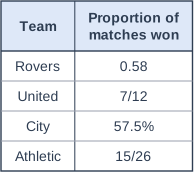
The table shows the proportion of their matches that four netball teams won last season.

Write the names of the teams in order of the proportion of matches won.
Start with the highest.

Table with columns "Team", "Proportion of matches won". Team: Rovers; Proportion of matches won: 0.58 | Team: United; Proportion of matches won: 7/12 | Team: City; Proportion of matches won: 57.5% | Team: Athletic; Proportion of matches won: 15/26.

Model answer

Rovers: 0.58
United: \(\dfrac{7}{12}\) = \(7 \div 12 = 0.5833...\)
City: 57.5% = 0.575
Athletic: \(\dfrac{15}{26}\) = \(15 \div 26 = 0.5769...\)
Highest first: United, Rovers, Athletic, City

Explanation

Change every proportion into the same form (decimals are easiest) using a calculator, then compare them digit by digit. The values are very close, so keep at least three decimal places: 0.5769... for Athletic is more than 0.575 for City. The question asks for the highest first.

Mark scheme
  1. 1 mark

    M1 for all four proportions written in the same form

    e.g. 0.58, 0.583..., 0.575, 0.576... or 58%, 58.3...%, 57.5%, 57.6...%. Allow values rounded or truncated to 3 decimal places (0.583, 0.577 or 0.576); correct answer with no working scores full marks

  2. 1 mark

    A1 for United, Rovers, Athletic, City

    Correct answer with no working scores 2 marks. The order reversed (City, Athletic, Rovers, United) scores M1 A0. Athletic and City swapped (from truncating \(\dfrac{15}{26}\) to 0.57) scores M1 A0 if M1 is seen.

Question 4

4 marks

A factory fills packets of rice that are labelled 500 g.
A packet is accepted only if its mass, m grams, satisfies

\(m \geqslant \dfrac{39}{40}\) of 500

The table shows the masses of five packets.

Which of the five packets are accepted?

Table with columns "Packet", "A", "B", "C", "D", "E". Packet: Mass (g); A: 487.6; B: 487.4; C: 492; D: 486.9; E: 487.5.

Model answer

\(\dfrac{39}{40}\) of 500 = \(500 \div 40 \times 39 = 12.5 \times 39 = 487.5\) g
A packet is accepted if its mass is 487.5 g or more.
A: 487.6 g, accepted
B: 487.4 g, not accepted
C: 492 g, accepted
D: 486.9 g, not accepted
E: 487.5 g, accepted (equal to 487.5 g)
Packets A, C and E are accepted.

Explanation

Work out \(\dfrac{39}{40}\) of 500 g to find the smallest mass allowed, 487.5 g. The symbol ≥ means 'greater than or equal to', so a packet of exactly 487.5 g is accepted too. Compare each mass with 487.5 carefully using the decimal places: 487.4 is less than 487.5.

Mark scheme
  1. 1 mark

    M1 for \(\dfrac{39}{40} \times 500\) oe

    e.g. \(500 \div 40 \times 39\), or \(0.975 \times 500\), or 97.5% of 500; correct answer with no working scores full marks

  2. 1 mark

    A1 for 487.5 (g)

    Exact value.

  3. 2 marks

    B2 for A, C and E only

    FT their value from \(\dfrac{39}{40}\) of 500 for B1 only. B1 for A and C with E missing (E has mass exactly 487.5 g, and \(\geqslant\) includes 'equal to'), or for A, C and E with one incorrect packet added. Correct answer with no working scores 4 marks.

Ready to try the rest? Every answer you write is marked against the mark scheme, so you can see exactly where the marks are.

Study Helper Hints first, answers after you try

Stuck on this one? Ask for a hint and I’ll point you in the right direction, without giving the answer away. Once you’ve checked your answer, I’ll show you how the marks are awarded.
