
Level:
Correct: 0
Incorrect: 0
Marks: 0/0
Exam Practice
Course:
Topics:
OCR GCSE Maths (Foundation calculator) Smart practice A mixed round aimed at your weak spots
Unit 1
Number Operations and Integers
Unit 2
Fractions, Decimals and Percentages
Unit 3
Indices and Surds
Unit 4
Approximation and Estimation
Unit 5
Ratio, Proportion and Rates of Change
Unit 6
Algebra
Unit 7
Graphs of Equations and Functions
Unit 8
Basic Geometry
Unit 9
Congruence and Similarity
Unit 10
Mensuration
Unit 11
Probability
Unit 12
Statistics
Avg
score:
–
Topics
done:
0/100

Solving inequalities

Practise 15 exam-style questions on Solving inequalities for OCR GCSE Maths (Foundation calculator). Write your answer as you would in the exam and get it marked in seconds against the mark scheme, point by point, with the Study Helper on hand if you get stuck.

  • 15 questions
  • 1–4 marks each
  • Instant marking
  • No sign-up needed
15 questions, marked as you go

Sample questions with model answers

Here are 4 of the questions in this topic, each with a model answer, an explanation of why it earns the marks and the mark scheme an examiner would use.

Question 1

1 mark

Which inequality means '\(x\) is greater than \(-4\) and \(x\) is at most 1'?

Choose your answer.

  • \(-4 < x \leqslant 1\)
  • \(-4 \leqslant x < 1\)
  • \(-4 < x < 1\)
  • \(-4 \leqslant x \leqslant 1\)

Model answer

Greater than \(-4\): \(-4 < x\) (\(-4\) is not included)
At most 1: \(x \leqslant 1\) (1 is included)
The answer is \(-4 < x \leqslant 1\)

Explanation

'Greater than' gives a strict inequality, so −4 itself is not allowed, which needs <. 'At most' means 'less than or equal to', so 1 is allowed, which needs ≤. The other options mix up which ends are included.

Mark scheme
  1. 1 mark

    B1 for \(-4 < x \leqslant 1\)

    'Greater than −4' does not include −4 (<); 'at most 1' includes 1 (≤). Do not accept more than one choice.
Question 2

2 marks

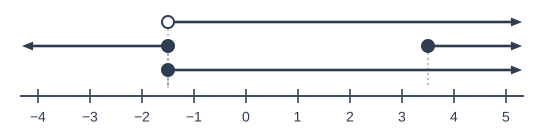
The number line shows four inequalities, labelled A, B, C and D.

Which one shows the solution of the inequality \(2x + 5 \geqslant 2\)?
Show how you decide.

A number line from −4 to 5, with a mark at every whole number. First: a filled (solid) circle at −1.5 with a line and arrow going right from it to the end of the number line, labelled "A". Second (drawn higher up): a filled (solid) circle at −1.5 with a line and arrow going left from it to the end of the number line, labelled "B". Third (drawn higher up): a filled (solid) circle at 3.5 with a line and arrow going right from it to the end of the number line, labelled "C". Fourth (drawn higher up): an open (hollow) circle at −1.5 with a line and arrow going right from it to the end of the number line, labelled "D".

Model answer

\(2x + 5 \geqslant 2\)
\(2x \geqslant -3\)
\(x \geqslant -1.5\)
This needs a filled circle at \(-1.5\) (\(-1.5\) is included) and an arrow to the right.
The answer is A.

Explanation

Solving gives x ≥ −1.5. On a number line ≥ is shown by a filled circle (the number is included) with the line going towards bigger numbers, to the right. D has an open circle, so it shows x > −1.5, and C comes from adding 5 instead of subtracting it.

Mark scheme
  1. 1 mark

    M1 for \(2x \geqslant -3\) or \(x \geqslant -1.5\)

    Allow = or the wrong sign for this mark, e.g. \(2x = -3\).

  2. 1 mark

    A1 for A

    A shows \(x \geqslant -1.5\) (filled circle at −1.5, arrow to the right). D (\(x > -1.5\), open circle) scores M1 A0. C (\(x \geqslant 3.5\), from adding 5) scores M0 A0. 'A' with no working scores 0.

Question 3

3 marks

Solve.

\(4(x - 1.5) < 2x + 3\)

Model answer

\(4x - 6 < 2x + 3\)
\(4x - 2x < 3 + 6\)
\(2x < 9\)
\(x < 4.5\)

Explanation

Expand the bracket (4 × 1.5 = 6), then collect the x terms on the left and the numbers on the right, just as for an equation. Subtracting 2x and adding 6 keeps the inequality the same way round, giving 2x < 9, so x < 4.5.

Mark scheme
  1. 1 mark

    M1 for \(4x - 6\) seen

    Correct expansion of the bracket. Correct answer with no working scores 3 marks.

  2. 1 mark

    M1 for \(2x < 9\)

    FT their expansion with terms collected correctly. Allow = or the wrong sign for this mark.

  3. 1 mark

    A1 for \(x < 4.5\)

    Accept \(4.5 > x\). \(x = 4.5\) as the final answer scores M1 M1 A0. \(4x - 1.5 < 2x + 3\) leading to \(x < 2.25\) scores M0 M1 A0.

Question 4

4 marks

Gym A charges £30 each month plus £2.50 for each visit.
Gym B charges £8.75 for each visit and has no monthly charge.

Kai visits the gym \(v\) times in a month.

Form and solve an inequality to find the least number of visits in a month for which Gym A is cheaper than Gym B.

Model answer

Gym A costs \(30 + 2.5v\) and Gym B costs \(8.75v\).
\(30 + 2.5v < 8.75v\)
\(30 < 6.25v\)
\(4.8 < v\)
\(v\) is a whole number, so the least number of visits is 5.
(Check: 5 visits cost £42.50 at Gym A and £43.75 at Gym B.)

Explanation

Write the cost at each gym as an expression and use < because Gym A must be cheaper. Subtracting 2.5v from both sides gives 30 < 6.25v, so v > 4.8. The number of visits is a whole number greater than 4.8, so the least is 5; at 4 visits Gym B is still cheaper.

Mark scheme
  1. 1 mark

    M1 for \(30 + 2.5v < 8.75v\) oe

    Allow = or the wrong sign for this mark. Allow working in pence; correct answer with no working scores full marks

  2. 1 mark

    M1 for \(30 < 6.25v\) oe

    Or for \(30 \div 6.25\) seen.

  3. 1 mark

    A1 for \(v > 4.8\)

    Accept 4.8 seen with a correct inequality sign.

  4. 1 mark

    A1 for 5 visits

    4 visits (rounded down) scores M1 M1 A1 A0: for 4 visits Gym A costs £40 and Gym B £35. Correct answer with no inequality formed (e.g. from trials: 5 visits cost £42.50 at A and £43.75 at B) scores SC2.

Ready to try the rest? Every answer you write is marked against the mark scheme, so you can see exactly where the marks are.

Study Helper Hints first, answers after you try

Stuck on this one? Ask for a hint and I’ll point you in the right direction, without giving the answer away. Once you’ve checked your answer, I’ll show you how the marks are awarded.