
Level:
Correct: 0
Incorrect: 0
Marks: 0/0
Exam Practice
Course:
Topics:
OCR GCSE Maths (Foundation calculator) Smart practice A mixed round aimed at your weak spots
Unit 1
Number Operations and Integers
Unit 2
Fractions, Decimals and Percentages
Unit 3
Indices and Surds
Unit 4
Approximation and Estimation
Unit 5
Ratio, Proportion and Rates of Change
Unit 6
Algebra
Unit 7
Graphs of Equations and Functions
Unit 8
Basic Geometry
Unit 9
Congruence and Similarity
Unit 10
Mensuration
Unit 11
Probability
Unit 12
Statistics
Avg
score:
–
Topics
done:
0/100

Error intervals and bounds

Practise 14 exam-style questions on Error intervals and bounds for OCR GCSE Maths (Foundation calculator). Write your answer as you would in the exam and get it marked in seconds against the mark scheme, point by point, with the Study Helper on hand if you get stuck.

  • 14 questions
  • 1–4 marks each
  • Instant marking
  • No sign-up needed
14 questions, marked as you go

Sample questions with model answers

Here are 4 of the questions in this topic, each with a model answer, an explanation of why it earns the marks and the mark scheme an examiner would use.

Question 1

2 marks

The mass of a cat is 4 kg, correct to the nearest kilogram.

Write down the error interval for the mass, \(m\) kg, of the cat.

Model answer

Rounding to the nearest kilogram, every mass from 3.5 kg up to (but not including) 4.5 kg rounds to 4 kg.
\(3.5 \leqslant m < 4.5\)

Explanation

The limits are half a kilogram either side of 4 kg. 3.5 kg rounds up to 4 kg, so it is included (\(\leqslant\)). 4.5 kg would round up to 5 kg, so it is not included (\(<\)), even though every mass just below it rounds to 4 kg.

Mark scheme
  1. 1 mark

    B1 for \(3.5 \leqslant m\)

    Exact value. The lower end with \(\leqslant\); correct answer with no working scores full marks

  2. 1 mark

    B1 for \(m < 4.5\)

    Exact value. The upper end with \(<\). The full answer is \(3.5 \leqslant m < 4.5\). If 0 scored, SC1 for \(3.5 \leqslant m \leqslant 4.5\), or \(3.5 < m < 4.5\), or the correct values the wrong way round. Do not accept 4.49 or 4.499 for the upper end.
Question 2

2 marks

\(x = 8\), correct to the nearest whole number.

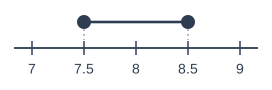
Sam shows the error interval for \(x\) on the number line.
Sam's number line shows \(7.5 \leqslant x \leqslant 8.5\)

Explain the mistake Sam has made.
Write down the correct error interval for \(x\) using inequality notation.

A number line from 7 to 9, with a mark at every 0.5. Above it is a filled (solid) circle at 7.5 joined by a line to a filled (solid) circle at 8.5.

Model answer

8.5 rounded to the nearest whole number is 9, not 8, so \(x\) cannot equal 8.5.
The upper limit must use \(<\).
\(7.5 \leqslant x < 8.5\)

Explanation

Numbers ending in .5 round up. So 7.5 rounds up to 8 (included) but 8.5 rounds up to 9 (not included). That is why an error interval for rounding has \(\leqslant\) at the bottom and \(<\) at the top; on a number line, a filled circle at 7.5 and an open circle at 8.5.

Mark scheme
  1. 1 mark

    B1 for a correct explanation

    e.g. '8.5 rounds up to 9, so \(x\) cannot be 8.5', 'the upper limit should not be included', 'there should be an open circle at 8.5', 'it should be \(<\) 8.5 not \(\leqslant\) 8.5'. Do not accept 'the circles are wrong' or 'the signs are wrong' with no detail.

  2. 1 mark

    B1 for \(7.5 \leqslant x < 8.5\)

    Exact values. Independent of the explanation.

Question 3

2 marks

An airline says that cabin bags must be no more than 55 cm long.

Mia's bag is 55 cm long, correct to the nearest centimetre.

Can Mia be sure that her bag is allowed?
Give a reason for your answer.

Model answer

Error interval for the length, \(L\) cm: \(54.5 \leqslant L < 55.5\)
The bag could be, for example, 55.3 cm long, which is more than 55 cm.
No, Mia cannot be sure that her bag is allowed.

Explanation

A length of 55 cm to the nearest centimetre could really be anything from 54.5 cm up to just under 55.5 cm. Some of those lengths are over the 55 cm limit, so the bag might be too long. Mia would need a more accurate measurement to be sure.

Mark scheme
  1. 1 mark

    B1 for 55.5 seen as the upper limit, or \(54.5 \leqslant L < 55.5\)

    Exact values.

  2. 1 mark

    B1 for No, with a reason

    e.g. 'the bag could be up to 55.5 cm, which is more than 55 cm', 'it could be 55.3 cm long'. 'No' with no reason scores B0. 'Yes, because it is 55 cm' scores 0.

Question 4

4 marks

A box is 34.6 cm long, correct to 1 decimal place.

A drawer is 350 mm long, correct to the nearest 10 mm.

Will the box definitely fit in the drawer, lengthways?
Show how you decide.

Model answer

Box, \(b\) cm: \(34.55 \leqslant b < 34.65\)
Drawer, \(d\) mm: \(345 \leqslant d < 355\), which is \(34.5 \leqslant d < 35.5\) in cm
The drawer could be as short as 34.5 cm.
The box could be 34.6 cm long, which is longer than 34.5 cm.
So the box might not fit. No, it will not definitely fit.

Explanation

Write both error intervals in the same units. For the box to fit for certain, its longest possible length would have to be no more than the drawer's shortest possible length. The drawer could be as short as 34.5 cm, while the box could be up to 34.65 cm, so it might not fit. Comparing 34.6 cm with 35 cm ignores the rounding.

Mark scheme
  1. 1 mark

    B1 for 34.65 (cm) as the upper limit of the box, or \(34.55 \leqslant b < 34.65\)

    Exact values. Accept 346.5 mm.

  2. 1 mark

    B1 for 345 (mm) as the lower limit of the drawer, or \(345 \leqslant d < 355\)

    Exact values. Accept 34.5 cm.

  3. 1 mark

    M1 for both lengths in the same units and a comparison of the box with the lower limit of the drawer

    e.g. 34.6 cm (or 34.65 cm) compared with 34.5 cm, or 346 mm compared with 345 mm.

  4. 1 mark

    A1 for No, it might not fit, with correct values

    e.g. 'the drawer could be only 34.5 cm long but the box could be 34.6 cm long'. 'Yes, because 34.6 cm is less than 35 cm' scores 0 overall. 'No' with no correct values scores 0.

Ready to try the rest? Every answer you write is marked against the mark scheme, so you can see exactly where the marks are.

Study Helper Hints first, answers after you try

Stuck on this one? Ask for a hint and I’ll point you in the right direction, without giving the answer away. Once you’ve checked your answer, I’ll show you how the marks are awarded.