
Level:
Correct: 0
Incorrect: 0
Marks: 0/0
Exam Practice
Course:
Topics:
OCR GCSE Maths (Foundation calculator) Smart practice A mixed round aimed at your weak spots
Unit 1
Number Operations and Integers
Unit 2
Fractions, Decimals and Percentages
Unit 3
Indices and Surds
Unit 4
Approximation and Estimation
Unit 5
Ratio, Proportion and Rates of Change
Unit 6
Algebra
Unit 7
Graphs of Equations and Functions
Unit 8
Basic Geometry
Unit 9
Congruence and Similarity
Unit 10
Mensuration
Unit 11
Probability
Unit 12
Statistics
Avg
score:
–
Topics
done:
0/100

Listing outcomes and the product rule

Practise 13 exam-style questions on Listing outcomes and the product rule for OCR GCSE Maths (Foundation calculator). Write your answer as you would in the exam and get it marked in seconds against the mark scheme, point by point, with the Study Helper on hand if you get stuck.

  • 13 questions
  • 1–5 marks each
  • Instant marking
  • No sign-up needed
13 questions, marked as you go

Sample questions with model answers

Here are 4 of the questions in this topic, each with a model answer, an explanation of why it earns the marks and the mark scheme an examiner would use.

Question 1

2 marks

A football match between United and City ended with the score 2-1 to United.

List all the possible scores at half-time.
Write each score with United's goals first.

Model answer

At half-time United had scored 0, 1 or 2 goals, and City had scored 0 or 1 goal.
United 0: 0-0, 0-1
United 1: 1-0, 1-1
United 2: 2-0, 2-1
There are 6 possible half-time scores.

Explanation

At half-time neither team can have more goals than at the end, so United had 0, 1 or 2 and City had 0 or 1. Pair each possible United score with each possible City score, working in order. 0-0 and 2-1 are both possible: no goals before half-time, or all of them.

Mark scheme
  1. 2 marks

    B2 for 0-0, 0-1, 1-0, 1-1, 2-0, 2-1 and no others

    In any order and any clear form (e.g. 1 : 0). Ignore repeats. B1 for at least four correct scores with no wrong ones, or all six with one wrong extra score (e.g. 1-2 or 0-2).
Question 2

2 marks

Sam chooses three different letters from A, B, C and D.
He writes them in alphabetical order to make a code, for example ACD.

List all the different codes Sam could write.

Model answer

Codes starting with A: ABC, ABD, ACD
Codes starting with B: BCD
Codes starting with C would need two letters after C, but only D is left.
There are 4 codes: ABC, ABD, ACD, BCD.

Explanation

Because the letters are in alphabetical order, each choice of three letters gives exactly one code. Start with A and list the pairs of later letters, then start with B. Another way to see it: each code leaves out exactly one of the four letters, so there are 4 codes.

Mark scheme
  1. 2 marks

    B2 for ABC, ABD, ACD, BCD and no others

    Ignore repeats. Codes not in alphabetical order (e.g. BAC) count as wrong. B1 for three correct codes with no wrong ones, or all four with one wrong extra code.

Question 3

3 marks

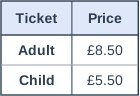
The table shows the prices of theatre tickets.

Kirsty buys some adult tickets and some child tickets.
She spends exactly £50.

Work out how many adult tickets and how many child tickets Kirsty buys.
Show how you decide.

Table with columns "Ticket", "Price". Ticket: Adult; Price: £8.50 | Ticket: Child; Price: £5.50.

Model answer

Try each number of adult tickets and see whether the money left is a whole number of child tickets:
1 adult: £8.50, leaves £41.50, and 41.50 ÷ 5.50 = 7.54... (no)
2 adults: £17, leaves £33, and 33 ÷ 5.50 = 6 (yes)
3 adults: £25.50, leaves £24.50, and 24.50 ÷ 5.50 = 4.45... (no)
4 adults: £34, leaves £16, and 16 ÷ 5.50 = 2.90... (no)
5 adults: £42.50, leaves £7.50, and 7.50 ÷ 5.50 = 1.36... (no)
Kirsty buys 2 adult tickets and 6 child tickets.
Check: \(2 \times 8.50 + 6 \times 5.50 = 17 + 33 = 50\)

Explanation

Work systematically through the possible numbers of adult tickets (at most 5, since 6 would cost £51). For each one, check whether the money left divides exactly by £5.50. Only 2 adults works, so the answer is 2 adult and 6 child tickets.

Mark scheme
  1. 1 mark

    M1 for a systematic trial of numbers of adult (or child) tickets, with at least two correct costs checked

    E.g. a list of the costs of 1, 2, 3, ... adult tickets (8.50, 17, 25.50, 34, 42.50) with the money left checked for being a multiple of 5.50 (41.50, 33, 24.50, 16, 7.50).

  2. 1 mark

    M1 for \(2 \times 8.50 + 6 \times 5.50 = 50\) or 17 + 33 = 50 oe

    These are exact values. Or 50 − 17 = 33 and 33 ÷ 5.50 = 6.

  3. 1 mark

    A1 for 2 adult tickets and 6 child tickets

    Both numbers needed, clearly matched. The question asks how you decide: a correct answer with only the check \(2 \times 8.50 + 6 \times 5.50 = 50\) shown scores M0 M1 A1; a correct answer with no working at all scores SC1. Answers the wrong way round (6 adult and 2 child) score M1 M0 A0.

Question 4

4 marks

A straight garden path is 5 m long.
It is made from paving slabs laid in a line.
Each slab is either 1 m long or 2 m long.

For example, one way is 2 m, 2 m, 1 m, and another way is 1 m, 2 m, 2 m.

Work out the number of different ways the path can be made.
Show your working.

Model answer

The slabs must add up to 5 m.
Five 1 m slabs: 11111 (1 way)
Three 1 m slabs and one 2 m slab: 2111, 1211, 1121, 1112 (4 ways)
One 1 m slab and two 2 m slabs: 122, 212, 221 (3 ways)
(Three 2 m slabs would be 6 m, which is too long.)
Number of ways = 1 + 4 + 3 = 8

Explanation

First find which groups of slabs make 5 m: no 2 m slabs, one 2 m slab or two 2 m slabs. Then, for each group, list the orders systematically by where the different slab goes. Order matters here, as the example in the question shows, so 1 m, 2 m, 2 m and 2 m, 2 m, 1 m are different ways.

Mark scheme
  1. 1 mark

    B1 for identifying the three groups of slabs: five 1 m slabs, three 1 m and one 2 m, or one 1 m and two 2 m

    May be implied by a list that includes at least one arrangement from each group.

  2. 1 mark

    M1 for listing the 4 orders of three 1 m slabs and one 2 m slab

    2111, 1211, 1121, 1112.

  3. 1 mark

    M1 for listing the 3 orders of one 1 m slab and two 2 m slabs

    122, 212, 221.

  4. 1 mark

    A1 for 8

    1 + 4 + 3 = 8. A correct answer with no working scores 0 because working is asked for; SC1 for 8 with no list. 3 (the three groups only) scores B1 M0 M0 A0. 7 (missing 11111) scores B0 M1 M1 A0.

Ready to try the rest? Every answer you write is marked against the mark scheme, so you can see exactly where the marks are.

Study Helper Hints first, answers after you try

Stuck on this one? Ask for a hint and I’ll point you in the right direction, without giving the answer away. Once you’ve checked your answer, I’ll show you how the marks are awarded.