Question 1
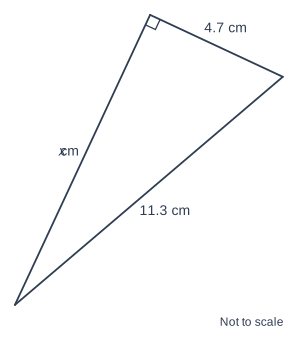
2 marksIn the right-angled triangle in the diagram, the longest side is 11.3 cm and one of the shorter sides is 4.7 cm.
Work out the length of the other shorter side, \(x\) cm.
Give your answer correct to 3 significant figures.
Model answer
The side of length 11.3 cm is opposite the right angle, so it is the hypotenuse.
\(x^2 + 4.7^2 = 11.3^2\)
\(x^2 = 11.3^2 - 4.7^2 = 127.69 - 22.09 = 105.6\)
\(x = \sqrt{105.6} = 10.276...\)
\(x = 10.3\) (to 3 s.f.)
Explanation
Here the hypotenuse (11.3 cm, opposite the right angle) is given and x is one of the shorter sides, so subtract the square of 4.7 from the square of 11.3 before taking the square root. Check: x must be shorter than 11.3 cm. Adding the squares gives 12.2, which is longer than the hypotenuse and so cannot be right.
Mark scheme
-
1 mark
M1 for \(11.3^2 - 4.7^2\) or 127.69 − 22.09 or 105.6
These are exact values from the question. Also award M1 for \(x^2 + 4.7^2 = 11.3^2\) oe or \(\sqrt{11.3^2 - 4.7^2}\) or \(\sqrt{105.6}\); correct answer with no working scores full marks
-
1 mark
A1 for 10.3
Accept 10.3, or a more accurate value from 10.27 to 10.28 (the full value is 10.276...). A correct answer with no working scores 2 marks. 105.6 as the final answer scores M1 A0. 12.2 (from \(11.3^2 + 4.7^2\)) scores M0 A0 and 6.6 (from 11.3 − 4.7) scores 0. If 0 scored, SC1 for their answer to more than 3 figures correctly rounded to 3 s.f.