
Level:
Correct: 0
Incorrect: 0
Marks: 0/0
Exam Practice
Course:
Topics:
OCR GCSE Maths (Foundation calculator) Smart practice A mixed round aimed at your weak spots
Unit 1
Number Operations and Integers
Unit 2
Fractions, Decimals and Percentages
Unit 3
Indices and Surds
Unit 4
Approximation and Estimation
Unit 5
Ratio, Proportion and Rates of Change
Unit 6
Algebra
Unit 7
Graphs of Equations and Functions
Unit 8
Basic Geometry
Unit 9
Congruence and Similarity
Unit 10
Mensuration
Unit 11
Probability
Unit 12
Statistics
Avg
score:
–
Topics
done:
0/100

HCF and LCM

Practise 14 exam-style questions on HCF and LCM for OCR GCSE Maths (Foundation calculator). Write your answer as you would in the exam and get it marked in seconds against the mark scheme, point by point, with the Study Helper on hand if you get stuck.

  • 14 questions
  • 1–4 marks each
  • Instant marking
  • No sign-up needed
14 questions, marked as you go

Sample questions with model answers

Here are 4 of the questions in this topic, each with a model answer, an explanation of why it earns the marks and the mark scheme an examiner would use.

Question 1

1 mark

The table shows all the factors of 63 and all the factors of 84.

Write down the highest common factor (HCF) of 63 and 84.
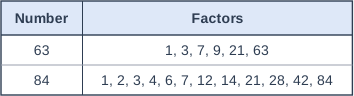
Table with columns "Number", "Factors". Number: 63; Factors: 1, 3, 7, 9, 21, 63 | Number: 84; Factors: 1, 2, 3, 4, 6, 7, 12, 14, 21, 28, 42, 84.

Model answer

Common factors of 63 and 84: 1, 3, 7, 21
The highest of these is 21.

Explanation

Find the numbers that appear in both lists: 1, 3, 7 and 21. The highest common factor is the largest of them, 21. A common error is to give 7, which is a common factor but not the highest one.

Mark scheme
  1. 1 mark

    B1 for 21

    Do not accept 3 or 7 (common factors, but not the highest), or 252 (the LCM).

Question 2

2 marks

One type of cicada (an insect) appears above ground every 13 years.
Another type of cicada appears above ground every 17 years.

In 2024, both types appeared together in the same area.

In which year will both types next appear together in that area?

Model answer

13 and 17 are both prime numbers, so their lowest common multiple is \(13 \times 17 = 221\).
The two types appear together every 221 years.
\(2024 + 221 = 2245\)

Explanation

Both types appear together after a number of years that is a multiple of 13 and of 17: the lowest common multiple. 13 and 17 have no common factors other than 1, so the LCM is their product, 221. Adding 221 to 2024 gives 2245. A common error is to add 13 and 17.

Mark scheme
  1. 1 mark

    M1 for \(13 \times 17\) or 221 seen

    Or for lists of years (or multiples of 13 and 17) reaching 221 or 2245; correct answer with no working scores full marks

  2. 1 mark

    A1 for 2245

    A correct answer with no working scores 2 marks. 221 on its own scores M1 A0. 2054 (from \(2024 + 13 + 17\)) scores M0 A0.

Question 3

3 marks

\(A = 2^4 \times 3 \times 7^2\)
\(B = 2^2 \times 3^3 \times 7\)

Work out the highest common factor (HCF) and the lowest common multiple (LCM) of \(A\) and \(B\).
Give each answer as an ordinary number.

Model answer

HCF: take the lower power of each prime that is in both: \(2^2 \times 3 \times 7 = 4 \times 3 \times 7 = 84\)
LCM: take the higher power of each prime: \(2^4 \times 3^3 \times 7^2 = 16 \times 27 \times 49 = 21168\)
HCF = 84, LCM = 21168

Explanation

For the HCF, use only the primes in both numbers, each with the smaller power: \(2^2\), \(3^1\) and \(7^1\). For the LCM, use every prime with the bigger power: \(2^4\), \(3^3\) and \(7^2\). You can check: \(A = 2352\), \(B = 756\), and \(2352 \div 84 = 28\), \(756 \div 84 = 9\), \(21168 \div 2352 = 9\), \(21168 \div 756 = 28\).

Mark scheme
  1. 1 mark

    B1 for HCF = 84

    Accept \(2^2 \times 3 \times 7\) worked out as 84. \(2^2 \times 3 \times 7\) not worked out scores B0; correct answer with no working scores full marks

  2. 1 mark

    M1 for \(2^4 \times 3^3 \times 7^2\) seen

    Or for \(A = 2352\) and \(B = 756\) with lists of multiples or a correct method from their values.

  3. 1 mark

    A1 for LCM = 21168

    Exact value. A correct answer with no working scores the marks for that answer. 1778112 (\(A \times B\)) scores M0 A0. HCF and LCM the wrong way round scores B0 M1 A0.

Question 4

4 marks

A printer prints 1386 maths booklets and 1782 science booklets.

The booklets are packed into boxes.
• Each box contains booklets for one subject only.
• Every box contains the same number of booklets.
• Every booklet is packed, and every box is full.

The printer uses as few boxes as possible.

How many boxes does the printer use?

Model answer

\(1386 = 2 \times 693 = 2 \times 3 \times 231 = 2 \times 3 \times 3 \times 77 = 2 \times 3^2 \times 7 \times 11\)
\(1782 = 2 \times 891 = 2 \times 3^4 \times 11\)
HCF \(= 2 \times 3^2 \times 11 = 198\)
Each box holds 198 booklets.
Maths boxes: \(1386 \div 198 = 7\)
Science boxes: \(1782 \div 198 = 9\)
Total: \(7 + 9 = 16\) boxes

Explanation

The number in each box must divide exactly into both 1386 and 1782, so it is a common factor; to use as few boxes as possible, it must be the highest common factor, 198. Then divide each total by 198 and add the numbers of boxes. A common error is to stop at 198, which is the number of booklets in each box, not the number of boxes.

Mark scheme
  1. 1 mark

    M1 for 1386 or 1782 written as a product of prime factors

    \(1386 = 2 \times 3^2 \times 7 \times 11\) and \(1782 = 2 \times 3^4 \times 11\). Allow one error. Or for listing factors of 1386 or 1782 (at least 6 correct); correct answer with no working scores full marks

  2. 1 mark

    M1 for a correct method for the HCF

    e.g. \(2 \times 3^2 \times 11\), or common factors of both numbers identified.

  3. 1 mark

    A1 for 198

    The number of booklets in each box.

  4. 1 mark

    A1 for 16

    From \(7 + 9\). A correct answer with no working scores 4 marks. 198 as the final answer scores M1 M1 A1 A0. Using a common factor that is not the highest (e.g. 99 booklets per box, giving \(14 + 18 = 32\) boxes) scores M1 M0 A0 A0.

Ready to try the rest? Every answer you write is marked against the mark scheme, so you can see exactly where the marks are.

Study Helper Hints first, answers after you try

Stuck on this one? Ask for a hint and I’ll point you in the right direction, without giving the answer away. Once you’ve checked your answer, I’ll show you how the marks are awarded.