Practise 15 exam-style questions on Angles at a point and on a straight line for OCR GCSE Maths (Foundation calculator). Write your answer as you would in the exam and get it marked in seconds against the mark scheme, point by point, with the Study Helper on hand if you get stuck.
15 questions
1–4 marks each
Instant marking
No sign-up needed
15 questions, marked as you go
Sample questions with model answers
Here are 4 of the questions in this topic, each with a model answer, an explanation of why it earns the marks and the mark scheme an examiner would use.
Question 1
1 mark
Rosa is facing north-west. She turns clockwise through 225°.
Which direction is she facing now?
Model answer
Turning clockwise from north-west: north-west to north is 45° north to south is a further 180° \(45 + 180 = 225^\circ\) Rosa is facing south.
Explanation
The eight compass directions are 45° apart. Turning clockwise from north-west, 45° brings Rosa to north and a further 180° brings her to south, a total of 225°. A common error is to turn anticlockwise.
Mark scheme
1 mark
B1 for south
Accept S. North-east (turning 225° anticlockwise, or 180° only) scores 0.
Question 2
2 marks
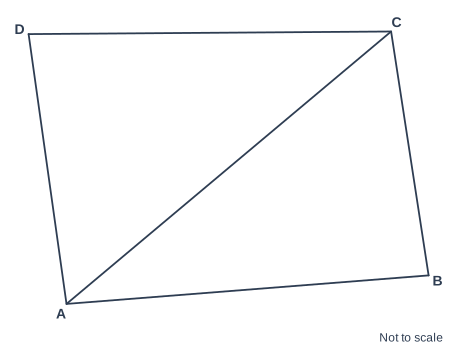
The diagram shows a quadrilateral ABCD and its diagonal AC.
\(\angle BAC = 35.5^\circ\) and \(\angle CAD = 58^\circ\).
Work out the size of \(\angle BAD\). Write down what type of angle \(\angle BAD\) is.
Model answer
\(\angle BAD = \angle BAC + \angle CAD\) \(\angle BAD = 35.5 + 58 = 93.5^\circ\) 93.5° is between 90° and 180°, so it is obtuse.
Explanation
The middle letter of each angle name gives the vertex, so all three angles are at A. Angle BAC is between AB and AC, and angle CAD is between AC and AD, so together they make angle BAD. An angle between 90° and 180° is obtuse.
Mark scheme
1 mark
B1 for 93.5
Accept 93.5°. 22.5 (58 − 35.5) scores 0 for this mark; correct answer with no working scores full marks
1 mark
B1 for obtuse
FT their angle BAD if it is not 93.5 (acute for under 90°, obtuse for between 90° and 180°).
Question 3
2 marks
Ivan says,
"Four obtuse angles can fit together exactly around a point."
Is Ivan correct? Give a reason for your answer.
Model answer
No. An obtuse angle is more than 90°. So four obtuse angles add up to more than \(4 \times 90 = 360^\circ\). Angles at a point must add up to exactly 360°, so four obtuse angles cannot fit around a point.
Explanation
Four right angles fit exactly around a point. Every obtuse angle is bigger than a right angle, so four obtuse angles would always total more than 360°. Three obtuse angles can fit around a point (for example 100°, 120° and 140°), but four cannot.
Mark scheme
1 mark
B1 for No
1 mark
B1 for each obtuse angle is more than 90°, so four of them add up to more than 4 × 90 = 360°, but angles at a point add up to 360° oe
Dependent on No. The reason must use both: obtuse angles are greater than 90°, and angles at a point add up to 360° (or four right angles make 360°). An example alone, such as 100 + 100 + 100 + 100 = 400, with no general statement, scores 0 for this mark.
Question 4
4 marks
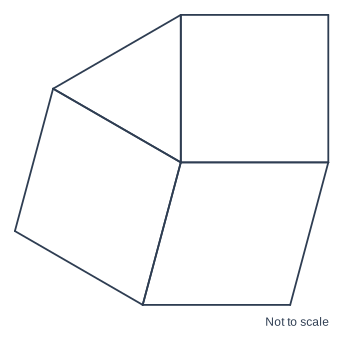
The diagram shows four tiles that fit together exactly around a point, with no gaps. The tiles are a square, an equilateral triangle and two identical rhombuses.
Work out the size of each of the four angles of one rhombus.
Model answer
Angle of the square = 90°. Angle of the equilateral triangle = 60°. Angles at a point add up to 360°: \(360 - 90 - 60 = 210\) \(210 \div 2 = 105^\circ\) for each rhombus at the point. Opposite angles of a rhombus are equal, and the four angles add up to 360°: \((360 - 2 \times 105) \div 2 = 75^\circ\) The angles of one rhombus are 105°, 75°, 105° and 75°.
Explanation
Every angle of a square is 90° and every angle of an equilateral triangle is 60°. The four angles at the point add up to 360°, and the two rhombuses share what is left equally. A rhombus has opposite angles equal, so its other angles are 180° − 105° = 75°.
Mark scheme
1 mark
B1 for 90 and 60 (the angles of the square and the triangle at the point)
May be seen on the diagram; correct answer with no working scores full marks
1 mark
M1 for (360 − 90 − 60) ÷ 2 oe
FT their 90 and 60. Accept 210 ÷ 2.
1 mark
A1 for 105
The angle of each rhombus at the point.
1 mark
B1 for 75, 105, 75 (with 105) as the four angles
FT 180 − their 105 for the other angles. Accept the four angles listed in any order, e.g. 105, 75, 105, 75. Opposite angles of a rhombus are equal and the four angles add up to 360°.
Ready to try the rest? Every answer you write is marked against the mark scheme, so you can see exactly where the marks are.
Ctrl + Enter to check
Study HelperHints first, answers after you try
Stuck on this one? Ask for a hint and I’ll point you in the right direction, without giving the answer away. Once you’ve checked your answer, I’ll show you how the marks are awarded.