Level:
Correct: 0
Incorrect: 0
Marks: 0/0
Exam Practice
Course:
Topics:
OCR GCSE Maths (Foundation calculator) Smart practice A mixed round aimed at your weak spots
Unit 1
Number Operations and Integers
Unit 2
Fractions, Decimals and Percentages
Unit 3
Indices and Surds
Unit 4
Approximation and Estimation
Unit 5
Ratio, Proportion and Rates of Change
Unit 6
Algebra
Unit 7
Graphs of Equations and Functions
Unit 8
Basic Geometry
Unit 9
Congruence and Similarity
Unit 10
Mensuration
Unit 11
Probability
Unit 12
Statistics
Avg
score:
–
Topics
done:
0/100

Loci

Practise 12 exam-style questions on Loci for OCR GCSE Maths (Foundation calculator). Write your answer as you would in the exam and get it marked in seconds against the mark scheme, point by point, with the Study Helper on hand if you get stuck.

  • 12 questions
  • 1–4 marks each
  • Instant marking
  • No sign-up needed
12 questions, marked as you go

Sample questions with model answers

Here are 4 of the questions in this topic, each with a model answer, an explanation of why it earns the marks and the mark scheme an examiner would use.

Question 1

1 mark

Points A and B are 9.4 cm apart.
A point P moves so that it is always the same distance from A as it is from B.

Which of these describes the locus of P?

Choose your answer.

  • a circle with centre A and radius 9.4 cm
  • the perpendicular bisector of AB
  • a line parallel to AB
  • the straight line through A and B

Model answer

The perpendicular bisector of AB

Explanation

Every point on the perpendicular bisector of AB is equidistant from A and B, and no other points are. The line through A and B contains only one such point (the midpoint), and a circle with centre A gives points a fixed distance from A only.

Mark scheme
  1. 1 mark

    B1 for the perpendicular bisector of AB

    Only this option. Do not accept more than one option chosen.
Question 2

2 marks

Mo makes an angle of 60° at the point A on a straight line L.
He uses only a ruler and a pair of compasses.

Step 1: He puts the compass point on A and makes an arc that crosses L at B.
Step 2: He keeps the same radius, puts the compass point on B and makes an arc that crosses the first arc at C.
Step 3: He uses the ruler to join A to C.

Explain why angle CAB is 60°.

Model answer

AC and AB are radii of the first arc, and BC is the radius of the second arc, which is the same.
So AB = AC = BC and triangle ABC is equilateral.
The angles of an equilateral triangle are equal, so angle CAB = \(180 \div 3 = 60^\circ\).

Explanation

Because the compasses are not changed, all three distances AB, AC and BC are equal to the same radius. A triangle with three equal sides is equilateral, and its three equal angles add up to 180°, so each is 60°. The explanation needs both facts: equal sides, and what that means for the angles.

Mark scheme
  1. 1 mark

    B1 for AB = AC = BC (all equal to the radius of the compasses)

    Accept 'all three sides are the same length because the compasses were not changed' oe. Must refer to all three sides, or to AC = AB and BC = AB.

  2. 1 mark

    B1 for triangle ABC is equilateral, so each angle is 180 ÷ 3 = 60°

    Accept 'it is an equilateral triangle and the angles of an equilateral triangle are all 60°'. 'Because the arcs are the same' alone scores 0.

Question 3

3 marks

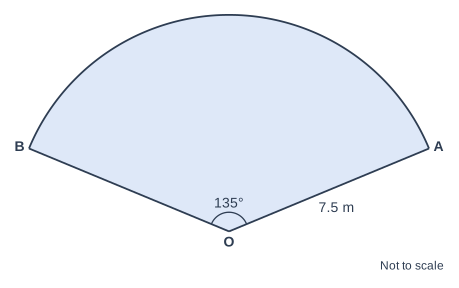
A garden sprinkler at the point O turns backwards and forwards through an angle of 135°.
It waters every point inside this angle that is within 7.5 m of O.

The diagram shows the region that it waters, shaded.

Calculate the area of the region.
Give your answer correct to 1 decimal place.

Geometry diagram, marked "Not to scale". A shaded sector with centre O, bounded by the radii OA and OB and the minor arc from A to B. Angle AOB is marked 135°. OA is labelled 7.5 m.

Model answer

The region is a sector of a circle with radius 7.5 m and angle 135°.
Area of whole circle = \(\pi \times 7.5^2 = 176.71...\)
Area of sector = \(\dfrac{135}{360} \times 176.71... = 66.268...\)
Area = 66.3 m² (1 d.p.)

Explanation

The watered region is the fraction 135/360 of a circle of radius 7.5 m. Work out the area of the full circle, then multiply by 135/360. Common errors are using the circumference instead of the area, or using the 225° that is left over.

Mark scheme
  1. 1 mark

    M1 for \(\pi \times 7.5^2\) or 176.7...

    Accept 3.142 × 7.5²; correct answer with no working scores full marks

  2. 1 mark

    M1 for \(\dfrac{135}{360}\) × their 176.7 oe

    Accept 0.375 × their 176.7 or \(\dfrac{3}{8}\) × their 176.7.

  3. 1 mark

    A1 for 66.3 (m²)

    Accept 66.26 to 66.3 (the full value is 66.268...; π = 3.142 gives 66.276...). 17.7 (from the arc length 135/360 × 2 × π × 7.5) scores M0 M0 A0. 110.4 (from 225/360) scores M1 M0 A0.

Question 4

4 marks

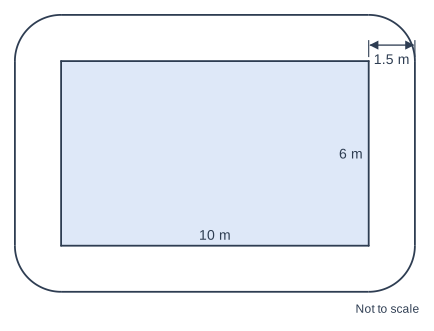
A rectangular swimming pool is 10 m long and 6 m wide.

A paved path is laid around the pool.
The path covers every point outside the pool that is within 1.5 m of the edge of the pool.
The diagram shows the pool and the outside edge of the path.

Calculate the area of the path.
Give your answer correct to 1 decimal place.

Geometry diagram, marked "Not to scale". A rectangular pool (its vertices are not labelled) (shaded). A horizontal line with no labelled ends is drawn. A minor arc from an unlabelled point to an unlabelled point. A vertical line with no labelled ends is drawn. A minor arc from an unlabelled point to an unlabelled point. A horizontal line with no labelled ends is drawn. A minor arc from an unlabelled point to an unlabelled point. A vertical line with no labelled ends is drawn. A minor arc from an unlabelled point to an unlabelled point. The unlabelled side going to the right is labelled 10 m. The unlabelled side going upwards is labelled 6 m. A double-headed dimension arrow alongside an unlabelled line going to the right (the distance from an unlabelled point to an unlabelled point) is labelled 1.5 m.

Model answer

Rectangles along the sides: \(2 \times 10 \times 1.5 + 2 \times 6 \times 1.5 = 30 + 18 = 48\) m²
The four corners are quarter circles of radius 1.5 m, which make one whole circle.
Corners: \(\pi \times 1.5^2 = 7.068...\) m²
Area of path = \(48 + 7.068... = 55.068...\)
Area = 55.1 m² (1 d.p.)

Explanation

Along each side, the points within 1.5 m of the pool form a rectangle 1.5 m wide. At each corner, the points within 1.5 m of the corner of the pool form a quarter circle, so the corners are rounded. The four quarter circles make one circle. A common error is to make the corners square, which gives 57 m².

Mark scheme
  1. 1 mark

    M1 for 2 × 10 × 1.5 + 2 × 6 × 1.5 or 48

    The four rectangles along the sides of the pool. Accept 30 + 18; correct answer with no working scores full marks

  2. 1 mark

    M1 for \(\pi \times 1.5^2\) or 7.06... or \(4 \times \dfrac{1}{4} \times \pi \times 1.5^2\)

    The four quarter circles at the corners make one whole circle of radius 1.5 m. Accept 7.06 to 7.07 (7.068...).

  3. 1 mark

    M1 for their 48 + their 7.07

    Adding the rectangles and the corner pieces; their 7.07 may be any value from 7.06 to 7.07.

  4. 1 mark

    A1 for 55.1 (m²)

    Accept 55.06 to 55.1 (the full value is 55.068...; π = 3.142 gives 55.069...). 57 (from 13 × 9 − 60, square corners) scores M1 M0 M0 A0. 115.1 (the pool included) scores M3 A0.

Ready to try the rest? Every answer you write is marked against the mark scheme, so you can see exactly where the marks are.

Study Helper Hints first, answers after you try

Stuck on this one? Ask for a hint and I’ll point you in the right direction, without giving the answer away. Once you’ve checked your answer, I’ll show you how the marks are awarded.