Practise 15 exam-style questions on Straight line graphs for OCR GCSE Maths (Foundation calculator). Write your answer as you would in the exam and get it marked in seconds against the mark scheme, point by point, with the Study Helper on hand if you get stuck.
15 questions
1–5 marks each
Instant marking
No sign-up needed
15 questions, marked as you go
Sample questions with model answers
Here are 4 of the questions in this topic, each with a model answer, an explanation of why it earns the marks and the mark scheme an examiner would use.
Question 1
1 mark
Write down the coordinates of the point where the line \(y = 3.5 - 0.4x\) crosses the y-axis.
Model answer
On the y-axis \(x = 0\): \(y = 3.5 - 0.4 \times 0 = 3.5\) The line crosses the y-axis at \((0, 3.5)\).
Explanation
The line crosses the y-axis where x = 0, which leaves y = 3.5. Written as y = −0.4x + 3.5, the equation shows c = 3.5 directly, even though the terms are in a different order. Coordinates on the y-axis always have x-coordinate 0.
Mark scheme
1 mark
B1 for \((0, 3.5)\)
Do not accept (3.5, 0) or (0, −0.4).
Question 2
2 marks
The line \(y = mx + 2\) passes through the point \((4, 8)\).
Find the value of \(m\).
Model answer
\(8 = m \times 4 + 2\) \(4m = 6\) \(m = 1.5\)
Explanation
The point (4, 8) is on the line, so x = 4 and y = 8 must fit the equation: 8 = 4m + 2, giving m = 1.5. Another way: the line crosses the y-axis at (0, 2), so from (0, 2) to (4, 8) it rises 6 in 4 across, a gradient of 1.5.
Mark scheme
1 mark
M1 for \(8 = 4m + 2\)
Or for \(\dfrac{8 - 2}{4 - 0}\) (gradient from (0, 2) to (4, 8)); correct answer with no working scores full marks
1 mark
A1 for \(m = 1.5\)
Accept \(\dfrac{3}{2}\). 2.5 (from 4m = 8 + 2) scores M1 A0. Correct answer with no working scores 2 marks.
Question 3
2 marks
The point P lies on the line \(y = 0.5x + 3\) The x-coordinate and the y-coordinate of P are equal.
Find the coordinates of P.
Model answer
At P, \(y = x\), so \(x = 0.5x + 3\) \(0.5x = 3\) \(x = 6\) P is \((6, 6)\).
Explanation
If the coordinates are equal then y = x, so replace y with x in the equation of the line and solve: 0.5x = 3, so x = 6. Check: 0.5 × 6 + 3 = 6. P is where the line meets the line y = x.
Mark scheme
1 mark
M1 for \(x = 0.5x + 3\) oe
Or for a correct trial showing equal coordinates, e.g. x = 6 gives y = 6; correct answer with no working scores full marks
1 mark
A1 for \((6, 6)\)
x = 6 alone scores M1 A0. Correct answer with no working scores 2 marks.
Question 4
4 marks
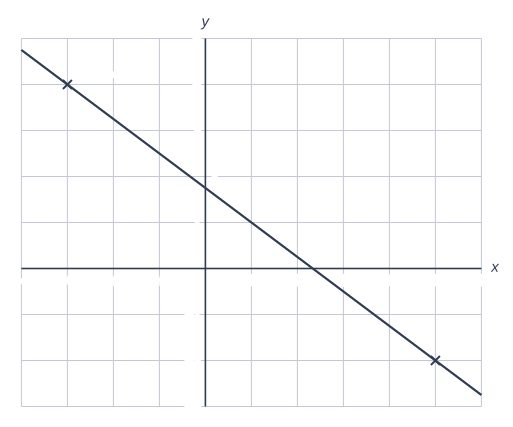
The straight line L passes through the points A and B shown on the grid.
Find the equation of L. Give your answer in the form \(y = mx + c\).
Find the gradient from the two points: the line goes down 6 as it goes 8 across, so m = −0.75. Then substitute either point into y = −0.75x + c to find c = 1.75; the y-intercept is not on a grid line, so it must be calculated rather than read off. Check the equation with the other point.
Mark scheme
1 mark
M1 for \(\dfrac{-2 - 4}{5 - (-3)}\) oe
Change in y ÷ change in x for A(−3, 4) and B(5, −2); sign may be wrong for M1; correct answer with no working scores full marks
1 mark
A1 for gradient \(-0.75\)
Accept \(-\dfrac{3}{4}\) or \(-\dfrac{6}{8}\).
1 mark
M1 for substituting A or B into \(y = (\text{their } m)x + c\)
e.g. \(4 = -0.75 \times (-3) + c\) or \(-2 = -0.75 \times 5 + c\).
1 mark
A1 for \(y = -0.75x + 1.75\)
Accept \(y = -\dfrac{3}{4}x + \dfrac{7}{4}\) oe. A correct equation in another form (e.g. \(3x + 4y = 7\)) scores M1 A1 M1 A0. Correct answer with no working scores 4 marks.
Ready to try the rest? Every answer you write is marked against the mark scheme, so you can see exactly where the marks are.
Ctrl + Enter to check
Study HelperHints first, answers after you try
Stuck on this one? Ask for a hint and I’ll point you in the right direction, without giving the answer away. Once you’ve checked your answer, I’ll show you how the marks are awarded.