Practise 16 exam-style questions on Calculating with fractions for OCR GCSE Maths (Foundation calculator). Write your answer as you would in the exam and get it marked in seconds against the mark scheme, point by point, with the Study Helper on hand if you get stuck.
16 questions
1–4 marks each
Instant marking
No sign-up needed
16 questions, marked as you go
Sample questions with model answers
Here are 4 of the questions in this topic, each with a model answer, an explanation of why it earns the marks and the mark scheme an examiner would use.
Change both mixed numbers to improper fractions, multiply the numerators and the denominators, then simplify. A negative times a positive gives a negative answer. On a calculator, use the mixed-number key and the negative key, or put the negative number in brackets. Multiplying the whole numbers and the fractions separately is wrong.
Mark scheme
1 mark
B1 for \(-4\dfrac{1}{2}\) oe
Accept \(-\dfrac{9}{2}\), \(-\dfrac{180}{40}\) or -4.5. \(4\dfrac{1}{2}\) (sign lost) scores 0. \(-2\dfrac{7}{20}\) (multiplying the whole numbers and the fractions separately: \(-(1 \times 2 + \dfrac{7}{8} \times \dfrac{2}{5})\)) scores 0.
Follow the machine in order: multiply by \(\dfrac{3}{5}\) first, then add \(1\dfrac{3}{4}\). Multiplying a negative number by a positive fraction gives a negative answer, and adding \(1\dfrac{3}{4}\) to \(-1\dfrac{1}{2}\) takes it just past zero. A common error is to lose the negative sign.
Mark scheme
1 mark
M1 for \(-2\dfrac{1}{2} \times \dfrac{3}{5}\) oe
Implied by \(-1\dfrac{1}{2}\), \(-\dfrac{3}{2}\), \(-\dfrac{15}{10}\) or -1.5 seen; correct answer with no working scores full marks
1 mark
A1 for \(\dfrac{1}{4}\) oe
Accept 0.25. Correct answer with no working scores 2 marks. \(3\dfrac{1}{4}\) (sign lost: \(1\dfrac{1}{2} + 1\dfrac{3}{4}\)) scores M1 A0. \(-\dfrac{9}{20}\) (adding before multiplying) scores 0.
Question 3
2 marks
Pip says,
"When I multiply \(2\dfrac{2}{3}\) by any fraction, the answer is smaller than \(2\dfrac{2}{3}\)."
Give an example to show that Pip is wrong.
Model answer
Use the improper fraction \(\dfrac{3}{2}\): \(2\dfrac{2}{3} \times \dfrac{3}{2} = \dfrac{8}{3} \times \dfrac{3}{2} = \dfrac{24}{6} = 4\) 4 is bigger than \(2\dfrac{2}{3}\), so Pip is wrong.
Explanation
Multiplying by a proper fraction (between 0 and 1) makes a positive number smaller, but improper fractions such as \(\dfrac{3}{2}\) are greater than 1, so multiplying by them makes the number bigger. One counter-example is enough to show that a statement about 'any fraction' is false. Choosing a fraction such as \(\dfrac{1}{2}\) does not help, because it agrees with Pip.
Mark scheme
1 mark
B1 for choosing a fraction greater than or equal to 1
e.g. an improper fraction such as \(\dfrac{3}{2}\) or \(\dfrac{9}{8}\), or a mixed number such as \(1\dfrac{1}{4}\). Accept a fraction equal to 1 such as \(\dfrac{4}{4}\) (the answer is then not smaller). A proper fraction or a negative fraction scores 0 (these do give smaller answers).
1 mark
B1 for a correct product with their fraction and a statement that it is not smaller than \(2\dfrac{2}{3}\)
e.g. '\(2\dfrac{2}{3} \times \dfrac{3}{2} = 4\), and 4 is bigger than \(2\dfrac{2}{3}\)'. The product must be correct for their fraction; decimals are fine (e.g. \(2.666... \times 1.5 = 4\)).
Question 4
4 marks
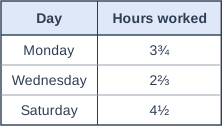
The table shows the number of hours Erin worked on three days last week.
Erin is paid £11.44 per hour on weekdays. On Saturdays she is paid \(1\dfrac{1}{2}\) times her weekday rate.
Work out Erin's total pay for these three days. Give your answer to the nearest penny.
Add the weekday hours and multiply by the weekday rate; work out the Saturday rate (\(1\dfrac{1}{2}\) times £11.44 is £17.16) and multiply by the Saturday hours. Keep the full calculator value until the end and then round to the nearest penny. Rounding \(6\dfrac{5}{12}\) hours to 6.42 gives £150.66, which is wrong, and forgetting the higher Saturday rate gives £124.89.
Mark scheme
1 mark
M1 for \(3\dfrac{3}{4} + 2\dfrac{2}{3}\) oe
Implied by \(6\dfrac{5}{12}\), \(\dfrac{77}{12}\) or 6.41... or 6.42 hours seen, or by the pay for each weekday: 42.90 and 30.50 to 30.51; correct answer with no working scores full marks
1 mark
M1 for \(11.44 \times 1.5\) or \(4\dfrac{1}{2} \times 1\dfrac{1}{2}\)
Implied by 17.16 (Saturday rate) or 6.75 (equivalent hours) seen. Exact values from the question.
1 mark
M1 for their \(6\dfrac{5}{12}\) × 11.44 + \(4\dfrac{1}{2}\) × their 17.16 oe
Or (their \(6\dfrac{5}{12}\) + their 6.75) × 11.44, e.g. \(13\dfrac{1}{6}\) × 11.44. Implied by 73.40... + 77.22 (17.16 and 77.22 are exact values; accept 73.4 to 73.41 for the weekday pay).
1 mark
A1 for £150.63
Accept 150.626 to 150.63 (the calculator value is 150.6266...). Correct answer with no working scores 4 marks. Premature rounding: 6.42 hours gives 150.66 (or 6.4 hours gives 150.44), M3 A0. 124.89 (Saturday paid at the weekday rate) scores M1 M0 M0 A0.
Ready to try the rest? Every answer you write is marked against the mark scheme, so you can see exactly where the marks are.
Ctrl + Enter to check
Study HelperHints first, answers after you try
Stuck on this one? Ask for a hint and I’ll point you in the right direction, without giving the answer away. Once you’ve checked your answer, I’ll show you how the marks are awarded.