
Level:
Correct: 0
Incorrect: 0
Marks: 0/0
Exam Practice
Course:
Topics:
OCR GCSE Maths (Foundation calculator) Smart practice A mixed round aimed at your weak spots
Unit 1
Number Operations and Integers
Unit 2
Fractions, Decimals and Percentages
Unit 3
Indices and Surds
Unit 4
Approximation and Estimation
Unit 5
Ratio, Proportion and Rates of Change
Unit 6
Algebra
Unit 7
Graphs of Equations and Functions
Unit 8
Basic Geometry
Unit 9
Congruence and Similarity
Unit 10
Mensuration
Unit 11
Probability
Unit 12
Statistics
Avg
score:
–
Topics
done:
0/100

Prime numbers and prime factors

Practise 14 exam-style questions on Prime numbers and prime factors for OCR GCSE Maths (Foundation calculator). Write your answer as you would in the exam and get it marked in seconds against the mark scheme, point by point, with the Study Helper on hand if you get stuck.

  • 14 questions
  • 1–4 marks each
  • Instant marking
  • No sign-up needed
14 questions, marked as you go

Sample questions with model answers

Here are 4 of the questions in this topic, each with a model answer, an explanation of why it earns the marks and the mark scheme an examiner would use.

Question 1

1 mark

Write \(2 \times 2 \times 3 \times 3 \times 3 \times 7\) in index form.

Model answer

There are two 2s, three 3s and one 7.
\(2 \times 2 \times 3 \times 3 \times 3 \times 7 = 2^2 \times 3^3 \times 7\)

Explanation

In index form, a repeated factor is written as a power: the power tells you how many times it is multiplied. Two 2s is \(2^2\) and three 3s is \(3^3\). A 7 that appears once is just written as 7.

Mark scheme
  1. 1 mark

    B1 for \(2^2 \times 3^3 \times 7\)

    Accept the factors in any order and \(7^1\) for 7. Do not accept 756 (the value) on its own, or \(2^2 \times 3^3 \times 7^0\).
Question 2

2 marks

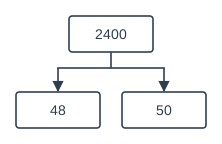
Lily starts a factor tree for 2400, as shown in the diagram.

Write 2400 as a product of its prime factors.
Give your answer in index form.

Flow chart of 3 boxes joined by arrows, read from top to bottom. The first box is "2400". From "2400", 2 arrows branch out side by side: the left arrow leads to "48"; the right arrow leads to "50".

Model answer

\(48 = 2 \times 24 = 2 \times 2 \times 12 = 2 \times 2 \times 2 \times 6 = 2 \times 2 \times 2 \times 2 \times 3\)
\(50 = 2 \times 25 = 2 \times 5 \times 5\)
\(2400 = 2 \times 2 \times 2 \times 2 \times 3 \times 2 \times 5 \times 5\)
\(2400 = 2^5 \times 3 \times 5^2\)

Explanation

Keep splitting each branch into a pair of factors until every end is a prime number. 48 gives four 2s and a 3, and 50 gives a 2 and two 5s. Altogether there are five 2s, one 3 and two 5s. A common error is to forget to combine the 2s from both branches.

Mark scheme
  1. 1 mark

    M1 for \(2 \times 2 \times 2 \times 2 \times 2 \times 3 \times 5 \times 5\) in any order

    Or for a correct method with at most one error, e.g. a complete factor tree or repeated division with all prime ends, or \(48 = 2^4 \times 3\) and \(50 = 2 \times 5^2\); correct answer with no working scores full marks

  2. 1 mark

    A1 for \(2^5 \times 3 \times 5^2\)

    Accept the factors in any order. \(2^4 \times 2 \times 3 \times 5^2\) scores M1 A0. A correct answer with no working scores 2 marks.

Question 3

2 marks

Abdul says,

'\(2^3 \times 5^2 = 10^5\) because \(2 \times 5 = 10\) and \(3 + 2 = 5\).'

Is Abdul correct?
Show how you decide.

Model answer

\(2^3 \times 5^2 = 8 \times 25 = 200\)
\(10^5 = 100\,000\)
200 is not equal to 100 000, so Abdul is not correct.

Explanation

You can only add powers when the numbers being multiplied (the bases) are the same. \(2^3 \times 5^2\) is \(2 \times 2 \times 2 \times 5 \times 5\): pairing each 5 with a 2 gives \(10 \times 10 \times 2 = 200\). Abdul's answer is far too big.

Mark scheme
  1. 1 mark

    M1 for 200 or 100 000 seen

    \(2^3 \times 5^2 = 8 \times 25 = 200\) and \(10^5 = 100\,000\). Also award for a correct explanation that the powers can only be added when the base numbers are the same.

  2. 1 mark

    A1 for No with 200 and 100 000

    Or No with a full correct reason, e.g. '\(2^3 \times 5^2 = 2 \times 2 \times 2 \times 5 \times 5\), which has only two 10s, \(2 \times 10^2\)'. 'No' with no working scores 0.

Question 4

4 marks

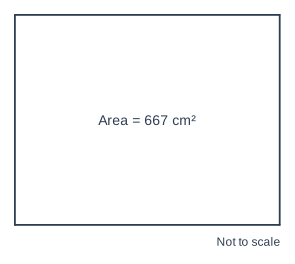
The diagram shows a rectangle with an area of 667 cm².

The length and the width of the rectangle are both prime numbers of centimetres.

A square has the same perimeter as the rectangle.

Work out the area of the square.

Geometry diagram, marked "Not to scale". A rectangle (its vertices are not labelled). The text "Area = 667 cm²" is written inside the shape.

Model answer

Try dividing 667 by primes:
\(667 \div 7 = 95.28...\), \(667 \div 11 = 60.63...\), \(667 \div 13 = 51.30...\), \(667 \div 17 = 39.23...\), \(667 \div 19 = 35.10...\)
\(667 \div 23 = 29\)
The rectangle is 23 cm by 29 cm.
Perimeter \(= 2 \times (23 + 29) = 104\) cm
Side of the square \(= 104 \div 4 = 26\) cm
Area of the square \(= 26^2 = 676\) cm²

Explanation

667 is odd and does not end in 0 or 5, so try the primes 3, 7, 11, 13, ... until one divides exactly: \(667 = 23 \times 29\), and both are prime. The square's perimeter is 104 cm, so each side is 26 cm. A common error is to stop at the perimeter or the side length instead of finding the area.

Mark scheme
  1. 1 mark

    M1 for dividing 667 by prime numbers to find a factor

    e.g. \(667 \div 23 = 29\), or several primes tried with at least one correct division shown; correct answer with no working scores full marks

  2. 1 mark

    A1 for 23 and 29

    The length and width in centimetres.

  3. 1 mark

    M1 for \(2 \times (23 + 29) \div 4\) oe

    FT their two factors of 667. May be implied by 104 (perimeter) and 26 (side of square).

  4. 1 mark

    A1 for 676

    Accept 676 cm². A correct answer with no working scores 4 marks. 104 (the perimeter) or 26 (the side) as the final answer scores M1 A1 M1 A0. 667 scores 0.

Ready to try the rest? Every answer you write is marked against the mark scheme, so you can see exactly where the marks are.

Study Helper Hints first, answers after you try

Stuck on this one? Ask for a hint and I’ll point you in the right direction, without giving the answer away. Once you’ve checked your answer, I’ll show you how the marks are awarded.