Practise 13 exam-style questions on Exact trigonometric values for OCR GCSE Maths (Foundation calculator). Write your answer as you would in the exam and get it marked in seconds against the mark scheme, point by point, with the Study Helper on hand if you get stuck.
13 questions
1–4 marks each
Instant marking
No sign-up needed
13 questions, marked as you go
Sample questions with model answers
Here are 4 of the questions in this topic, each with a model answer, an explanation of why it earns the marks and the mark scheme an examiner would use.
Question 1
1 mark
Write down the exact value of \(\tan 30^\circ\).
Model answer
\(\tan 30^\circ = \dfrac{\sqrt{3}}{3}\), which is the same as \(\dfrac{1}{\sqrt{3}}\)
Explanation
In the right-angled triangle with sides 1, √3 and 2, the side opposite 30° is 1 and the side next to it is √3, so tan 30° = 1/√3, which is the same as √3/3. tan 30° is less than tan 45° = 1, while tan 60° = √3 is more than 1.
Mark scheme
1 mark
B1 for \(\dfrac{\sqrt{3}}{3}\) oe
Accept \(\dfrac{1}{\sqrt{3}}\), sqrt(3)/3 or 1/sqrt(3). A decimal such as 0.577 or 0.58 scores 0 (not exact). \(\sqrt{3}\) (tan 60°) and \(\dfrac{1}{2}\) (sin 30°) score 0.
Question 2
2 marks
Jade writes \(\sin 60^\circ = 0.87\).
Ben says this is not the exact value of \(\sin 60^\circ\).
Write down the exact value of \(\sin 60^\circ\) and explain why 0.87 is not exact.
Model answer
\(\sin 60^\circ = \dfrac{\sqrt{3}}{2}\) \(\dfrac{\sqrt{3}}{2} = 0.8660254...\), and the decimal never ends. 0.87 is this value rounded to 2 decimal places, so it is close but not exact.
Explanation
The exact value of sin 60° is √3/2. Because √3 is not a whole number (or a fraction), its decimal goes on for ever without repeating, so any decimal you write is only an approximation. 0.87 is 0.866... rounded to 2 decimal places.
Mark scheme
1 mark
B1 for \(\dfrac{\sqrt{3}}{2}\)
Accept sqrt(3)/2. \(\dfrac{1}{2}\), \(\sqrt{3}\) or \(\dfrac{\sqrt{2}}{2}\) score 0.
1 mark
B1 for an explanation that 0.87 is a rounded value: \(\dfrac{\sqrt{3}}{2} = 0.866025...\) and its decimal never ends (it is not exactly 0.87)
Accept e.g. '0.87 is rounded to 2 decimal places', '√3 is not a whole number so the decimal goes on forever', '\(0.87 \times 2 = 1.74\), and \(1.74^2 = 3.0276\), not 3'. Do not accept 'because it is a decimal' with no further reason, or 'because sin 60° is √3/2' alone.
Question 3
3 marks
\(x\) and \(y\) are acute angles.
\(\tan x = \sqrt{3}\) and \(\cos y = \dfrac{\sqrt{3}}{2}\)
Use the exact values backwards to find each angle: the acute angle with tan √3 is 60°, and the acute angle with cos √3/2 is 30°. Add the angles first, then find the sine of the total. sin(x + y) is not the same as sin x + sin y.
Mark scheme
1 mark
B1 for \(x = 60\)
Accept 60°; correct answer with no working scores full marks
1 mark
B1 for \(y = 30\)
Accept 30°.
1 mark
B1 for 1
FT \(\sin(\text{their } x + \text{their } y)\) when their \(x + y\) is 0, 30, 45, 60 or 90, given as an exact value. A correct answer with no working scores 3 marks. \(\sin 60^\circ + \sin 30^\circ\) (adding the sines) scores B1 B1 B0.
Question 4
4 marks
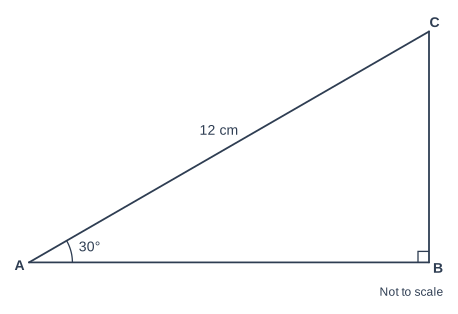
The diagram shows triangle ABC. Angle ABC = 90° and angle BAC = 30°. AC = 12 cm.
Use exact values to show that the area of triangle ABC is \(18\sqrt{3}\) cm².
Model answer
From the 30° angle at A, AC = 12 cm is the hypotenuse. \(BC = 12 \times \sin 30^\circ = 12 \times \dfrac{1}{2} = 6\) cm \(AB = 12 \times \cos 30^\circ = 12 \times \dfrac{\sqrt{3}}{2} = 6\sqrt{3}\) cm AB and BC are perpendicular, so Area = \(\dfrac{1}{2} \times 6 \times 6\sqrt{3} = 3 \times 6\sqrt{3} = 18\sqrt{3}\) cm²
Explanation
The two shorter sides are the base and height, so find both with exact values: sin 30° = 1/2 gives the side opposite the 30° angle and cos 30° = √3/2 gives the side next to it. Then \(\dfrac{1}{2} \times 6 \times 6\sqrt{3} = 18\sqrt{3}\): multiply the whole numbers and keep the √3. Using calculator decimals cannot show an exact answer.
Mark scheme
1 mark
M1 for \(BC = 12 \times \sin 30^\circ\) or \(12 \times \dfrac{1}{2}\)
Implied by BC = 6.
1 mark
M1 for \(AB = 12 \times \cos 30^\circ\) or \(12 \times \dfrac{\sqrt{3}}{2}\)
Implied by \(AB = 6\sqrt{3}\). Alternative: AB by Pythagoras, \(\sqrt{12^2 - 6^2} = \sqrt{108}\), scores M1.
1 mark
A1 for BC = 6 and \(AB = 6\sqrt{3}\)
Both exact. With the Pythagoras method, BC = 6 and \(AB = \sqrt{108}\).
1 mark
A1 for \(\dfrac{1}{2} \times 6 \times 6\sqrt{3} = 18\sqrt{3}\)
The working must be seen: this is a 'show that' question and answer only scores 0. Decimals (e.g. area 31.18 compared with \(18\sqrt{3} = 31.18\)) score M1 M1 A0 A0. With the Pythagoras method, \(\dfrac{1}{2} \times 6 \times \sqrt{108} = 3\sqrt{108}\) must be shown equal to \(18\sqrt{3}\), e.g. \((3\sqrt{108})^2 = 972\) and \((18\sqrt{3})^2 = 972\), for the final A1.
Ready to try the rest? Every answer you write is marked against the mark scheme, so you can see exactly where the marks are.
Ctrl + Enter to check
Study HelperHints first, answers after you try
Stuck on this one? Ask for a hint and I’ll point you in the right direction, without giving the answer away. Once you’ve checked your answer, I’ll show you how the marks are awarded.