Level:
Correct: 0
Incorrect: 0
Marks: 0/0
Exam Practice
Course:
Topics:
OCR GCSE Maths (Foundation calculator) Smart practice A mixed round aimed at your weak spots
Unit 1
Number Operations and Integers
Unit 2
Fractions, Decimals and Percentages
Unit 3
Indices and Surds
Unit 4
Approximation and Estimation
Unit 5
Ratio, Proportion and Rates of Change
Unit 6
Algebra
Unit 7
Graphs of Equations and Functions
Unit 8
Basic Geometry
Unit 9
Congruence and Similarity
Unit 10
Mensuration
Unit 11
Probability
Unit 12
Statistics
Avg
score:
–
Topics
done:
0/100

Properties of quadrilaterals

Practise 14 exam-style questions on Properties of quadrilaterals for OCR GCSE Maths (Foundation calculator). Write your answer as you would in the exam and get it marked in seconds against the mark scheme, point by point, with the Study Helper on hand if you get stuck.

  • 14 questions
  • 1–4 marks each
  • Instant marking
  • No sign-up needed
14 questions, marked as you go

Sample questions with model answers

Here are 4 of the questions in this topic, each with a model answer, an explanation of why it earns the marks and the mark scheme an examiner would use.

Question 1

1 mark

One diagonal of a rectangle is 12.6 cm long.

Write down the length of the other diagonal.

Model answer

12.6 cm (the diagonals of a rectangle are equal in length).

Explanation

The two diagonals of a rectangle are the same length, and they cut each other in half. This is not true for every quadrilateral: the diagonals of a rhombus or a kite are usually different lengths.

Mark scheme
  1. 1 mark

    B1 for 12.6 (cm)

    6.3 (half) scores 0.
Question 2

2 marks

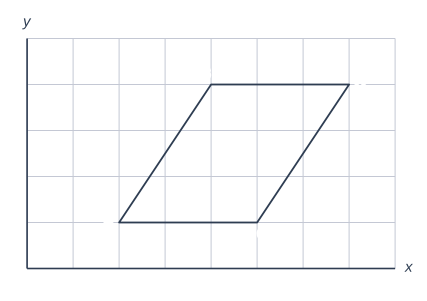
The grid shows a quadrilateral PQRS.

Write down the mathematical name of PQRS.
Give a reason for your answer.

A coordinate grid with x from 0 to 8 and y from 0 to 5; each grid square is 1 unit across, and the axes cross at the origin O. Quadrilateral PQRS (unshaded) is drawn with vertices P(2, 1), Q(5, 1), R(7, 4) and S(4, 4).

Model answer

PQRS is a parallelogram.
PQ and SR are both horizontal and 3 units long, so they are parallel and equal.
PS and QR both go 2 right and 3 up, so they are parallel too.
PQ = 3 but PS is longer than 3, so it is not a rhombus.

Explanation

A quadrilateral with both pairs of opposite sides parallel is a parallelogram. On the grid, PQ and SR are horizontal, and PS and QR have the same slope (2 across, 3 up). The sides are not all equal and the angles are not right angles, so it is not a rhombus, rectangle or square.

Mark scheme
  1. 1 mark

    B1 for parallelogram

    Rhombus, trapezium, kite or rectangle scores 0, and then the reason scores 0.

  2. 1 mark

    B1 for both pairs of opposite sides are parallel oe

    Accept 'PQ is parallel to SR and PS is parallel to QR', or 'PQ and SR are parallel and both 3 units long'. A full reason may also say it is not a rhombus because PQ = 3 but PS is longer than 3, but this is not required.

Question 3

2 marks

Some identical tiles are each in the shape of a rhombus.
One angle of each tile is 72°.

The tiles are placed around a point, with a 72° angle of each tile at the point.
They fit together exactly, with no gaps or overlaps.

Work out how many tiles there are.
Work out the size of the obtuse angle of each tile.

Model answer

Angles at a point add up to 360°.
Number of tiles = \(360 \div 72 = 5\)
Neighbouring angles of a rhombus add up to 180°, so the obtuse angle = \(180 - 72 = 108^\circ\).

Explanation

The 72° angles fill a full turn, so 360° ÷ 72° gives the number of tiles. A rhombus is a parallelogram, so its opposite angles are equal and neighbouring angles add up to 180°: the angles are 72°, 108°, 72° and 108°.

Mark scheme
  1. 1 mark

    B1 for 5 (tiles)

    From 360 ÷ 72; correct answer with no working scores full marks

  2. 1 mark

    B1 for 108°

    From 180 − 72 (or (360 − 2 × 72) ÷ 2). Independent of the first mark.

Question 4

4 marks

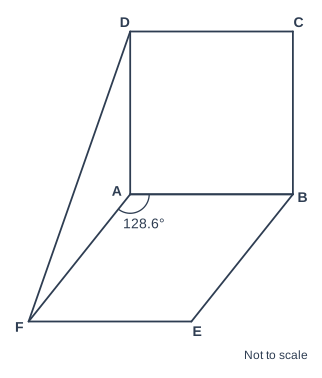
The diagram shows a square ABCD and a rhombus ABEF.
The square and the rhombus are on opposite sides of AB.
D is joined to F.

Angle FAB = 128.6°.

Work out the size of angle ADF.

Geometry diagram, marked "Not to scale". Square ABCD. Rhombus ABEF. Line segment DF is drawn. Angle FAB is marked 128.6°.

Model answer

Angle DAB = 90° (angle of a square).
Angles at a point add up to 360°:
Angle DAF = \(360 - 90 - 128.6 = 141.4^\circ\)
AD = AB (sides of a square) and AF = AB (sides of a rhombus), so AD = AF.
Triangle ADF is isosceles, so angle ADF = angle AFD.
Angle ADF = \((180 - 141.4) \div 2 = 38.6 \div 2 = 19.3^\circ\)

Explanation

Three angles meet at A: the right angle of the square, the 128.6° angle of the rhombus and angle DAF, which together make 360°. The square and the rhombus share the side AB, so AD and AF are both equal to AB, making triangle ADF isosceles. Its two equal angles share what is left of 180°.

Mark scheme
  1. 1 mark

    B1 for angle DAF = 360 − 90 − 128.6 or 141.4

    Angles at a point, using the 90° angle of the square; correct answer with no working scores full marks

  2. 1 mark

    B1 for AD = AF (or triangle ADF is isosceles)

    Both equal AB: the sides of a square are equal and the sides of a rhombus are equal. May be implied by the method.

  3. 1 mark

    M1 for (180 − their 141.4) ÷ 2

  4. 1 mark

    A1 for 19.3

    Accept 19.3°. 38.6 (180 − 141.4 without halving) scores B1 B0 M0 A0, or B1 B1 M0 A0 if AD = AF is stated.

Ready to try the rest? Every answer you write is marked against the mark scheme, so you can see exactly where the marks are.

Study Helper Hints first, answers after you try

Stuck on this one? Ask for a hint and I’ll point you in the right direction, without giving the answer away. Once you’ve checked your answer, I’ll show you how the marks are awarded.