Practise 15 exam-style questions on Sharing in a ratio for OCR GCSE Maths (Foundation calculator). Write your answer as you would in the exam and get it marked in seconds against the mark scheme, point by point, with the Study Helper on hand if you get stuck.
15 questions
1–5 marks each
Instant marking
No sign-up needed
15 questions, marked as you go
Sample questions with model answers
Here are 4 of the questions in this topic, each with a model answer, an explanation of why it earns the marks and the mark scheme an examiner would use.
Question 1
2 marks
Grace and Rob share £12.50 in the ratio 3 : 7.
How much does Rob get?
Model answer
Total number of parts = 3 + 7 = 10 One part = \(12.50 \div 10 = 1.25\) Rob gets 7 parts: \(7 \times 1.25 = 8.75\) Rob gets £8.75
Explanation
Add the parts to get 10, so one part is \(£12.50 \div 10 = £1.25\). Rob's share is 7 parts. Money answers should be written with two decimal places, so write £8.75, not £8.7.
Mark scheme
1 mark
M1 for \(12.50 \div 10\) or one part = 1.25 seen
Exact values from the question. Also M1 for \(\dfrac{7}{10} \times 12.50\) oe. Implied by Grace = £3.75; correct answer with no working scores full marks
1 mark
A1 for £8.75
Accept 875p. £8.75 with no working scores 2 marks. £3.75 (Grace's share) as the final answer scores M1 A0. Do not accept £8.7 or £8.8.
Question 2
2 marks
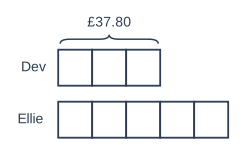
Dev and Ellie share some prize money in the ratio 3 : 5. The bar model shows this information.
Dev gets £37.80.
How much money do they share altogether?
Model answer
Dev has 3 parts, so 3 parts = £37.80. One part = \(37.80 \div 3 = 12.60\) Total number of parts = 3 + 5 = 8 Total = \(8 \times 12.60 = 100.80\) They share £100.80.
Explanation
The bar model shows Dev's 3 parts are worth £37.80, so each part is £12.60. Altogether there are 8 equal parts, so the total is \(8 \times 12.60\). A common error is to treat £37.80 as the total and divide it by 8.
Mark scheme
1 mark
M1 for \(37.80 \div 3\) or one part = 12.60 seen
Exact values from the question. Implied by Ellie = £63 seen; correct answer with no working scores full marks
1 mark
A1 for £100.80
£100.80 with no working scores 2 marks. £63 (Ellie's share) as the final answer scores M1 A0. \(37.80 \div 8 \times 3\) or similar scores 0.
Question 3
3 marks
Mr Okafor gives £500 to three charities. He shares the money in the ratio 3 : 4 : 6.
How much does the charity with the largest share get? Give your answer to the nearest penny.
Model answer
Total number of parts = 3 + 4 + 6 = 13 One part = \(500 \div 13 = 38.461538...\) Largest share = \(6 \times 38.461538... = 230.769...\) To the nearest penny: £230.77
Explanation
There are 13 equal parts, and one part is not an exact number of pence, so keep the full calculator value. Multiply by 6 and only then round to 2 decimal places. Rounding one part to £38.46 first gives £230.76, which is 1p out.
Mark scheme
1 mark
M1 for \(500 \div 13\)
Exact values from the question. Implied by 38.46... seen (calculator value 38.461538...). Also M1 for \(\dfrac{6}{13} \times 500\) oe; correct answer with no working scores full marks
1 mark
M1 for their \(\dfrac{500}{13} \times 6\)
Implied by 230.76... or 230.8 seen (calculator value 230.769...).
1 mark
A1 for £230.77
Accept answers from 230.769 to 230.77, e.g. 230.769... Premature rounding: one part rounded to 38.46 gives \(6 \times 38.46 = 230.76\), which scores M1 M1 A0. 230.8 or 231 scores M1 M1 A0. \(500 \div 6\) or \(500 \div 3\) methods score 0.
Question 4
4 marks
One week a sweet shop sells fudge and toffee in the ratio 5 : 3 by mass. It sells 18.6 kg more fudge than toffee.
The shop sells fudge for £1.80 per 100 g.
Work out how much money the shop takes for fudge that week.
Model answer
Fudge is 5 parts and toffee is 3 parts, so the difference is 2 parts. 2 parts = 18.6 kg One part = \(18.6 \div 2 = 9.3\) kg Fudge = 5 parts = \(5 \times 9.3 = 46.5\) kg = 46 500 g Number of 100 g = \(46500 \div 100 = 465\) Money = \(465 \times 1.80 = 837\) The shop takes £837.
Explanation
The extra 18.6 kg of fudge is the difference between 5 parts and 3 parts, which is 2 parts, so one part is 9.3 kg. The fudge is 5 parts, 46.5 kg. The price is per 100 g, so change kilograms into hundreds of grams (or use £18 per kg) before multiplying.
Mark scheme
1 mark
M1 for \(18.6 \div 2\) or one part = 9.3 (kg) seen
Exact values from the question. The difference 5 − 3 = 2 parts must be used; correct answer with no working scores full marks
1 mark
M1 for their \(9.3 \times 5\) (= 46.5 kg)
FT their one part. Implied by 46.5 kg or 46 500 g seen.
1 mark
M1 for their 46.5 kg converted to 465 lots of 100 g and multiplied by 1.80, or their 46 500 \(\div 100 \times 1.80\) oe
Also M1 for £18 per kg used: their \(46.5 \times 18\). FT their mass of fudge.
1 mark
A1 for £837
Exact answer. Accept £837.00. £837 with no working scores 4 marks. Using 18.6 kg as 1 part (fudge = 93 kg, £1674) scores M0 M0 M1 A0. \(46.5 \times 1.80 = 83.70\) (units not changed) scores M1 M1 M0 A0.
Ready to try the rest? Every answer you write is marked against the mark scheme, so you can see exactly where the marks are.
Ctrl + Enter to check
Study HelperHints first, answers after you try
Stuck on this one? Ask for a hint and I’ll point you in the right direction, without giving the answer away. Once you’ve checked your answer, I’ll show you how the marks are awarded.