
Level:
Correct: 0
Incorrect: 0
Marks: 0/0
Exam Practice
Course:
Topics:
OCR GCSE Maths (Foundation calculator) Smart practice A mixed round aimed at your weak spots
Unit 1
Number Operations and Integers
Unit 2
Fractions, Decimals and Percentages
Unit 3
Indices and Surds
Unit 4
Approximation and Estimation
Unit 5
Ratio, Proportion and Rates of Change
Unit 6
Algebra
Unit 7
Graphs of Equations and Functions
Unit 8
Basic Geometry
Unit 9
Congruence and Similarity
Unit 10
Mensuration
Unit 11
Probability
Unit 12
Statistics
Avg
score:
–
Topics
done:
0/100

Parts of a circle

Practise 13 exam-style questions on Parts of a circle for OCR GCSE Maths (Foundation calculator). Write your answer as you would in the exam and get it marked in seconds against the mark scheme, point by point, with the Study Helper on hand if you get stuck.

  • 13 questions
  • 1–4 marks each
  • Instant marking
  • No sign-up needed
13 questions, marked as you go

Sample questions with model answers

Here are 4 of the questions in this topic, each with a model answer, an explanation of why it earns the marks and the mark scheme an examiner would use.

Question 1

1 mark

AB is a diameter of a circle with centre O.
AB = 15.8 cm.
C is another point on the circle.

Write down the length of OC.

Model answer

OC is a radius, and a radius is half a diameter.
\(OC = 15.8 \div 2 = 7.9\) cm

Explanation

Every point on a circle is the same distance from the centre, so OC is a radius, the same length as OA and OB. The diameter AB is made of two radii, so OC is half of 15.8 cm.

Mark scheme
  1. 1 mark

    B1 for 7.9 (cm)

    15.8 or 31.6 scores 0.
Question 2

2 marks

A circular rug is divided into three sectors by straight lines from its centre.
One sector is a quadrant (a quarter of the circle).
The other two sectors are the same size as each other.

Work out the angle at the centre of each of the two equal sectors.

Model answer

The angle of a quadrant is \(360 \div 4 = 90^\circ\).
The angles at the centre add up to 360°.
Each equal sector = \((360 - 90) \div 2 = 135^\circ\)

Explanation

The angles of the sectors meet at the centre, so they add up to 360°. A quadrant is a quarter of a circle, with angle 90°. The two equal sectors share the remaining 270°.

Mark scheme
  1. 1 mark

    M1 for (360 − 90) ÷ 2 or 270 ÷ 2

    correct answer with no working scores full marks

  2. 1 mark

    A1 for 135°

    45 (from (180 − 90) ÷ 2) scores M0 A0. 270 scores M0 A0.

Question 3

2 marks

A circle has centre C(3, 2).
The point A(5, 3.5) is on the circle.
AB is a diameter of the circle.

Work out the coordinates of B.

Model answer

A diameter passes through the centre, so C is the midpoint of AB.
From A to C: \(x\) goes from 5 to 3 (down 2) and \(y\) from 3.5 to 2 (down 1.5).
From C to B is the same step again: \(B = (3 - 2,\ 2 - 1.5) = (1, 0.5)\)

Explanation

A diameter is made of two radii in a straight line, so the centre is exactly halfway along it. B is as far beyond C as A is before it. A common error is to find the midpoint of AC instead.

Mark scheme
  1. 1 mark

    M1 for C is the midpoint of AB, or the step from A to C is 2 left and 1.5 down, or (2 × 3 − 5, 2 × 2 − 3.5)

    One coordinate of B correct implies M1; correct answer with no working scores full marks

  2. 1 mark

    A1 for (1, 0.5)

    (7, 5) (going the wrong way from C) or (4, 2.75) (the midpoint of AC) scores M0 A0.

Question 4

4 marks

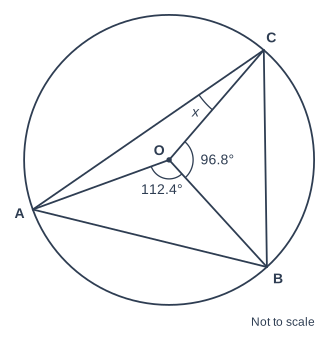
The diagram shows a circle with centre O.
A, B and C are points on the circle.
The radii OA, OB and OC and the chords AB, BC and CA are drawn.

Angle AOB = 112.4° and angle BOC = 96.8°.

Work out the size of angle OCA, marked \(x\).

Geometry diagram, marked "Not to scale". A circle with centre O; A, B and C lie on it, in that order going anticlockwise. Triangle ABC. Line segments OA, OB and OC are drawn. Angle AOB is marked 112.4°. Angle BOC is marked 96.8°. Angle OCA is marked x.

Model answer

Angles at a point add up to 360°:
Angle AOC = \(360 - 112.4 - 96.8 = 150.8^\circ\)
OA = OC because they are both radii, so triangle OAC is isosceles and angle OCA = angle OAC.
\(x = (180 - 150.8) \div 2 = 29.2 \div 2 = 14.6^\circ\)

Explanation

The three angles at the centre fill a full turn. Any triangle made by two radii and a chord is isosceles, because the two radii are equal, so its base angles are equal and share what is left of 180°. A common error is to forget that the angle at O in triangle OAC is the third angle at the centre.

Mark scheme
  1. 1 mark

    B1 for angle AOC = 360 − 112.4 − 96.8 or 150.8

    Angles at a point add up to 360°; correct answer with no working scores full marks

  2. 1 mark

    B1 for OA = OC (radii), so triangle OAC is isosceles

    May be implied by the method (equal base angles at A and C).

  3. 1 mark

    M1 for (180 − their 150.8) ÷ 2

  4. 1 mark

    A1 for 14.6

    Accept 14.6°. 29.2 (not halved) scores B1 B0 M0 A0. 150.8 as the final answer scores B1 only.

Ready to try the rest? Every answer you write is marked against the mark scheme, so you can see exactly where the marks are.

Study Helper Hints first, answers after you try

Stuck on this one? Ask for a hint and I’ll point you in the right direction, without giving the answer away. Once you’ve checked your answer, I’ll show you how the marks are awarded.