
Level:
Correct: 0
Incorrect: 0
Marks: 0/0
Exam Practice
Course:
Topics:
OCR GCSE Maths (Foundation calculator) Smart practice A mixed round aimed at your weak spots
Unit 1
Number Operations and Integers
Unit 2
Fractions, Decimals and Percentages
Unit 3
Indices and Surds
Unit 4
Approximation and Estimation
Unit 5
Ratio, Proportion and Rates of Change
Unit 6
Algebra
Unit 7
Graphs of Equations and Functions
Unit 8
Basic Geometry
Unit 9
Congruence and Similarity
Unit 10
Mensuration
Unit 11
Probability
Unit 12
Statistics
Avg
score:
–
Topics
done:
0/100

Basic probability

Practise 16 exam-style questions on Basic probability for OCR GCSE Maths (Foundation calculator). Write your answer as you would in the exam and get it marked in seconds against the mark scheme, point by point, with the Study Helper on hand if you get stuck.

  • 16 questions
  • 1–4 marks each
  • Instant marking
  • No sign-up needed
16 questions, marked as you go

Sample questions with model answers

Here are 4 of the questions in this topic, each with a model answer, an explanation of why it earns the marks and the mark scheme an examiner would use.

Question 1

2 marks

Forty cards are numbered 1 to 40.
One card is taken at random.

Work out the probability that the number on the card is a multiple of 6.
Give your answer as a decimal.

Model answer

Multiples of 6 from 1 to 40: 6, 12, 18, 24, 30, 36
That is 6 cards out of 40.
Probability = \(\dfrac{6}{40} = 0.15\)

Explanation

All 40 cards are equally likely, so list the multiples of 6 up to 40 and count them: there are 6. Divide by 40 and change the fraction to a decimal with your calculator. A common error is to include a number such as 42, which is not on any card.

Mark scheme
  1. 1 mark

    M1 for \(\dfrac{6}{40}\) oe

    Or the six multiples 6, 12, 18, 24, 30, 36 listed with 40 as the total; correct answer with no working scores full marks

  2. 1 mark

    A1 for 0.15

    Exact value: no rounding needed. \(\dfrac{6}{40}\) not changed to a decimal scores M1 A0. 0.175 (from 7 multiples, including 42 or 3) scores M0 A0.
Question 2

2 marks

A weather forecast says there is a 15% chance of snow tomorrow.

Lou says,

'Snow tomorrow is more likely than getting a 6 when I roll a fair six-sided dice.'

Is Lou correct?
Show how you decide.

Model answer

Probability of getting a 6 = \(\dfrac{1}{6} = 0.1666...\) = 16.7%
Probability of snow = 15% = 0.15
15% is less than 16.7%, so getting a 6 is more likely than snow.
Lou is not correct.

Explanation

To compare probabilities they must be in the same form. On a calculator, 1 ÷ 6 = 0.1666..., which is 16.7% to 1 decimal place. This is greater than 15%, so rolling a 6 is slightly more likely than snow. A common error is to think a percentage of 15 is bigger than a fraction with 6 on the bottom.

Mark scheme
  1. 1 mark

    M1 for \(\dfrac{1}{6}\) converted to a decimal or percentage, or 15% converted to a fraction or decimal for comparison

    Accept 0.166... or 0.17, or 16.6...% or 16.7% or 17%, or 0.15 compared with 0.16 or 0.17. \(\dfrac{1}{6}\) alone with no conversion scores M0.

  2. 1 mark

    A1 for No, with 15% less than 16.7% oe

    Accept 'No, 0.15 is less than 0.166..., so a 6 is more likely'. Accept 16.6% or 16.67%. 'No' with no correct comparison scores M0 A0.

Question 3

2 marks

A spinner is biased.
The probability that it lands on red is 0.35.

Ivy is going to spin the spinner 260 times.

Work out how many times Ivy should expect the spinner to land on red.

Ivy says,

'The spinner will land on red exactly that number of times.'

Explain why Ivy may be wrong.

Model answer

Expected number of reds = \(0.35 \times 260 = 91\)
Ivy may be wrong because each spin is random. 91 is only an estimate of the number of reds; she could get a few more or a few fewer than 91.

Explanation

The expected number of outcomes is the probability multiplied by the number of trials: 0.35 × 260 = 91. This is what you would expect on average, but the results of a random experiment vary, so the actual number of reds is likely to be close to 91 but not necessarily equal to it.

Mark scheme
  1. 1 mark

    B1 for 91

    From \(0.35 \times 260\). Exact value: no rounding needed.

  2. 1 mark

    B1 for the results are random, so the actual number may be different from the expected number oe

    Accept 'it is only an estimate', 'it could land on red more or fewer times', 'probability does not tell you exactly what will happen', 'each spin is random'. Do not accept 'the spinner is biased' on its own.

Question 4

4 marks

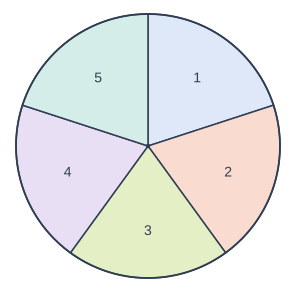
The diagram shows a fair spinner with five equal sections, numbered 1, 2, 3, 4 and 5.
A fair six-sided dice is numbered 1 to 6.

In a game, the spinner is spun and the dice is rolled.
The two scores are added together to give a total.

The game is played 450 times.

Work out an estimate for the number of times the total is 9 or more.

Pie chart. A circle divided into sectors, drawn clockwise from the top (12 o'clock): 1, 72°; 2, 72°; 3, 72°; 4, 72°; 5, 72°. (Angles are not printed on the chart; these are the drawn sizes, which can be measured with a protractor.)

Model answer

There are \(5 \times 6 = 30\) equally likely outcomes.
Totals of 9 or more (spinner, dice): (3, 6), (4, 5), (4, 6), (5, 4), (5, 5), (5, 6)
That is 6 outcomes.
P(total is 9 or more) = \(\dfrac{6}{30} = 0.2\)
Estimate = \(0.2 \times 450 = 90\)

Explanation

Each of the 5 spinner scores can go with each of the 6 dice scores, so there are 30 equally likely outcomes; a table of totals makes them easy to count. Six of them give 9 or more, so the probability is 0.2, and the expected number of times is 0.2 × 450. A common error is to treat the spinner like a second six-sided dice.

Mark scheme
  1. 1 mark

    B1 for 30 equally likely outcomes

    May be seen as a complete sample space table (5 rows and 6 columns, or 6 rows and 5 columns) or as \(5 \times 6\).

  2. 1 mark

    M1 for the 6 outcomes with a total of 9 or more identified

    (3, 6), (4, 5), (4, 6), (5, 4), (5, 5), (5, 6), as spinner then dice. May be seen as totals 9, 9, 10, 9, 10, 11 marked in a table.

  3. 1 mark

    M1 for their \(\dfrac{6}{30} \times 450\)

    FT their probability from a list or table of 30 outcomes. Implied by 0.2 × 450.

  4. 1 mark

    A1 for 90

    Exact value: no rounding needed. 125 (from two six-sided dice, \(\dfrac{10}{36} \times 450\)) scores M0 M0 A0 unless 30 outcomes are seen. 45 (total of exactly 9) scores B1 M0 M1 A0.

Ready to try the rest? Every answer you write is marked against the mark scheme, so you can see exactly where the marks are.

Study Helper Hints first, answers after you try

Stuck on this one? Ask for a hint and I’ll point you in the right direction, without giving the answer away. Once you’ve checked your answer, I’ll show you how the marks are awarded.