Practise 28 exam-style questions on Venn diagrams and sets for Edexcel GCSE Maths (Calculator). Write your answer as you would in the exam and get it marked in seconds against the mark scheme, point by point, with an AI tutor on hand if you get stuck.
28 questions
1–5 marks each
Instant marking
No sign-up needed
20 questions, marked as you go
Sample questions with model answers
Here are 4 of the questions in this topic, each with a model answer, an explanation of why it earns the marks and the mark scheme an examiner would use.
Question 1
2 marks
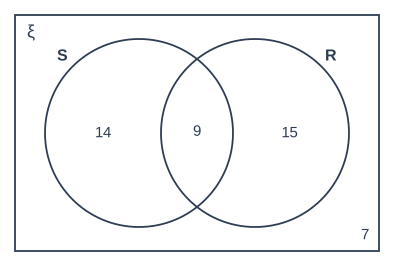
The Venn diagram shows information about 45 people at a gym who swim (S) and run (R).
One of the 45 people is chosen at random. Work out the probability that this person runs but does not swim.
Model answer
Runs but does not swim = R only = 15 people P(runs but does not swim) = \(\frac{15}{45} = \frac{1}{3}\)
Explanation
"Runs but does not swim" is the part of circle R outside circle S, the set \(R \cap S'\). Divide by the total number of people, 45, which includes the 7 people outside both circles. A common mistake is to use 15 + 9 = 24, which includes people who also swim.
Mark scheme
1 mark
M1 for \(\frac{15}{\text{a total}}\) or \(\frac{\text{a number}}{45}\)
correct answer with no working scores full marks
1 mark
A1 for \(\frac{15}{45}\) oe
accept \(\frac{1}{3}\) or 0.333...
Question 2
3 marks
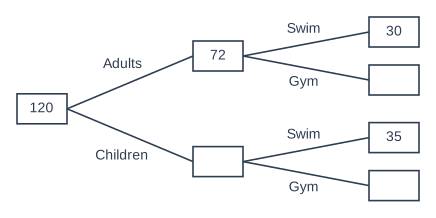
120 people visited a leisure centre one morning. Each person either went swimming or used the gym. The frequency tree shows some information about these people.
One of the children is chosen at random. Work out the probability that this child used the gym.
Model answer
Number of children = 120 − 72 = 48 Children who used the gym = 48 − 35 = 13 P(child used the gym) = \(\frac{13}{48}\)
Explanation
In a frequency tree, the numbers at the end of each pair of branches add up to the number they split from, which lets you fill in the empty boxes. The child is chosen from the 48 children only, so the denominator is 48, not 120.
Mark scheme
1 mark
M1 for 120 − 72 (= 48) children
correct answer with no working scores full marks
1 mark
M1 for their 48 − 35 (= 13) children who used the gym
1 mark
A1 for \(\frac{13}{48}\) oe
accept 0.27 or better (0.2708...)
Question 3
3 marks
ξ = {whole numbers from 1 to 30} A = {prime numbers} B = {odd numbers} C = {multiples of 3}
A number is chosen at random from \(\xi\). Work out the probability that the number is in \(A' \cap B \cap C\).
Model answer
\(A' \cap B \cap C\) = numbers that are not prime, odd, and a multiple of 3. Odd multiples of 3 up to 30: 3, 9, 15, 21, 27 3 is prime, so remove it: \(A' \cap B \cap C = \{9, 15, 21, 27\}\) P = \(\frac{4}{30} = \frac{2}{15}\)
Explanation
Read the set notation one part at a time: B ∩ C is the odd multiples of 3, and A′ removes the primes. Listing systematically from 1 to 30 makes it easy to check each number. The probability is out of all 30 equally likely numbers in \(\xi\).
Mark scheme
1 mark
M1 for listing the odd multiples of 3: 3, 9, 15, 21, 27, or the members of B ∩ C
correct answer with no working scores full marks
1 mark
M1 for removing the prime 3 to give \(\{9, 15, 21, 27\}\)
1 mark
A1 for \(\frac{4}{30}\) oe
accept \(\frac{2}{15}\) or 0.133...
Question 4
5 marks
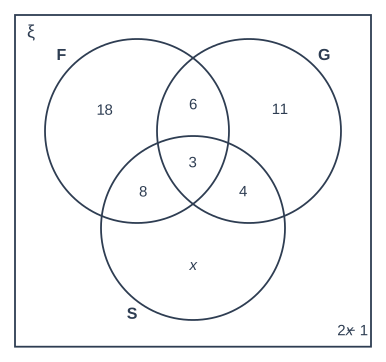
The Venn diagram shows information about the languages studied by 100 students. F = {students who study French} G = {students who study German} S = {students who study Spanish}
A student who studies Spanish is chosen at random. Work out the probability that this student studies Spanish only.
Model answer
All the regions add up to 100: 18 + 11 + x + 6 + 8 + 4 + 3 + (2x − 1) = 100 3x + 49 = 100 3x = 51 x = 17 Students who study Spanish: n(S) = 17 + 8 + 4 + 3 = 32 P(Spanish only, given Spanish) = \(\frac{17}{32}\)
Explanation
First use the total of 100 to form and solve an equation for x. The student is chosen from the Spanish students only, so the denominator is everything inside circle S (32), and the numerator is the "S only" region. A common mistake is to divide by 100.
Mark scheme
1 mark
P1 for 18 + 11 + 6 + 8 + 4 + 3 (= 50) or an equation with all eight regions, e.g. 50 + x + 2x − 1 = 100
oe; correct answer with no working scores full marks
1 mark
P1 for 3x + 49 = 100 or 3x = 51
oe
1 mark
A1 for x = 17
cao
1 mark
P1 for n(S) = 17 + 8 + 4 + 3 (= 32)
ft their x
1 mark
A1 for \(\frac{17}{32}\) oe
accept 0.53 or better (0.53125)
Ready to try the rest? Every answer you write is marked against the mark scheme, so you can see exactly where the marks are.
Ctrl + Enter to check
AI TutorHints first, answers after you try
Hi! Stuck? Ask me for a hint and I’ll help you work it out. Once you’ve checked your answer I can explain exactly where the marks are.