Practise 28 exam-style questions on Transformations for Edexcel GCSE Maths (Calculator). Write your answer as you would in the exam and get it marked in seconds against the mark scheme, point by point, with an AI tutor on hand if you get stuck.
28 questions
1–5 marks each
Instant marking
No sign-up needed
20 questions, marked as you go
Sample questions with model answers
Here are 4 of the questions in this topic, each with a model answer, an explanation of why it earns the marks and the mark scheme an examiner would use.
Question 1
2 marks
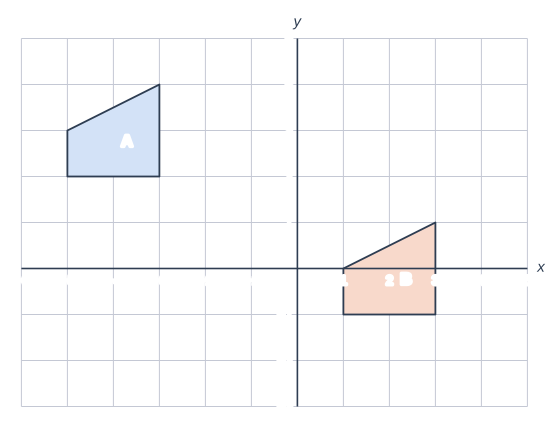
The diagram shows two shapes, A and B, on a grid.
Describe fully the single transformation that maps shape A onto shape B.
Model answer
Translation by the vector \(\begin{pmatrix}6\\-3\end{pmatrix}\) (each vertex of A moves 6 squares right and 3 squares down to the matching vertex of B)
Explanation
B is the same size, shape and way round as A, so it is a translation. Pick one vertex of A, find the matching vertex of B, and count across then up/down. Write the movement as a column vector: right is positive on top, down is negative underneath.
Mark scheme
1 mark
B1 for translation
award no marks if more than one transformation is given
1 mark
B1 for the vector \(\begin{pmatrix}6\\-3\end{pmatrix}\)
accept a description such as "6 right and 3 down"
Question 2
3 marks
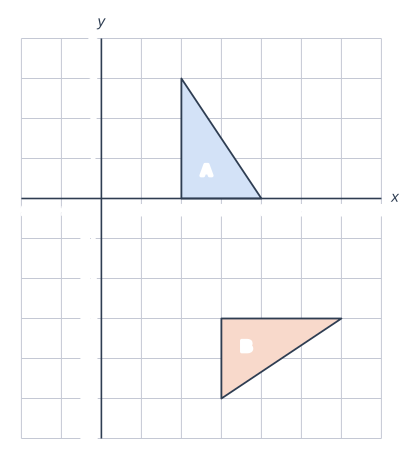
On the grid below, triangle B is the image of triangle A after a single transformation.
Describe fully this transformation.
Model answer
Rotation 90° clockwise about (1, −2). (Check: (2, 0) is 1 right and 2 up from (1, −2); turning this 90° clockwise gives 2 right and 1 down, which is (3, −3), a vertex of B.)
Explanation
B is the same size and shape as A but turned, so it is a rotation. Find the angle and direction by comparing a side (vertical in A, horizontal in B), then find the centre by trial with tracing paper or by checking that each vertex is the same distance from the centre as its image.
Mark scheme
1 mark
B1 for rotation
award no marks if more than one transformation is given
1 mark
B1 for 90° clockwise
accept −90° or 270° anticlockwise
1 mark
B1 for centre (1, −2)
Question 3
3 marks
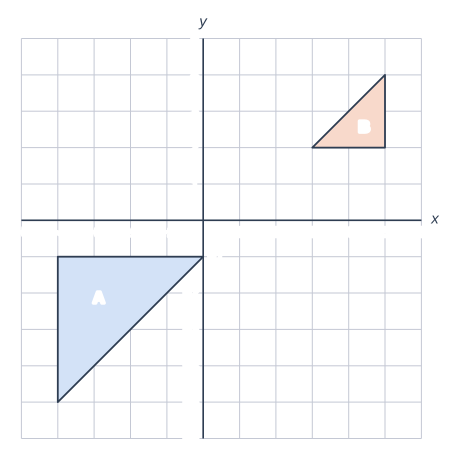
Look at the triangles A and B on the grid below.
Give a full description of the single transformation that maps triangle A onto triangle B.
Model answer
Enlargement, scale factor \(-\frac{1}{2}\), centre (2, 1). (B is half the size of A and upside down on the other side of the centre. Lines through matching vertices, e.g. (−4, −1) and (5, 2), cross at (2, 1).)
Explanation
B is smaller (so the size of the scale factor is less than 1) and upside down on the other side of the centre (so it is negative). Check with vectors: from (2, 1) to (−4, −1) is \(\begin{pmatrix}-6\\-2\end{pmatrix}\), and \(-\frac{1}{2}\) times this is \(\begin{pmatrix}3\\1\end{pmatrix}\), which reaches (5, 2).
Mark scheme
1 mark
B1 for enlargement
award no marks if more than one transformation is given; correct answer with no working scores full marks
1 mark
B1 for scale factor \(-\frac{1}{2}\)
accept −0.5; do not accept ½ or −2
1 mark
B1 for centre (2, 1)
accept the centre written as a column vector
Question 4
5 marks
A photograph is 12 cm wide and 8 cm high. The photograph is enlarged so that it fits inside a frame 30 cm wide and 25 cm high. The enlarged photograph must be as large as possible, and it must be an enlargement of the original.
What area of the frame is not covered by the enlarged photograph?
Model answer
To fill the width: 30 ÷ 12 = 2.5. To fill the height: 25 ÷ 8 = 3.125. The scale factor cannot be more than 2.5, or the photograph would be too wide. Enlarged photograph: 12 × 2.5 = 30 cm by 8 × 2.5 = 20 cm, so area = 600 cm². Frame area = 30 × 25 = 750 cm². Area not covered = 750 − 600 = 150 cm²
Explanation
An enlargement multiplies the width and height by the same scale factor, so you cannot stretch each to fill the frame. The largest possible scale factor is the smaller of the two ratios, otherwise one side would not fit.
Mark scheme
1 mark
P1 for 30 ÷ 12 = 2.5 and 25 ÷ 8 = 3.125
correct answer with no working scores full marks
1 mark
P1 for choosing the smaller scale factor, 2.5
1 mark
P1 for the size of the enlarged photograph, 30 cm by 20 cm
1 mark
P1 for the area of the frame minus the area of the photograph, e.g. 750 − 600
1 mark
A1 for 150 cm²
cao
Ready to try the rest? Every answer you write is marked against the mark scheme, so you can see exactly where the marks are.
Ctrl + Enter to check
AI TutorHints first, answers after you try
Hi! Stuck? Ask me for a hint and I’ll help you work it out. Once you’ve checked your answer I can explain exactly where the marks are.