
Level:
Correct: 0
Incorrect: 0
Marks: 0/0
Exam Practice
Subject:
Topics:
Edexcel GCSE Maths (Calculator) Smart practice A mixed round aimed at your weak spots
Unit 1
Number
Unit 2
Algebra
Unit 3
Ratio, proportion and rates of change
Unit 4
Geometry and measures
Unit 5
Probability
Unit 6
Statistics
Avg
score:
–
Topics
done:
0/97

Scale drawings and bearings

Practise 28 exam-style questions on Scale drawings and bearings for Edexcel GCSE Maths (Calculator). Write your answer as you would in the exam and get it marked in seconds against the mark scheme, point by point, with an AI tutor on hand if you get stuck.

  • 28 questions
  • 1–5 marks each
  • Instant marking
  • No sign-up needed
20 questions, marked as you go

Sample questions with model answers

Here are 4 of the questions in this topic, each with a model answer, an explanation of why it earns the marks and the mark scheme an examiner would use.

Question 1

2 marks

A map has a scale of 1 : 60 000.
On the map, the distance between two villages is 13.7 cm.

Work out the real distance between the two villages.
Give your answer in kilometres.

Model answer

Real distance \(= 13.7 \times 60\,000 = 822\,000\) cm
\(822\,000 \div 100\,000 = 8.22\)
8.22 km

Explanation

A scale of 1 : 60 000 means every 1 cm on the map is 60 000 cm in real life. Multiply, then change cm into km by dividing by 100 000 (100 cm in a metre and 1000 m in a kilometre).

Mark scheme
  1. 1 mark

    M1 for \(13.7 \times 60\,000\) (= 822 000 cm)

    oe, e.g. 1 cm represents 0.6 km, so 13.7 × 0.6

  2. 1 mark

    A1 for 8.22 km

    cao; correct answer with no working scores full marks
Question 2

3 marks

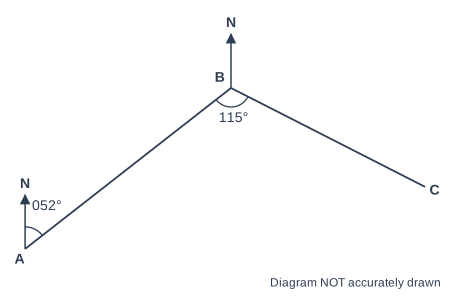
The diagram shows the positions of three points, A, B and C.

The bearing of B from A is 052°.
Angle ABC = 115°

Work out the bearing of C from B.

Geometry diagram, marked "Diagram NOT accurately drawn". Line segments AB and BC are drawn. A north line (an arrow pointing straight up, labelled N) is drawn at A. At A, the angle measured clockwise from north round to AB is marked 052° (the bearing of B from A). A north line (an arrow pointing straight up, labelled N) is drawn at B. Angle ABC is marked 115°.

Model answer

The north lines at A and B are parallel.
The bearing of A from B is \(52^\circ + 180^\circ = 232^\circ\).
C is 115° anticlockwise from BA, so the bearing of C from B is
\(232^\circ - 115^\circ = 117^\circ\)

Explanation

North lines are parallel, so you can use angle facts: the bearing of A from B is the back bearing 052° + 180° = 232°. Angle ABC is then measured from BA round to BC, which takes you back towards north, so subtract 115°. Always check with the diagram that your bearing points in the right direction (C is south-east of B, so the bearing is between 090° and 180°).

Mark scheme
  1. 1 mark

    M1 for the bearing of A from B = 232° (or 180 + 52), or the angle between north at B and BA = 128° (co-interior angles, 180 − 52)

  2. 1 mark

    M1 for \(232 - 115\) or \(360 - 128 - 115\)

    oe

  3. 1 mark

    A1 for 117°

    cao; correct answer with no working scores full marks
Question 3

3 marks

A scale drawing of a wheelchair ramp uses a scale of 1 : 25.
On the scale drawing, the ramp is a right-angled triangle.
The horizontal length is 18.4 cm and the vertical height is 1.6 cm.

Work out the real vertical height of the ramp, in cm, and the angle that the ramp makes with the horizontal.
Give the angle correct to 1 decimal place.

Model answer

Real height \(= 1.6 \times 25 = 40\) cm
Angles are the same on a scale drawing as in real life.
\(\tan x = \dfrac{1.6}{18.4}\)
\(x = \tan^{-1}(0.08695...) = 4.969...^\circ\)
Height 40 cm, angle 5.0° (1 d.p.)

Explanation

Lengths are multiplied by 25, but angles do not change on a scale drawing, so the angle can be worked out from the drawing's lengths (or the real ones - the ratio 1.6 : 18.4 is the same as 40 : 460). The height is opposite the angle and the horizontal length is adjacent, so use tan. Multiplying the angle by 25 is a common misunderstanding.

Mark scheme
  1. 1 mark

    B1 for 40 cm

    cao

  2. 1 mark

    M1 for \(\tan^{-1}\left(\dfrac{1.6}{18.4}\right)\) or \(\tan^{-1}\left(\dfrac{40}{460}\right)\)

    oe, e.g. using the hypotenuse with sin or cos

  3. 1 mark

    A1 for 5.0°

    awrt 5.0 (4.969...); accept 4.97; correct answer with no working scores full marks

Question 4

5 marks

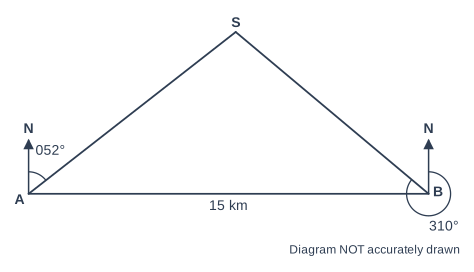
The diagram shows two coastguard stations, A and B, and a ship, S.
B is 15 km due east of A.
The bearing of S from A is 052°.
The bearing of S from B is 310°.

Work out the distance AS.
Give your answer correct to 3 significant figures.

Geometry diagram, marked "Diagram NOT accurately drawn". Triangle ABS. A north line (an arrow pointing straight up, labelled N) is drawn at A. At A, the angle measured clockwise from north round to AS is marked 052° (the bearing of S from A). A north line (an arrow pointing straight up, labelled N) is drawn at B. At B, the angle measured clockwise from north round to BS is marked 310° (the bearing of S from B). Side AB is labelled 15 km.

Model answer

Angle SAB \(= 90^\circ - 52^\circ = 38^\circ\) (AB points due east)
Angle SBA \(= 310^\circ - 270^\circ = 40^\circ\) (BA points due west, a bearing of 270°)
Angle ASB \(= 180^\circ - 38^\circ - 40^\circ = 102^\circ\)
\(\dfrac{AS}{\sin 40^\circ} = \dfrac{15}{\sin 102^\circ}\)
\(AS = \dfrac{15 \sin 40^\circ}{\sin 102^\circ} = 9.857...\)
AS = 9.86 km (3 s.f.)

Explanation

Turn the bearings into angles inside the triangle: east is 090° and west is 270°, so the angles at A and B are 38° and 40°. You then know a side and the angle opposite it (AB = 15 km opposite 102°), so the sine rule gives AS, which is opposite the 40° angle. Pairing AS with sin 38° is the common error.

Mark scheme
  1. 1 mark

    P1 for angle SAB = 38° (90 − 52)

  2. 1 mark

    P1 for angle SBA = 40° (310 − 270)

  3. 1 mark

    P1 for angle ASB = 102° (180 − 38 − 40)

    ft their angles

  4. 1 mark

    M1 for \(\dfrac{AS}{\sin 40^\circ} = \dfrac{15}{\sin 102^\circ}\) oe

    ft their angles

  5. 1 mark

    A1 for 9.86 km

    awrt 9.86 (9.857...); correct answer with no working scores full marks

Ready to try the rest? Every answer you write is marked against the mark scheme, so you can see exactly where the marks are.

AI Tutor Hints first, answers after you try

Hi! Stuck? Ask me for a hint and I’ll help you work it out. Once you’ve checked your answer I can explain exactly where the marks are.