
Level:
Correct: 0
Incorrect: 0
Marks: 0/0
Exam Practice
Subject:
Topics:
Edexcel GCSE Maths (Calculator) Smart practice A mixed round aimed at your weak spots
Unit 1
Number
Unit 2
Algebra
Unit 3
Ratio, proportion and rates of change
Unit 4
Geometry and measures
Unit 5
Probability
Unit 6
Statistics
Avg
score:
–
Topics
done:
0/97

Expected outcomes

Practise 18 exam-style questions on Expected outcomes for Edexcel GCSE Maths (Calculator). Write your answer as you would in the exam and get it marked in seconds against the mark scheme, point by point, with an AI tutor on hand if you get stuck.

  • 18 questions
  • 1–5 marks each
  • Instant marking
  • No sign-up needed
18 questions, marked as you go

Sample questions with model answers

Here are 4 of the questions in this topic, each with a model answer, an explanation of why it earns the marks and the mark scheme an examiner would use.

Question 1

2 marks

The probability that a tomato seed germinates is 0.86.
Ruby plants 450 of these seeds.

Work out an estimate for the number of seeds that germinate.

Model answer

Estimate = 0.86 × 450 = 387 seeds

Explanation

The expected number of times an event happens is its probability multiplied by the number of trials. Here each seed is one trial, so multiply 0.86 by 450. A common mistake is to divide by the probability instead of multiplying.

Mark scheme
  1. 1 mark

    M1 for 0.86 × 450

    oe

  2. 1 mark

    A1 for 387

    cao; correct answer with no working scores full marks
Question 2

3 marks

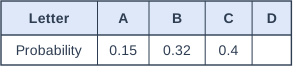
The table shows information about the probability that a biased four-sided spinner lands on each of the letters A, B, C and D.
The probability for D is missing from the table.

The spinner is spun 400 times.

Work out an estimate for how many more times the spinner will land on B than on D.

Table with columns "Letter", "A", "B", "C", "D". Letter: Probability; A: 0.15; B: 0.32; C: 0.4; D: .

Model answer

P(D) = 1 − (0.15 + 0.32 + 0.4) = 1 − 0.87 = 0.13
Expected number of Bs = 0.32 × 400 = 128
Expected number of Ds = 0.13 × 400 = 52
128 − 52 = 76 more times

Explanation

The four outcomes are mutually exclusive and cover every possibility, so their probabilities add up to 1 - this gives P(D). Each expected number is probability × 400. You can also find the difference of the probabilities first: (0.32 − 0.13) × 400 = 76.

Mark scheme
  1. 1 mark

    M1 for 1 − (0.15 + 0.32 + 0.4) or for P(D) = 0.13

    oe; correct answer with no working scores full marks

  2. 1 mark

    M1 for 0.32 × 400 (= 128) and 0.13 × 400 (= 52), or for (0.32 − their 0.13) × 400

    ft their P(D) if 0 < P(D) < 1

  3. 1 mark

    A1 for 76

    cao

Question 3

4 marks

At a school fair, there is a game with a fair spinner.
The spinner has 8 equal sections.
1 section is labelled £5, 2 sections are labelled £1 and the other 5 sections are labelled £0.

It costs £1.20 to play the game once.
A player spins the spinner once and wins the amount of money shown on the section it lands on.

150 people each play the game once.
Work out an estimate for the profit the school makes.

Model answer

Expected number of £5 wins = \(\frac{1}{8} \times 150 = 18.75\)
Expected number of £1 wins = \(\frac{2}{8} \times 150 = 37.5\)
Expected prize money = 18.75 × £5 + 37.5 × £1 = £93.75 + £37.50 = £131.25
Money taken = 150 × £1.20 = £180
Estimated profit = £180 − £131.25 = £48.75

Explanation

Use the probabilities to estimate how many times each prize is won, and so the total prize money; the profit is the money taken minus the prize money paid out. Expected numbers such as 18.75 are fine in the working because they are averages. Equivalently, the expected prize per game is £0.875, so the school expects to make £0.325 per game.

Mark scheme
  1. 1 mark

    P1 for P(£5) = \(\frac{1}{8}\) and P(£1) = \(\frac{2}{8}\) used, e.g. \(\frac{1}{8} \times 150\) (= 18.75) or \(\frac{2}{8} \times 150\) (= 37.5)

    oe

  2. 1 mark

    P1 for the expected prize money, e.g. 18.75 × 5 + 37.5 × 1 (= 131.25), or \(\frac{1}{8} \times 5 + \frac{2}{8} \times 1\) (= 0.875 per game)

    oe

  3. 1 mark

    P1 for 150 × 1.20 (= 180) − their 131.25, or (1.20 − their 0.875) × 150

    ft their prize money

  4. 1 mark

    A1 for £48.75

    accept £48.75 or £49 if 48.75 seen; correct answer with no working scores full marks

Question 4

5 marks

An insurance company sells 8600 phone insurance policies for one year.
For each policy, the probability that a claim is made during the year is 0.035.
The mean cost of a claim to the company is £2400.

The company wants to make a profit of £100 000 from these policies.
All the policies cost the same amount.

Work out how much the company should charge for each policy.
Give your answer to the nearest penny.

Model answer

Expected number of claims = 0.035 × 8600 = 301
Expected cost of claims = 301 × £2400 = £722 400
Money needed = £722 400 + £100 000 = £822 400
Charge per policy = £822 400 ÷ 8600 = £95.627...
= £95.63 (to the nearest penny)

Explanation

Use the probability to estimate how many claims will be made, then the total cost of those claims. The income from the policies must cover the claims and the profit, so divide that total by the number of policies. A common mistake is to forget to add the profit, or to divide only the profit by 8600.

Mark scheme
  1. 1 mark

    P1 for 0.035 × 8600 (= 301) expected claims

    oe

  2. 1 mark

    P1 for their 301 × 2400 (= 722 400)

    or 0.035 × 2400 (= 84) expected cost per policy

  3. 1 mark

    P1 for their 722 400 + 100 000 (= 822 400)

    or 100 000 ÷ 8600 (= 11.627...) added to their 84

  4. 1 mark

    P1 for their 822 400 ÷ 8600

    ft their total

  5. 1 mark

    A1 for £95.63

    cao (95.627...); correct answer with no working scores full marks

Ready to try the rest? Every answer you write is marked against the mark scheme, so you can see exactly where the marks are.

AI Tutor Hints first, answers after you try

Hi! Stuck? Ask me for a hint and I’ll help you work it out. Once you’ve checked your answer I can explain exactly where the marks are.