Practise 28 exam-style questions on Gradients and intercepts for Edexcel GCSE Maths (Calculator). Write your answer as you would in the exam and get it marked in seconds against the mark scheme, point by point, with an AI tutor on hand if you get stuck.
28 questions
1–5 marks each
Instant marking
No sign-up needed
20 questions, marked as you go
Sample questions with model answers
Here are 4 of the questions in this topic, each with a model answer, an explanation of why it earns the marks and the mark scheme an examiner would use.
Question 1
2 marks
A plumber works out the cost of a job using the formula \[C = 45n + 60\] where \(C\) is the cost in pounds and \(n\) is the number of hours the job takes.
Explain what the 45 and the 60 represent.
Model answer
45 is the gradient: the cost goes up by £45 for every extra hour, so the plumber charges £45 per hour. 60 is the intercept: the cost when \(n = 0\), so it is a fixed (call-out) charge of £60.
Explanation
In a linear formula like \(y = mx + c\), the gradient is the rate of change - here pounds per hour - and the intercept is the starting value when the input is 0. Saying '45 is the gradient' without explaining it in context does not earn the mark.
Mark scheme
1 mark
C1 for 45 is the cost per hour (the plumber charges £45 for each hour)
oe; must refer to hours
1 mark
C1 for 60 is a fixed charge (£60 call-out charge, paid however long the job takes)
oe, e.g. the cost when \(n = 0\)
Question 2
3 marks
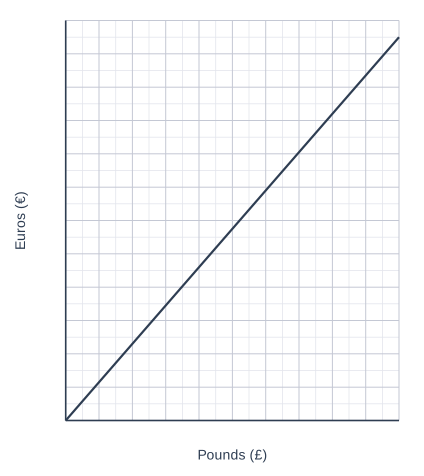
Here is a graph for converting between pounds (£) and euros (€).
Work out the gradient of the line, and explain what it represents.
Model answer
The line passes through \((0, 0)\) and \((100, 115)\) Gradient \(= \dfrac{115 - 0}{100 - 0} = 1.15\) The gradient is the number of euros you get for each pound: £1 = €1.15
Explanation
The gradient is the change in euros divided by the change in pounds, so its units are euros per pound - the exchange rate. Use points far apart on the line, such as \((0, 0)\) and \((100, 115)\), for an accurate value. The line goes through the origin because £0 is worth €0.
Mark scheme
1 mark
M1 for a correct method for the gradient using two points on the line, e.g. \(\dfrac{115}{100}\)
allow readings within half a small square
1 mark
A1 for 1.15
accept 1.14 to 1.16
1 mark
C1 for the number of euros for each pound (the exchange rate: £1 = €1.15)
oe; must be in context
Question 3
3 marks
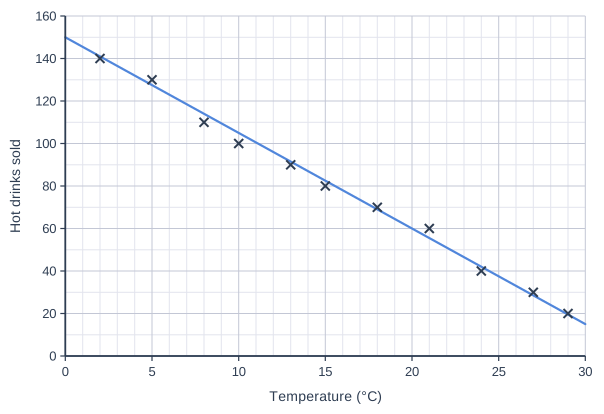
A café records the temperature at noon and the number of hot drinks sold on each of 11 days. The scatter graph shows this information, with a line of best fit.
Work out the gradient of the line of best fit, and explain what it tells you.
Model answer
The line passes through \((0, 150)\) and \((20, 60)\) Gradient \(= \dfrac{60 - 150}{20 - 0} = \dfrac{-90}{20} = -4.5\) For every 1 °C increase in temperature, the café sells about 4.5 fewer hot drinks.
Explanation
The gradient is the change in drinks sold per degree, so it is a rate in context. It is negative because fewer hot drinks are sold on warmer days (negative correlation). Use points on the line of best fit, far apart, rather than individual crosses.
Mark scheme
1 mark
M1 for a correct method for the gradient using two points on the line, e.g. \(\dfrac{60 - 150}{20 - 0}\)
points read from the line, not the crosses
1 mark
A1 for −4.5
accept −4 to −5
1 mark
C1 for each 1 °C rise in temperature means about 4.5 fewer hot drinks are sold
oe; ft their gradient; must be in context
Question 4
4 marks
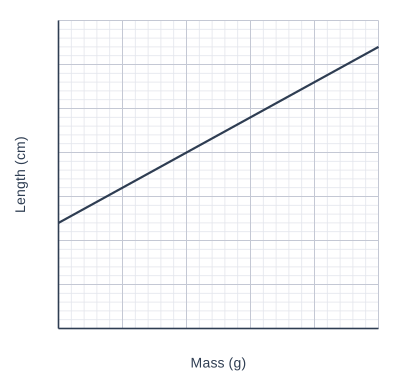
The graph shows how the length of a spring changes when different masses hang from it.
The spring will break if its length reaches 40 cm. Assuming the graph continues as a straight line, work out the mass that will make the spring break.
Model answer
The line passes through \((0, 12)\) and \((500, 32)\) Gradient \(= \dfrac{32 - 12}{500} = \dfrac{20}{500} = 0.04\) cm per gram Length \(L = 0.04m + 12\) \(0.04m + 12 = 40\) \(0.04m = 28\) \(m = 700\) The spring breaks with a mass of 700 g.
Explanation
The intercept, 12 cm, is the natural length of the spring with no mass, and the gradient is the extension per gram. The spring must stretch \(40 - 12 = 28\) cm, which takes \(28 \div 0.04 = 700\) g. A common mistake is to divide 40 by 0.04, forgetting the starting length.
Mark scheme
1 mark
M1 for a correct method for the gradient, e.g. \(\dfrac{32 - 12}{500 - 0}\)
allow readings within half a small square; correct answer with no working scores full marks
1 mark
A1 for 0.04 (cm per gram) or \(L = 0.04m + 12\)
oe (exact)
1 mark
M1 for \((40 - 12) \div 0.04\) or solving \(0.04m + 12 = 40\)
ft their gradient and intercept
1 mark
A1 for 700 g
cao
Ready to try the rest? Every answer you write is marked against the mark scheme, so you can see exactly where the marks are.
Ctrl + Enter to check
AI TutorHints first, answers after you try
Hi! Stuck? Ask me for a hint and I’ll help you work it out. Once you’ve checked your answer I can explain exactly where the marks are.