
Level:
Correct: 0
Incorrect: 0
Marks: 0/0
Exam Practice
Subject:
Topics:
Edexcel GCSE Maths (Calculator) Smart practice A mixed round aimed at your weak spots
Unit 1
Number
Unit 2
Algebra
Unit 3
Ratio, proportion and rates of change
Unit 4
Geometry and measures
Unit 5
Probability
Unit 6
Statistics
Avg
score:
–
Topics
done:
0/97

Converting standard and compound units

Practise 30 exam-style questions on Converting standard and compound units for Edexcel GCSE Maths (Calculator). Write your answer as you would in the exam and get it marked in seconds against the mark scheme, point by point, with an AI tutor on hand if you get stuck.

  • 30 questions
  • 1–5 marks each
  • Instant marking
  • No sign-up needed
20 questions, marked as you go

Sample questions with model answers

Here are 4 of the questions in this topic, each with a model answer, an explanation of why it earns the marks and the mark scheme an examiner would use.

Question 1

2 marks

A car is travelling at 30 metres per second.

Change 30 metres per second into kilometres per hour.

Model answer

In 1 hour: \(30 \times 3600 = 108\,000\) m
\(108\,000 \div 1000 = 108\)
30 m/s = 108 km/h

Explanation

Change the time first: there are 3600 seconds in an hour, so the car travels \(30 \times 3600\) metres in an hour. Then change metres to kilometres by dividing by 1000. Overall, multiplying m/s by 3.6 gives km/h.

Mark scheme
  1. 1 mark

    M1 for a correct method, e.g. \(30 \times 3600 \div 1000\) or \(30 \times 60 \times 60 = 108\,000\) (m per hour)

  2. 1 mark

    A1 for 108 km/h

    cao; correct answer with no working scores full marks
Question 2

3 marks

The density of mercury is 13 600 kg/m³.

Work out the mass, in kg, of 250 ml of mercury.

Model answer

250 ml = 250 cm³
1 m³ = 1 000 000 cm³, so 250 cm³ = \(250 \div 1\,000\,000 = 0.00025\) m³
Mass = density × volume = \(13\,600 \times 0.00025 = 3.4\) kg

Explanation

The density and the volume must use the same volume unit before you multiply. Either change 250 ml (= 250 cm³) into m³, or change the density into g/cm³ (13.6 g/cm³, giving 3400 g). A common mistake is to multiply 13 600 by 250.

Mark scheme
  1. 1 mark

    M1 for converting the density to 13.6 g/cm³, or the volume to 0.00025 m³

    1 ml = 1 cm³; correct answer with no working scores full marks

  2. 1 mark

    M1 for mass = density × volume with consistent units, e.g. \(13.6 \times 250\) or \(13\,600 \times 0.00025\)

  3. 1 mark

    A1 for 3.4 kg

    cao

Question 3

3 marks

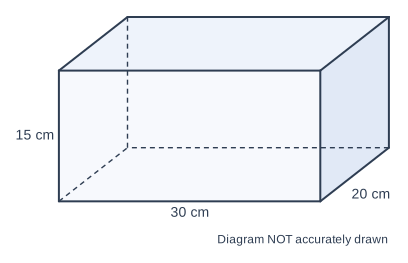
The diagram shows a solid concrete block in the shape of a cuboid.

The density of concrete is 2400 kg/m³.

Work out the mass of the block in kg.

A cuboid drawn in 3D with hidden edges shown as dashed lines. The length is labelled 30 cm (along the front bottom edge). The width (the edge going back) is labelled 20 cm (along the bottom edge going back on the right). The height is labelled 15 cm (along the front left vertical edge). The diagram is labelled "Diagram NOT accurately drawn".

Model answer

Volume = 0.3 m × 0.2 m × 0.15 m = 0.009 m³
(or \(30 \times 20 \times 15 = 9000\) cm³ = \(9000 \div 1\,000\,000 = 0.009\) m³)
Mass = density × volume = \(2400 \times 0.009 = 21.6\) kg

Explanation

The density is in kg per m³, so the volume must be in m³: change each length to metres before multiplying, or divide the volume in cm³ by 1 000 000. Multiplying 9000 by 2400 gives a mass of 21 600 000 kg, which is clearly far too big for a block.

Mark scheme
  1. 1 mark

    M1 for \(30 \times 20 \times 15\) (= 9000 cm³) or \(0.3 \times 0.2 \times 0.15\)

    correct answer with no working scores full marks

  2. 1 mark

    M1 for converting to 0.009 m³ and multiplying by 2400, or for 2.4 g/cm³ \(\times\) 9000

  3. 1 mark

    A1 for 21.6 kg

    cao

Question 4

5 marks

A tap drips once every 1.5 seconds.
Each drip is 0.06 ml of water.
The tap drips all day, every day, for one year of 365 days.

Water costs £2.05 per m³.

Work out the cost of the water wasted in one year.

Model answer

Seconds in a year = \(365 \times 24 \times 60 \times 60 = 31\,536\,000\)
Number of drips = \(31\,536\,000 \div 1.5 = 21\,024\,000\)
Volume = \(21\,024\,000 \times 0.06 = 1\,261\,440\) ml
1 m³ = 1 000 000 cm³ = 1 000 000 ml, so volume = 1.26144 m³
Cost = \(1.26144 \times 2.05 = 2.5859...\)
Cost = £2.59

Explanation

Build the answer up one unit at a time: seconds in a year, number of drips, volume in ml, then volume in m³ to match the price. 1 ml = 1 cm³ and 1 m³ = 1 000 000 cm³, so dividing by 1000 (which gives litres) is not enough.

Mark scheme
  1. 1 mark

    P1 for the number of seconds in a year, \(365 \times 24 \times 60 \times 60\) (= 31 536 000)

    correct answer with no working scores full marks

  2. 1 mark

    P1 for the number of drips (21 024 000) or the volume in ml (1 261 440)

  3. 1 mark

    P1 for converting their volume to m³, e.g. \(1\,261\,440 \div 1\,000\,000\) (= 1.26144)

    1 m³ = 1 000 000 ml

  4. 1 mark

    P1 for multiplying their volume in m³ by 2.05

  5. 1 mark

    A1 for £2.59

    accept £2.58 to £2.59 (2.5859...)

Ready to try the rest? Every answer you write is marked against the mark scheme, so you can see exactly where the marks are.

AI Tutor Hints first, answers after you try

Hi! Stuck? Ask me for a hint and I’ll help you work it out. Once you’ve checked your answer I can explain exactly where the marks are.