Practise 18 exam-style questions on Ratios, fractions and linear functions for Edexcel GCSE Maths (Calculator). Write your answer as you would in the exam and get it marked in seconds against the mark scheme, point by point, with an AI tutor on hand if you get stuck.
18 questions
1–5 marks each
Instant marking
No sign-up needed
18 questions, marked as you go
Sample questions with model answers
Here are 4 of the questions in this topic, each with a model answer, an explanation of why it earns the marks and the mark scheme an examiner would use.
Question 1
2 marks
\(a : b = 5 : 3\)
Work out \(\dfrac{a - b}{a + b}\). Give your answer as a fraction in its simplest form.
A ratio does not tell you the actual values, only that \(a\) and \(b\) are 5 and 3 lots of the same amount, \(k\). The \(k\)s cancel, so you can simply use \(a = 5\) and \(b = 3\). The answer must be simplified: \(\frac{2}{8}\) is not in its simplest form.
Mark scheme
1 mark
M1 for using \(a = 5k, b = 3k\) (or \(a = 5, b = 3\)) to get \(\frac{2}{8}\) or \(\frac{2k}{8k}\)
oe; correct answer with no working scores full marks
1 mark
A1 for \(\frac{1}{4}\)
cao
Question 2
2 marks
A taxi company charges a fixed fee of £3.20 plus £1.85 for each mile travelled.
Zara says, "The ratio of the fare to the number of miles is the same for every journey."
Show that Zara is wrong.
Model answer
2 miles: fare = 3.20 + 2 × 1.85 = £6.90, ratio fare : miles = 6.90 : 2 = 3.45 : 1 4 miles: fare = 3.20 + 4 × 1.85 = £10.60, ratio fare : miles = 10.60 : 4 = 2.65 : 1 The ratios are different, so Zara is wrong. (The fixed fee means the fare is not proportional to the distance.)
Explanation
The fare is a linear function of the distance (\(F = 3.20 + 1.85m\)), but because of the fixed £3.20 its graph does not pass through the origin. Only a straight-line graph through the origin has the same ratio of \(y\) to \(x\) at every point. One pair of journeys with different ratios is enough to prove Zara wrong.
Mark scheme
1 mark
M1 for working out the fare for two different distances, e.g. 2 miles: £6.90 and 4 miles: £10.60
or for a correct general argument, e.g. the graph of fare against miles does not pass through the origin
1 mark
C1 for a complete explanation, e.g. 6.90 ÷ 2 = 3.45 but 10.60 ÷ 4 = 2.65, so the ratios are different
accept "doubling the miles does not double the fare" with correct figures
Question 3
3 marks
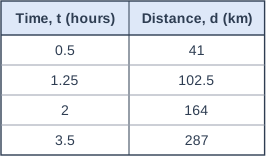
A car travels along a motorway at a constant speed. The table shows the distance, \(d\) km, travelled in time \(t\) hours.
Write a formula for \(d\) in terms of \(t\). Use your formula to work out the time it takes the car to travel 451 km.
Model answer
\(41 \div 0.5 = 82\), \(102.5 \div 1.25 = 82\), \(164 \div 2 = 82\), \(287 \div 3.5 = 82\) The ratio \(d : t\) is always 82 : 1, so \(d = 82t\) When \(d = 451\): \(451 = 82t\), \(t = 451 \div 82 = 5.5\) hours
Explanation
When d ÷ t gives the same value for every pair, the quantities are in a fixed ratio and the formula is \(d = kt\), a straight line through the origin. Here k = 82 is the speed in km/h. To find the time, rearrange to \(t = d \div 82\); note that 5.5 hours is 5 hours 30 minutes, not 5 hours 50 minutes.
Mark scheme
1 mark
M1 for \(d \div t\) = 82 for at least two pairs
oe; correct answer with no working scores full marks
1 mark
A1 for \(d = 82t\)
1 mark
B1 for 5.5 hours
accept 5 hours 30 minutes; ft their formula of the form \(d = kt\)
Question 4
4 marks
A is the point (2, 3) and B is the point (14, 12). C is the point on the line AB extended beyond B such that AB : BC = 3 : 1.
Find the coordinates of C. Find an equation of the line through A, B and C.
Model answer
From A to B: x increases by 12, y increases by 9. BC is \(\frac{1}{3}\) of AB: x increases by 4, y increases by 3. C = (14 + 4, 12 + 3) = (18, 15) Gradient = \(\frac{9}{12}\) = 0.75 \(y - 3 = 0.75(x - 2)\) \(y = 0.75x + 1.5\) Check with C: 0.75 × 18 + 1.5 = 15 ✓
Explanation
AB : BC = 3 : 1 means BC is one third as long as AB and goes in the same direction, so add one third of the change from A to B on to B. The gradient of the line is the ratio of the change in y to the change in x, \(\frac{9}{12}\), which is the same between any two of the points.
Mark scheme
1 mark
M1 for the change from A to B as (12, 9), or BC = \(\frac{1}{3}\) of AB = (4, 3)
oe; correct answer with no working scores full marks
1 mark
A1 for C = (18, 15)
cao
1 mark
M1 for gradient \(\frac{12 - 3}{14 - 2}\) (= 0.75)
oe
1 mark
A1 for \(y = 0.75x + 1.5\)
oe; accept \(4y = 3x + 6\)
Ready to try the rest? Every answer you write is marked against the mark scheme, so you can see exactly where the marks are.
Ctrl + Enter to check
AI TutorHints first, answers after you try
Hi! Stuck? Ask me for a hint and I’ll help you work it out. Once you’ve checked your answer I can explain exactly where the marks are.