
Level:
Correct: 0
Incorrect: 0
Marks: 0/0
Exam Practice
Subject:
Topics:
Edexcel GCSE Maths (Calculator) Smart practice A mixed round aimed at your weak spots
Unit 1
Number
Unit 2
Algebra
Unit 3
Ratio, proportion and rates of change
Unit 4
Geometry and measures
Unit 5
Probability
Unit 6
Statistics
Avg
score:
–
Topics
done:
0/97

Conditional probability

Practise 37 exam-style questions on Conditional probability for Edexcel GCSE Maths (Calculator). Write your answer as you would in the exam and get it marked in seconds against the mark scheme, point by point, with an AI tutor on hand if you get stuck.

  • 37 questions
  • 1–5 marks each
  • Instant marking
  • No sign-up needed
20 questions, marked as you go

Sample questions with model answers

Here are 4 of the questions in this topic, each with a model answer, an explanation of why it earns the marks and the mark scheme an examiner would use.

Question 1

2 marks

The table shows information about the members of a gym.
Each member has either standard or premium membership.

A member with premium membership is chosen at random.

Work out the probability that this member is over 40 years old.
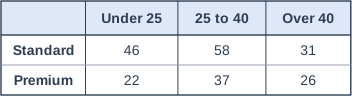
Table with columns (row headings), "Under 25", "25 to 40", "Over 40". Standard; Under 25: 46; 25 to 40: 58; Over 40: 31 | Premium; Under 25: 22; 25 to 40: 37; Over 40: 26.

Model answer

Number of premium members = 22 + 37 + 26 = 85
26 of them are over 40.
Probability = \(\dfrac{26}{85}\) (= 0.305...)

Explanation

The member is chosen from the premium members only, so the denominator is the premium total, 85. The numerator is the number of premium members who are over 40. A common mistake is to divide by all 220 members or by the 57 members over 40.

Mark scheme
  1. 1 mark

    M1 for 22 + 37 + 26 (= 85) used as the denominator

  2. 1 mark

    A1 for \(\dfrac{26}{85}\) oe

    accept awrt 0.306; correct answer with no working scores full marks
Question 2

2 marks

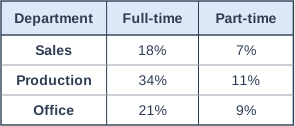
The table shows the percentages of the employees of a company who work in each department, full-time or part-time.

An employee who works part-time is chosen at random.

Work out the probability that this employee works in Production.

Table with columns "Department", "Full-time", "Part-time". Department: Sales; Full-time: 18%; Part-time: 7% | Department: Production; Full-time: 34%; Part-time: 11% | Department: Office; Full-time: 21%; Part-time: 9%.

Model answer

Percentage of employees who are part-time = 7% + 11% + 9% = 27%
Part-time in Production = 11%
Probability = \(\dfrac{11}{27}\) (= 0.407...)

Explanation

You do not need the number of employees: the percentages act like frequencies out of 100. The employee is chosen from the part-time workers, so divide 11 by the part-time total, 27. A common mistake is to give 0.11, which is the probability that a randomly chosen employee is a part-time Production worker.

Mark scheme
  1. 1 mark

    M1 for 7 + 11 + 9 (= 27) used as the denominator

    or 0.07 + 0.11 + 0.09 = 0.27

  2. 1 mark

    A1 for \(\dfrac{11}{27}\) oe

    accept awrt 0.407; correct answer with no working scores full marks

Question 3

3 marks

A bag contains 5 red counters and 7 blue counters.
Two counters are taken at random from the bag without replacement.

The two counters are different colours.

Lily says,
"The probability that the first counter taken was red is \(\dfrac{1}{2}\)."

Is Lily correct?
You must show how you get your answer.

Model answer

P(red, blue) = \(\dfrac{5}{12} \times \dfrac{7}{11} = \dfrac{35}{132}\)
P(blue, red) = \(\dfrac{7}{12} \times \dfrac{5}{11} = \dfrac{35}{132}\)
P(first red given different colours) = \(\dfrac{35}{132} \div \dfrac{70}{132} = \dfrac{1}{2}\)
Yes, Lily is correct.

Explanation

Given the colours are different, the only possible outcomes are red-blue and blue-red. Their probabilities use the same numbers multiplied in a different order, so they are equal and each is half of the total. It may be surprising that there are more blue counters, but the answer is still \(\dfrac{1}{2}\).

Mark scheme
  1. 1 mark

    M1 for P(red, blue) = \(\dfrac{5}{12} \times \dfrac{7}{11}\) (= \(\dfrac{35}{132}\)) or P(blue, red) = \(\dfrac{7}{12} \times \dfrac{5}{11}\) (= \(\dfrac{35}{132}\))

  2. 1 mark

    M1 for \(\dfrac{35}{132} \div \left(\dfrac{35}{132} + \dfrac{35}{132}\right)\) oe

  3. 1 mark

    C1 for Yes, with a correct probability of \(\dfrac{1}{2}\) shown

    accept a correct argument that P(red, blue) = P(blue, red)

Question 4

5 marks

150 people were asked whether they live in a house or a flat and whether they have a pet.

92 of the people live in a house.
The probability that a person who lives in a house has a pet is 0.75.
The probability that a person with no pet lives in a flat is \(\dfrac{2}{3}\).

One of the people who live in a flat is chosen at random.
Work out the probability that this person has a pet.

Model answer

Flat = 150 − 92 = 58
House with pet = 92 × 0.75 = 69, house with no pet = 92 − 69 = 23
People with no pet: \(\dfrac{2}{3}\) live in a flat, so the 23 in a house are the other \(\dfrac{1}{3}\).
People with no pet = 3 × 23 = 69, so flat with no pet = 69 − 23 = 46
Flat with pet = 58 − 46 = 12
P(pet given flat) = \(\dfrac{12}{58} = \dfrac{6}{29}\)

Explanation

Build a two-way table (house/flat against pet/no pet) and fill it in one step at a time. Each conditional probability applies to its own group: 0.75 to the people in houses, \(\dfrac{2}{3}\) to the people with no pet. The final answer divides by the 58 people in flats. A common mistake is to apply \(\dfrac{2}{3}\) to all 150 people.

Mark scheme
  1. 1 mark

    P1 for the number living in a flat, 150 − 92 (= 58)

    correct answer with no working scores full marks

  2. 1 mark

    P1 for house with a pet 92 × 0.75 (= 69) and house with no pet 92 − 69 (= 23)

  3. 1 mark

    P1 for a correct method to find the number in a flat with no pet, e.g. 23 is \(\dfrac{1}{3}\) of the people with no pet, so 46 in a flat with no pet

    or \(\dfrac{f}{f + 23} = \dfrac{2}{3}\) leading to f = 46

  4. 1 mark

    P1 for flat with a pet = 58 − 46 (= 12)

  5. 1 mark

    A1 for \(\dfrac{12}{58}\) oe

    accept \(\dfrac{6}{29}\) or awrt 0.207

Ready to try the rest? Every answer you write is marked against the mark scheme, so you can see exactly where the marks are.

AI Tutor Hints first, answers after you try

Hi! Stuck? Ask me for a hint and I’ll help you work it out. Once you’ve checked your answer I can explain exactly where the marks are.