Practise 28 exam-style questions on Roots and turning points of quadratics for Edexcel GCSE Maths (Calculator). Write your answer as you would in the exam and get it marked in seconds against the mark scheme, point by point, with an AI tutor on hand if you get stuck.
28 questions
1–5 marks each
Instant marking
No sign-up needed
20 questions, marked as you go
Sample questions with model answers
Here are 4 of the questions in this topic, each with a model answer, an explanation of why it earns the marks and the mark scheme an examiner would use.
Question 1
2 marks
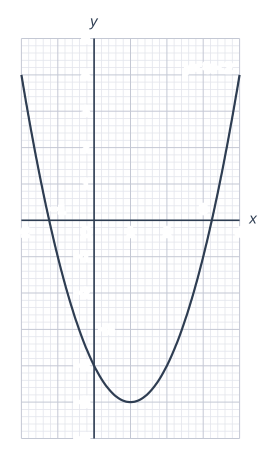
Here is the graph of \(y = x^2 - 2x - 4\)
Use the graph to find estimates for the solutions of \(x^2 - 2x - 4 = 0\)
Model answer
The solutions are where the curve crosses the x-axis (\(y = 0\)). \(x \approx -1.2\) and \(x \approx 3.2\)
Explanation
Read the x-values where the curve crosses the x-axis, using the small squares to estimate the decimals. The curve is symmetrical about \(x = 1\), so the two solutions should be the same distance either side of 1 - a useful check.
Mark scheme
1 mark
B1 for a value from −1.35 to −1.15
exact value \(1 - \sqrt{5} = -1.236...\); correct answer with no working scores full marks
1 mark
B1 for a value from 3.15 to 3.35
exact value \(1 + \sqrt{5} = 3.236...\)
Question 2
3 marks
Find the x-coordinates of the points where the curve \(y = 3x^2 - 5x - 4\) crosses the x-axis. Give your answers correct to 2 decimal places.
Model answer
The curve crosses the x-axis where \(3x^2 - 5x - 4 = 0\) \(x = \dfrac{5 \pm \sqrt{25 + 48}}{6} = \dfrac{5 \pm \sqrt{73}}{6}\) \(x = \dfrac{5 + 8.5440...}{6} = 2.2573...\) or \(x = \dfrac{5 - 8.5440...}{6} = -0.5906...\) \(x = 2.26\) or \(x = -0.59\) (2 d.p.)
Explanation
On the x-axis \(y = 0\), so solve \(3x^2 - 5x - 4 = 0\). It does not factorise, so use the quadratic formula with \(a = 3\), \(b = -5\), \(c = -4\). Careful: \(-4ac = -4 \times 3 \times (-4) = +48\), and divide the whole numerator by \(2a = 6\).
Mark scheme
1 mark
M1 for a correct substitution into the quadratic formula, e.g. \(\dfrac{5 \pm \sqrt{(-5)^2 - 4 \times 3 \times (-4)}}{2 \times 3}\)
allow one sign error in the substitution; correct answer with no working scores full marks
1 mark
M1 for \(\dfrac{5 \pm \sqrt{73}}{6}\)
oe, e.g. \(\dfrac{5 \pm 8.544...}{6}\)
1 mark
A1 for 2.26 and −0.59
awrt 2.26 and −0.59 (2.257... and −0.590...)
Question 3
3 marks
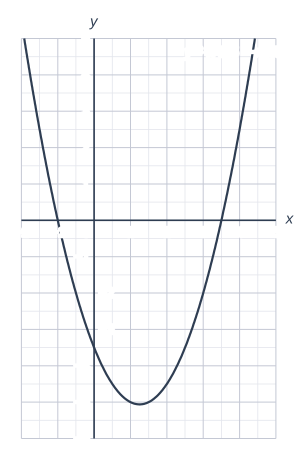
Here is the graph of \(y = x^2 - 2.5x - 3.5\)
Use the graph to write down the roots of \(x^2 - 2.5x - 3.5 = 0\) Use the symmetry of the curve to find the exact coordinates of its turning point.
Model answer
Roots: \(x = -1\) and \(x = 3.5\) The line of symmetry is halfway between the roots: \(x = \dfrac{-1 + 3.5}{2} = 1.25\) \(y = 1.25^2 - 2.5 \times 1.25 - 3.5 = 1.5625 - 3.125 - 3.5 = -5.0625\) Turning point: (1.25, −5.0625)
Explanation
A parabola is symmetrical about a vertical line through its turning point, which is halfway between the roots. The y-coordinate cannot be read exactly from the graph, so substitute \(x = 1.25\) into the equation.
Mark scheme
1 mark
B1 for roots \(x = -1\) and \(x = 3.5\)
both needed (exact values); correct answer with no working scores full marks
1 mark
M1 for the line of symmetry \(x = \dfrac{-1 + 3.5}{2} = 1.25\)
ft their roots
1 mark
A1 for (1.25, −5.0625)
cao; an estimate read from the graph such as (1.25, −5.1) scores M1 A0
Question 4
4 marks
The curve with equation \(y = x^2 + bx + c\) has a minimum point at \((3.2, -1.44)\).
Find the coordinates of the points where the curve crosses the x-axis and the y-axis.
Because the coefficient of \(x^2\) is 1, the minimum point gives the completed-square form \(y = (x - 3.2)^2 - 1.44\) directly. The roots are equally spaced either side of \(x = 3.2\). Check by expanding: \(x^2 - 6.4x + 8.8 = (x - 2)(x - 4.4)\).
Mark scheme
1 mark
M1 for \((x - 3.2)^2 - 1.44 = 0\)
oe, e.g. \(x^2 - 6.4x + 8.8 = 0\); correct answer with no working scores full marks
1 mark
A1 for (2, 0) and (4.4, 0)
cao
1 mark
M1 for substituting \(x = 0\), e.g. \((0 - 3.2)^2 - 1.44\)
or expanding to find \(c\)
1 mark
A1 for (0, 8.8)
cao
Ready to try the rest? Every answer you write is marked against the mark scheme, so you can see exactly where the marks are.
Ctrl + Enter to check
AI TutorHints first, answers after you try
Hi! Stuck? Ask me for a hint and I’ll help you work it out. Once you’ve checked your answer I can explain exactly where the marks are.