Level:
Correct: 0
Incorrect: 0
Marks: 0/0
Exam Practice
Subject:
Topics:
Edexcel GCSE Maths (Calculator) Smart practice A mixed round aimed at your weak spots
Unit 1
Number
Unit 2
Algebra
Unit 3
Ratio, proportion and rates of change
Unit 4
Geometry and measures
Unit 5
Probability
Unit 6
Statistics
Avg
score:
–
Topics
done:
0/97

Sample size and theoretical probability

Practise 18 exam-style questions on Sample size and theoretical probability for Edexcel GCSE Maths (Calculator). Write your answer as you would in the exam and get it marked in seconds against the mark scheme, point by point, with an AI tutor on hand if you get stuck.

  • 18 questions
  • 1–5 marks each
  • Instant marking
  • No sign-up needed
18 questions, marked as you go

Sample questions with model answers

Here are 4 of the questions in this topic, each with a model answer, an explanation of why it earns the marks and the mark scheme an examiner would use.

Question 1

2 marks

Jess spins a spinner 50 times. It lands on blue 18 times.
She then spins the same spinner another 150 times. It lands on blue 63 times.

Use all of Jess's results to work out the best estimate for the probability that the spinner lands on blue.

Model answer

Total number of spins = 50 + 150 = 200
Total number of blues = 18 + 63 = 81
Best estimate = \(\frac{81}{200} = 0.405\)

Explanation

The best estimate uses as many trials as possible, so combine the results: total blues over total spins. Do not average the two relative frequencies (0.36 and 0.42), because the two sets have different numbers of spins; averaging would give the 50 spins as much weight as the 150.

Mark scheme
  1. 1 mark

    M1 for \(\frac{18 + 63}{50 + 150}\)

    oe; correct answer with no working scores full marks

  2. 1 mark

    A1 for 0.405

    accept \(\frac{81}{200}\); do not accept the mean of 0.36 and 0.42 (= 0.39)
Question 2

3 marks

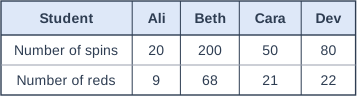
Four students each spin the same spinner.
The table shows the number of times each student spun the spinner and the number of times it landed on red.

Max says, "Beth's results are the most reliable, so the best estimate for the probability of red is Beth's relative frequency."

Is Max correct? Explain your answer, and work out the best estimate for the probability that the spinner lands on red.

Table with columns "Student", "Ali", "Beth", "Cara", "Dev". Student: Number of spins; Ali: 20; Beth: 200; Cara: 50; Dev: 80 | Student: Number of reds; Ali: 9; Beth: 68; Cara: 21; Dev: 22.

Model answer

Max is only partly right. Beth spun the spinner the most times (200), so her results are the most reliable of the four. But the best estimate uses all the results, because that gives the greatest number of trials.
Total spins = 20 + 200 + 50 + 80 = 350
Total reds = 9 + 68 + 21 + 22 = 120
Best estimate = \(\frac{120}{350}\) = 0.342857... ≈ 0.343

Explanation

The more trials, the closer the relative frequency is likely to be to the true probability. Combining all four students' results gives 350 spins, more than Beth's 200, so it is the best estimate. Add the frequencies and the numbers of spins separately - do not average the four relative frequencies.

Mark scheme
  1. 1 mark

    C1 for not correct: Beth's results are the most reliable individual results, but the best estimate combines all the results (350 spins)

    oe; accept "use all the results because more trials give a better estimate"

  2. 1 mark

    M1 for \(\frac{9 + 68 + 21 + 22}{20 + 200 + 50 + 80}\) (= \(\frac{120}{350}\))

    oe

  3. 1 mark

    A1 for 0.343

    awrt 0.343 (0.342857...); accept \(\frac{120}{350}\) or \(\frac{12}{35}\)

Question 3

4 marks

Two fair spinners each have three equal sections numbered 1, 2 and 3.
Both spinners are spun and the two numbers are added to give a total.

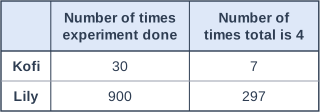
Kofi and Lily each do this experiment several times and record how many times the total is 4.
The table shows their results.

Compare Kofi's and Lily's results with the theoretical probability that the total is 4.
You must show your working.

Table with columns (row headings), "Number of times experiment done", "Number of times total is 4". Kofi; Number of times experiment done: 30; Number of times total is 4: 7 | Lily; Number of times experiment done: 900; Number of times total is 4: 297.

Model answer

Sample space (spinner 1, spinner 2): there are 3 × 3 = 9 equally likely outcomes.
Total 4: (1, 3), (2, 2), (3, 1), so P(total 4) = \(\frac{3}{9} = \frac{1}{3}\) = 0.333...
Kofi: \(\frac{7}{30}\) = 0.233...
Lily: \(\frac{297}{900}\) = 0.33
Lily's relative frequency is very close to the theoretical probability, but Kofi's is quite far from it. This is because Lily did 900 trials and Kofi only 30: the more trials, the closer the relative frequency tends to be to the theoretical probability.

Explanation

List the 9 equally likely outcomes in a sample space to get the theoretical probability 1/3. Then compare each relative frequency with it. Kofi's spinners are not unfair - with only 30 trials, chance variation is large; Lily's 900 trials give a result close to 1/3.

Mark scheme
  1. 1 mark

    B1 for the theoretical probability \(\frac{3}{9}\) (= \(\frac{1}{3}\)), from a correct sample space or list of 9 outcomes

    the totals of 4 are (1, 3), (2, 2), (3, 1)

  2. 1 mark

    M1 for \(\frac{7}{30}\) (= 0.233...) and \(\frac{297}{900}\) (= 0.33)

    oe

  3. 1 mark

    C1 for Lily's relative frequency is very close to \(\frac{1}{3}\) but Kofi's is not

    ft their theoretical probability

  4. 1 mark

    C1 for explaining that Lily did many more trials, so her relative frequency is closer to the theoretical probability

    oe

Question 4

5 marks

Leon spins a biased spinner n times. The relative frequency of red is 0.35.
He then spins the spinner 40 more times. It lands on red 18 times in these 40 spins.
The relative frequency of red for all of his spins is now 0.36.

Work out the value of n.

Model answer

Number of reds in the first n spins = 0.35n
After 40 more spins: relative frequency = \(\frac{0.35n + 18}{n + 40}\)
\(\frac{0.35n + 18}{n + 40} = 0.36\)
0.35n + 18 = 0.36n + 14.4
3.6 = 0.01n
n = 360
(Check: 0.35 × 360 = 126 reds; \(\frac{126 + 18}{400} = \frac{144}{400} = 0.36\))

Explanation

Relative frequency × number of trials gives the number of reds, so after n spins there were 0.35n reds. Add the new reds to the top and the new spins to the bottom, set the fraction equal to 0.36 and solve. Because n is large, the extra 40 spins only change the relative frequency slightly - it settles as the number of trials increases.

Mark scheme
  1. 1 mark

    P1 for 0.35n as the number of reds in the first n spins

    correct answer with no working scores full marks

  2. 1 mark

    P1 for \(\frac{0.35n + 18}{n + 40}\)

    oe

  3. 1 mark

    P1 for \(\frac{0.35n + 18}{n + 40} = 0.36\) or 0.35n + 18 = 0.36(n + 40)

  4. 1 mark

    P1 for 0.01n = 3.6 or 0.35n + 18 = 0.36n + 14.4

    oe

  5. 1 mark

    A1 for 360

    cao

Ready to try the rest? Every answer you write is marked against the mark scheme, so you can see exactly where the marks are.

AI Tutor Hints first, answers after you try

Hi! Stuck? Ask me for a hint and I’ll help you work it out. Once you’ve checked your answer I can explain exactly where the marks are.