
Level:
Correct: 0
Incorrect: 0
Marks: 0/0
Exam Practice
Subject:
Topics:
Edexcel GCSE Maths (Calculator) Smart practice A mixed round aimed at your weak spots
Unit 1
Number
Unit 2
Algebra
Unit 3
Ratio, proportion and rates of change
Unit 4
Geometry and measures
Unit 5
Probability
Unit 6
Statistics
Avg
score:
–
Topics
done:
0/97

Sampling and populations

Practise 19 exam-style questions on Sampling and populations for Edexcel GCSE Maths (Calculator). Write your answer as you would in the exam and get it marked in seconds against the mark scheme, point by point, with an AI tutor on hand if you get stuck.

  • 19 questions
  • 1–5 marks each
  • Instant marking
  • No sign-up needed
19 questions, marked as you go

Sample questions with model answers

Here are 4 of the questions in this topic, each with a model answer, an explanation of why it earns the marks and the mark scheme an examiner would use.

Question 1

2 marks

A factory makes 15 000 light bulbs each week.
A random sample of 120 of the light bulbs is tested.
7 of the light bulbs in the sample are faulty.

Work out an estimate for the number of faulty light bulbs made by the factory each week.

Model answer

Fraction of the sample that is faulty = \(\dfrac{7}{120}\)
Estimate = \(\dfrac{7}{120} \times 15000 = 875\)

Explanation

Assume that the proportion of faulty bulbs in the whole week's production is the same as in the random sample, then apply that fraction to 15 000. The estimate is only as good as the sample: a larger random sample would give a more reliable estimate.

Mark scheme
  1. 1 mark

    M1 for \(\dfrac{7}{120} \times 15000\) oe

  2. 1 mark

    A1 for 875

    cao; correct answer with no working scores full marks
Question 2

3 marks

Gemma wants to estimate the number of fish in a lake.
She catches 60 fish, marks each one and puts them back in the lake.
The next day she catches 75 fish.
9 of these fish are marked.

Work out an estimate for the number of fish in the lake.

Model answer

Fraction of the second sample that is marked = \(\dfrac{9}{75}\)
Assume the same fraction of all the fish in the lake is marked: \(\dfrac{60}{N} = \dfrac{9}{75}\)
\(N = \dfrac{60 \times 75}{9} = 500\)

Explanation

The fraction of marked fish in the second sample is used as an estimate of the fraction of marked fish in the whole lake. Since 60 fish are marked in total, solve \(\dfrac{60}{N} = \dfrac{9}{75}\). A common mistake is to multiply 9 by 75 or 60 by 9.

Mark scheme
  1. 1 mark

    M1 for \(\dfrac{9}{75} = \dfrac{60}{N}\) oe

    or \(\dfrac{9}{75}\) (= 0.12) seen as the fraction marked

  2. 1 mark

    M1 for \(\dfrac{60 \times 75}{9}\) or 60 ÷ 0.12

  3. 1 mark

    A1 for 500

    cao; correct answer with no working scores full marks

Question 3

3 marks

Jo wants to estimate the number of fish in a reservoir.
She catches 85 fish, tags each one and releases them.
Later she catches 120 fish.
11 of these fish are tagged.

Jo says,
"There are more than 1000 fish in the reservoir."

Use Jo's results to decide whether her statement is supported.
You must show your working.

Model answer

\(\dfrac{85}{N} = \dfrac{11}{120}\)
\(N = \dfrac{85 \times 120}{11} = 927.27...\)
The estimate is about 927 fish, which is less than 1000, so Jo's results do not support her statement.

Explanation

Use the capture-recapture estimate: number tagged × size of second sample ÷ number tagged in the second sample. Because this is only an estimate from one sample, the true number could still be more than 1000, but her results do not support her statement.

Mark scheme
  1. 1 mark

    M1 for \(\dfrac{11}{120} = \dfrac{85}{N}\) oe

  2. 1 mark

    A1 for 927 (927.2...)

    accept 927 to 928

  3. 1 mark

    C1 for No (not supported), as the estimate is less than 1000

    dependent on the M1

Question 4

4 marks

A delivery of potatoes contains 1500 bags.
A random sample of 60 bags is weighed.
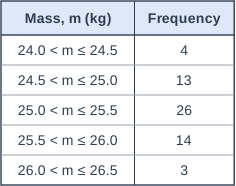
The table shows information about the masses of these 60 bags.

Work out an estimate for the total mass of all the potatoes in the delivery.

Table with columns "Mass, m (kg)", "Frequency". Mass, m (kg): 24.0 < m ≤ 24.5; Frequency: 4 | Mass, m (kg): 24.5 < m ≤ 25.0; Frequency: 13 | Mass, m (kg): 25.0 < m ≤ 25.5; Frequency: 26 | Mass, m (kg): 25.5 < m ≤ 26.0; Frequency: 14 | Mass, m (kg): 26.0 < m ≤ 26.5; Frequency: 3.

Model answer

Midpoints: 24.25, 24.75, 25.25, 25.75, 26.25
Σfx = 97 + 321.75 + 656.5 + 360.5 + 78.75 = 1514.5
Estimated mean mass of a bag = 1514.5 ÷ 60 = 25.2416... kg
Estimated total = 25.2416... × 1500 = 37 862.5 kg

Explanation

Estimate the mean mass of a bag in the sample using the class midpoints, then use it as an estimate of the mean for all 1500 bags. Keep the full value of the mean until the end. A common mistake is to add the midpoints without multiplying by the frequencies.

Mark scheme
  1. 1 mark

    M1 for using the midpoints 24.25, 24.75, 25.25, 25.75, 26.25

  2. 1 mark

    M1 for Σfx = 4 × 24.25 + 13 × 24.75 + 26 × 25.25 + 14 × 25.75 + 3 × 26.25 (= 1514.5)

  3. 1 mark

    M1 for their 1514.5 ÷ 60 × 1500 oe

    mean 25.241...

  4. 1 mark

    A1 for 37 862.5 kg

    accept 37 860 to 37 865; correct answer with no working scores full marks

Ready to try the rest? Every answer you write is marked against the mark scheme, so you can see exactly where the marks are.

AI Tutor Hints first, answers after you try

Hi! Stuck? Ask me for a hint and I’ll help you work it out. Once you’ve checked your answer I can explain exactly where the marks are.