Level:
Correct: 0
Incorrect: 0
Marks: 0/0
Exam Practice
Subject:
Topics:
Edexcel GCSE Maths (Calculator) Smart practice A mixed round aimed at your weak spots
Unit 1
Number
Unit 2
Algebra
Unit 3
Ratio, proportion and rates of change
Unit 4
Geometry and measures
Unit 5
Probability
Unit 6
Statistics
Avg
score:
–
Topics
done:
0/97

Using and rearranging formulae

Practise 36 exam-style questions on Using and rearranging formulae for Edexcel GCSE Maths (Calculator). Write your answer as you would in the exam and get it marked in seconds against the mark scheme, point by point, with an AI tutor on hand if you get stuck.

  • 36 questions
  • 1–5 marks each
  • Instant marking
  • No sign-up needed
20 questions, marked as you go

Sample questions with model answers

Here are 4 of the questions in this topic, each with a model answer, an explanation of why it earns the marks and the mark scheme an examiner would use.

Question 1

2 marks

Make u the subject of the formula \(v^2 = u^2 + 2as\)

Model answer

\(v^2 = u^2 + 2as\)
\(u^2 = v^2 - 2as\)
\(u = \sqrt{v^2 - 2as}\)

Explanation

Get \(u^2\) on its own by subtracting \(2as\) from both sides, then square root the whole of the other side. You cannot square root term by term: \(\sqrt{v^2 - 2as}\) is not \(v - \sqrt{2as}\).

Mark scheme
  1. 1 mark

    M1 for \(u^2 = v^2 - 2as\)

    oe; correct answer with no working scores full marks

  2. 1 mark

    A1 for \(u = \sqrt{v^2 - 2as}\)

    oe; accept \(u = \pm\sqrt{v^2 - 2as}\); the square root must cover both terms
Question 2

3 marks

The formula \(F = 1.8C + 32\) converts a temperature of C degrees Celsius into F degrees Fahrenheit.

There is one temperature that has the same value in degrees Celsius and in degrees Fahrenheit.
Work out this temperature.

Model answer

If the two values are equal, F = C, so
\(C = 1.8C + 32\)
\(C - 1.8C = 32\)
\(-0.8C = 32\)
\(C = 32 \div (-0.8) = -40\)
The temperature is −40 degrees (−40 °C = −40 °F).
Check: 1.8 × (−40) + 32 = −72 + 32 = −40 ✓

Explanation

If both readings are the same number, replace F by C to get an equation with one letter, then solve it. Collecting the C terms gives a negative coefficient, so the answer is negative. Check it by substituting back into the formula.

Mark scheme
  1. 1 mark

    M1 for \(C = 1.8C + 32\) or \(F = 1.8F + 32\)

    oe; using the same letter for both; correct answer with no working scores full marks

  2. 1 mark

    M1 for \(-0.8C = 32\) or \(0.8C = -32\)

    oe

  3. 1 mark

    A1 for −40

    cao; accept −40 °C or −40 °F

Question 3

3 marks

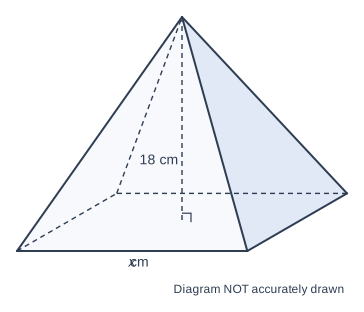
The diagram shows a solid square-based pyramid.
The pyramid has a volume of 2450 cm³ and a vertical height of 18 cm.
The sides of the square base are x cm long.

Volume of a pyramid = \(\frac{1}{3}\) × area of base × height

Work out the value of x.
Give your answer correct to 3 significant figures.

A square-based pyramid drawn in 3D with hidden edges shown as dashed lines. The length of the base is labelled x cm (along the front edge of the base). The perpendicular height is labelled 18 cm (beside a dashed vertical line from the apex down to the centre of the base, with a right angle marked there). The diagram is labelled "Diagram NOT accurately drawn".

Model answer

\(2450 = \frac{1}{3} \times x^2 \times 18\)
\(2450 = 6x^2\)
\(x^2 = 408.33...\)
\(x = \sqrt{408.33...} = 20.207...\)
x = 20.2 (3 s.f.)

Explanation

Substitute the volume and height into the formula, with \(x^2\) for the area of the square base, and rearrange to find \(x^2\). Remember to take the square root at the end, because the base area is \(x^2\). A common mistake is to forget the \(\frac{1}{3}\), giving 11.7 cm.

Mark scheme
  1. 1 mark

    M1 for \(2450 = \frac{1}{3} \times A \times 18\) or area of base = 408.3...

    oe, e.g. \(2450 = 6x^2\)

  2. 1 mark

    M1 for \(\sqrt{\text{their area}}\), e.g. \(\sqrt{408.3...}\)

  3. 1 mark

    A1 for 20.2

    awrt 20.2 (20.207...); correct answer with no working scores full marks

Question 4

5 marks

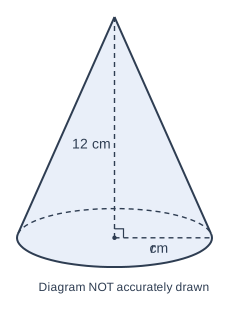
The diagram shows a solid cone.
The cone has a volume of 350 cm³, a vertical height of 12 cm and a base radius of r cm.

Volume of a cone = \(\frac{1}{3}\pi r^2h\)
Curved surface area of a cone = \(\pi rl\), where l is the slant height.

Work out the curved surface area of the cone.
Give your answer correct to 3 significant figures.

A cone drawn in 3D (hidden edges dashed). The radius is labelled r cm (on a dashed line from the centre of the base to its edge). The perpendicular height is labelled 12 cm (beside a dashed vertical line from the top down to the centre of the base, with a right angle marked there). The diagram is labelled "Diagram NOT accurately drawn".

Model answer

\(\frac{1}{3}\pi r^2 \times 12 = 350\)
\(4\pi r^2 = 350\)
\(r^2 = \dfrac{350}{4\pi} = 27.852...\)
\(r = 5.2775...\) cm
\(l = \sqrt{r^2 + h^2} = \sqrt{27.852... + 144} = \sqrt{171.852...} = 13.109...\) cm
Curved surface area = \(\pi r l = \pi \times 5.2775... \times 13.109... = 217.34...\)
= 217 cm² (3 s.f.)

Explanation

First rearrange the volume formula to find the radius. The slant height is the hypotenuse of a right-angled triangle with sides r and the height, so use Pythagoras. A common mistake is to use the vertical height (12) instead of the slant height in \(\pi rl\), which gives 199 cm².

Mark scheme
  1. 1 mark

    P1 for \(350 = \frac{1}{3}\pi r^2 \times 12\) or \(r^2 = \dfrac{3 \times 350}{12\pi}\) (= 27.85...)

    oe

  2. 1 mark

    P1 for r = 5.277...

    accept 5.27 to 5.28

  3. 1 mark

    P1 for \(l = \sqrt{r^2 + 12^2}\) with their r, e.g. \(\sqrt{27.85... + 144}\) (= 13.10...)

    accept 13.1

  4. 1 mark

    P1 for \(\pi \times\) their r × their l

  5. 1 mark

    A1 for 217 cm²

    awrt 217 (217.34...); correct answer with no working scores full marks

Ready to try the rest? Every answer you write is marked against the mark scheme, so you can see exactly where the marks are.

AI Tutor Hints first, answers after you try

Hi! Stuck? Ask me for a hint and I’ll help you work it out. Once you’ve checked your answer I can explain exactly where the marks are.