Level:
Correct: 0
Incorrect: 0
Marks: 0/0
Exam Practice
Subject:
Topics:
Edexcel GCSE Maths (Calculator) Smart practice A mixed round aimed at your weak spots
Unit 1
Number
Unit 2
Algebra
Unit 3
Ratio, proportion and rates of change
Unit 4
Geometry and measures
Unit 5
Probability
Unit 6
Statistics
Avg
score:
–
Topics
done:
0/97

Proportion as equality of ratios

Practise 20 exam-style questions on Proportion as equality of ratios for Edexcel GCSE Maths (Calculator). Write your answer as you would in the exam and get it marked in seconds against the mark scheme, point by point, with an AI tutor on hand if you get stuck.

  • 20 questions
  • 1–5 marks each
  • Instant marking
  • No sign-up needed
20 questions, marked as you go

Sample questions with model answers

Here are 4 of the questions in this topic, each with a model answer, an explanation of why it earns the marks and the mark scheme an examiner would use.

Question 1

2 marks

Liam says that the ratios 3.6 : 4.8 and 5.7 : 7.6 are equal.

Is Liam correct?
You must show how you get your answer.

Model answer

3.6 ÷ 4.8 = 0.75
5.7 ÷ 7.6 = 0.75
Both ratios simplify to 3 : 4, so they are equal. Liam is correct.

Explanation

To test whether two ratios are equal, divide the first part by the second part in each - if the answers are the same, the ratios are equal. Alternatively simplify both: 3.6 : 4.8 = 3 : 4 (÷ 1.2) and 5.7 : 7.6 = 3 : 4 (÷ 1.9).

Mark scheme
  1. 1 mark

    M1 for \(3.6 \div 4.8\) and \(5.7 \div 7.6\) (both 0.75), or simplifying both ratios to 3 : 4

    oe, e.g. \(4.8 \div 3.6\) and \(7.6 \div 5.7\) (both 1.33...)

  2. 1 mark

    C1 for Yes, with correct supporting values
Question 2

2 marks

\(a\), \(b\) and \(c\) are positive numbers such that \(a : b = b : c\).
\(a = 4.5\) and \(c = 12.5\)

Find the value of \(b\).

Model answer

\(\frac{4.5}{b} = \frac{b}{12.5}\)
\(b^2 = 4.5 \times 12.5 = 56.25\)
\(b = \sqrt{56.25} = 7.5\) (\(b\) is positive)

Explanation

Write the equal ratios as equal fractions and cross-multiply to get \(b^2 = ac\). Since \(b\) is positive, take the positive square root. Check: 4.5 : 7.5 and 7.5 : 12.5 both simplify to 3 : 5.

Mark scheme
  1. 1 mark

    M1 for \(\frac{4.5}{b} = \frac{b}{12.5}\) or \(b^2 = 4.5 \times 12.5\) (= 56.25)

    oe; correct answer with no working scores full marks

  2. 1 mark

    A1 for 7.5

    cao; do not accept ±7.5

Question 3

3 marks

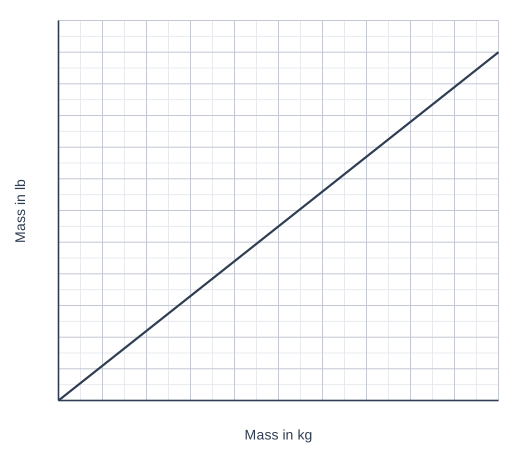
The graph can be used to convert between kilograms (kg) and pounds (lb).

Use the graph to convert 65 kg to pounds.

A graph of Mass in lb (vertical axis, 0 to 24, marked every 2) against Mass in kg (horizontal axis, 0 to 10, marked every 1), on a grid with 2 small squares to each large square. The graph is a straight line; its values can be read from the grid.

Model answer

From the graph, 10 kg = 22 lb.
Kilograms and pounds are in proportion, so 65 kg : \(x\) lb = 10 : 22
\(x = 22 \times \frac{65}{10} = 22 \times 6.5 = 143\) lb

Explanation

The graph only goes up to 10 kg, but because it is a straight line through the origin, kilograms and pounds are in proportion. Read off one pair of values accurately (the end of the line is best) and multiply up. Reading 6.5 kg from the graph and multiplying by 10 is another correct method.

Mark scheme
  1. 1 mark

    B1 for a correct reading from the graph, e.g. 10 kg = 22 lb or 5 kg = 11 lb

    accept readings within one small square; correct answer with no working scores full marks

  2. 1 mark

    M1 for a correct method to scale their reading to 65 kg, e.g. \(22 \times 6.5\) or \(11 \times 13\)

    oe

  3. 1 mark

    A1 for 143 lb

    accept 140 to 146

Question 4

4 marks

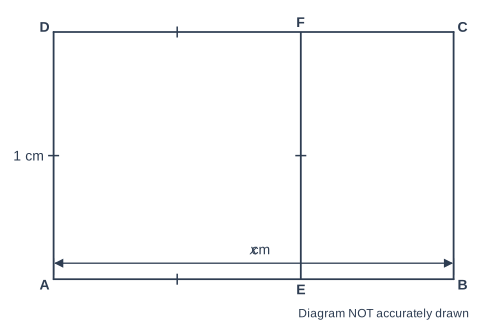
The diagram shows rectangle ABCD with AB = \(x\) cm and AD = 1 cm, where \(x > 1\).
The square AEFD, with sides of 1 cm, is cut off the rectangle.
The rectangle EBCF that is left is similar to rectangle ABCD.

Show that \(x^2 - x - 1 = 0\) and hence find the value of \(x\), correct to 3 significant figures.

Geometry diagram, marked "Diagram NOT accurately drawn". Rectangle ABCD. Line segment EF is drawn. E lies on side AB. F lies on side CD. Side AD is labelled 1 cm. A double-headed dimension arrow alongside AB (the distance from A to B) is labelled x cm. AE, EF, FD and DA are each marked with one short dash (equal lengths).

Model answer

EB = \(x - 1\) and BC = 1.
Since \(x\) is about 1.6, in EBCF the longer side is BC = 1 and the shorter side is EB = \(x - 1\).
Longer : shorter is the same in both rectangles:
\(\frac{x}{1} = \frac{1}{x - 1}\)
\(x(x - 1) = 1\)
\(x^2 - x - 1 = 0\)
\(x = \frac{1 \pm \sqrt{1 + 4}}{2} = \frac{1 \pm \sqrt{5}}{2}\)
\(x > 1\), so \(x = \frac{1 + \sqrt{5}}{2} = 1.618...\)
\(x = 1.62\) (3 s.f.)

Explanation

For similar rectangles, the ratio of the longer side to the shorter side is the same. In the small rectangle the longer side is 1 and the shorter side is \(x - 1\), so the ratio equation is \(x : 1 = 1 : (x - 1)\). The solution, 1.618..., is the golden ratio; the negative root is rejected because \(x > 1\).

Mark scheme
  1. 1 mark

    M1 for the sides of EBCF as \((x - 1)\) and 1

  2. 1 mark

    M1 for a correct equation of ratios, e.g. \(\frac{x}{1} = \frac{1}{x - 1}\)

    oe; longer side : shorter side the same in both rectangles

  3. 1 mark

    C1 for completing the proof to \(x^2 - x - 1 = 0\) with no errors

  4. 1 mark

    A1 for 1.62

    awrt 1.62 (1.618...); do not accept the negative root as a final answer

Ready to try the rest? Every answer you write is marked against the mark scheme, so you can see exactly where the marks are.

AI Tutor Hints first, answers after you try

Hi! Stuck? Ask me for a hint and I’ll help you work it out. Once you’ve checked your answer I can explain exactly where the marks are.