
Level:
Correct: 0
Incorrect: 0
Marks: 0/0
Exam Practice
Subject:
Topics:
Edexcel GCSE Maths (Calculator) Smart practice A mixed round aimed at your weak spots
Unit 1
Number
Unit 2
Algebra
Unit 3
Ratio, proportion and rates of change
Unit 4
Geometry and measures
Unit 5
Probability
Unit 6
Statistics
Avg
score:
–
Topics
done:
0/97

Congruent triangles

Practise 28 exam-style questions on Congruent triangles for Edexcel GCSE Maths (Calculator). Write your answer as you would in the exam and get it marked in seconds against the mark scheme, point by point, with an AI tutor on hand if you get stuck.

  • 28 questions
  • 1–5 marks each
  • Instant marking
  • No sign-up needed
20 questions, marked as you go

Sample questions with model answers

Here are 4 of the questions in this topic, each with a model answer, an explanation of why it earns the marks and the mark scheme an examiner would use.

Question 1

2 marks

The diagram shows two triangles, ABC and DEF.

Are triangles ABC and DEF congruent?
Give a reason for your answer.
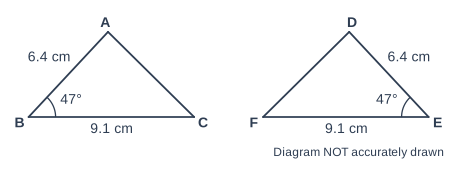
Geometry diagram, marked "Diagram NOT accurately drawn". Triangle ABC. Triangle DEF. Side AB is labelled 6.4 cm. Side BC is labelled 9.1 cm. Angle ABC is marked 47°. Side DE is labelled 6.4 cm. Side EF is labelled 9.1 cm. Angle DEF is marked 47°.

Model answer

AB = DE = 6.4 cm, BC = EF = 9.1 cm and angle ABC = angle DEF = 47°.
In both triangles the 47° angle is the angle between the two given sides (the included angle).
So yes, the triangles are congruent (SAS).

Explanation

For SAS the angle must be the one between the two equal sides. Here the 47° angle is at B, between AB and BC, and at E, between DE and EF, so SAS applies even though triangle DEF is a mirror image of triangle ABC.

Mark scheme
  1. 1 mark

    B1 for yes, congruent

  2. 1 mark

    C1 for SAS, with the reason that the 47° angle is between the 6.4 cm and 9.1 cm sides in both triangles

    oe; "SAS" with no mention of the angle being between the sides scores B1 C0
Question 2

3 marks

Triangle ABC has vertices A(1, 1), B(6, 2) and C(3, 5).
Triangle PQR has vertices P(−1, −1), Q(−2, 4) and R(−5, 1).

Show that triangle ABC is congruent to triangle PQR.

Model answer

\(AB = \sqrt{(6 - 1)^2 + (2 - 1)^2} = \sqrt{26}\), \(PQ = \sqrt{(-2 + 1)^2 + (4 + 1)^2} = \sqrt{26}\)
\(BC = \sqrt{(3 - 6)^2 + (5 - 2)^2} = \sqrt{18}\), \(QR = \sqrt{(-5 + 2)^2 + (1 - 4)^2} = \sqrt{18}\)
\(CA = \sqrt{(1 - 3)^2 + (1 - 5)^2} = \sqrt{20}\), \(RP = \sqrt{(-1 + 5)^2 + (-1 - 1)^2} = \sqrt{20}\)
All three pairs of sides are equal, so the triangles are congruent (SSS).

Explanation

Use Pythagoras on the horizontal and vertical distances to find each side length. When the three sides of one triangle equal the three sides of the other, the triangles are congruent by SSS. Leaving the lengths as surds avoids rounding problems.

Mark scheme
  1. 1 mark

    M1 for a correct method to find the length of one side, e.g. \(AB = \sqrt{5^2 + 1^2} = \sqrt{26}\)

  2. 1 mark

    M1 for all six lengths: \(AB = PQ = \sqrt{26}\), \(BC = QR = \sqrt{18}\), \(CA = RP = \sqrt{20}\)

    accept decimals 5.09..., 4.24..., 4.47...

  3. 1 mark

    C1 for a conclusion: all three pairs of sides are equal, so congruent (SSS)

    answer only scores 0

Question 3

3 marks

ABCD is an isosceles trapezium with AB parallel to DC.
AD = BC and angle DAB = angle CBA.

Prove that triangle ABD is congruent to triangle BAC.
Hence explain why AC = BD.

Model answer

AD = BC (given)
AB is common to triangles ABD and BAC.
Angle DAB = angle CBA (given), and in each triangle this angle is between the two sides.
So triangle ABD is congruent to triangle BAC (SAS).
BD and AC are corresponding sides (each is opposite the equal angle), so AC = BD: the diagonals of an isosceles trapezium are equal.

Explanation

Pick triangles that each contain one diagonal: ABD contains BD and BAC contains AC. They share the base AB, and the equal sloping sides and equal base angles complete SAS. Corresponding sides of congruent triangles are equal.

Mark scheme
  1. 1 mark

    B1 for AD = BC (given) and AB common

  2. 1 mark

    B1 for angle DAB = angle CBA (given), the angle between the two sides in each triangle

  3. 1 mark

    C1 for congruent by SAS, so BD = AC (corresponding sides)

Question 4

5 marks

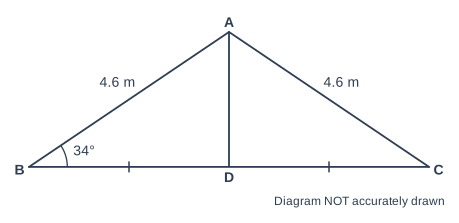
The diagram shows a roof truss ABC made from wood.
AB = AC = 4.6 m and angle ABC = 34°.
D is the midpoint of BC, and a piece of wood AD joins A to D.

Use congruent triangles to explain why AD is perpendicular to BC.
Work out the total length of wood needed for AB, AC, BC and AD.

Geometry diagram, marked "Diagram NOT accurately drawn". Isosceles triangle ABC. Line segment AD is drawn. D lies on side BC. Side AB is labelled 4.6 m. Side AC is labelled 4.6 m. Angle ABC is marked 34°. BD and DC are each marked with one short dash (equal lengths).

Model answer

AB = AC (given), BD = CD (D is the midpoint), AD is common.
So triangles ABD and ACD are congruent (SSS), and angle ADB = angle ADC.
These angles are on the straight line BC, so they add up to 180°: each is 90°, so AD is perpendicular to BC.
In right-angled triangle ABD:
\(BD = 4.6 \cos 34^\circ = 3.8135...\) m, so BC = 7.6271... m
\(AD = 4.6 \sin 34^\circ = 2.5722...\) m
Total = 4.6 + 4.6 + 7.6271... + 2.5722... = 19.399... m
Total length = 19.4 m (3 s.f.)

Explanation

Congruent triangles prove that AD meets BC at 90°, which is what allows you to use right-angled trigonometry in triangle ABD. Remember BC is twice BD, and keep full calculator values until the final total.

Mark scheme
  1. 1 mark

    C1 for triangles ABD and ACD congruent (SSS), with AB = AC, BD = CD and AD common

  2. 1 mark

    C1 for angle ADB = angle ADC and these add up to 180° (straight line), so each is 90°

  3. 1 mark

    P1 for \(BD = 4.6 \cos 34^\circ\) (= 3.813...) or \(AD = 4.6 \sin 34^\circ\) (= 2.572...)

  4. 1 mark

    P1 for a complete method for the total, e.g. \(4.6 + 4.6 + 2 \times 4.6 \cos 34^\circ + 4.6 \sin 34^\circ\)

  5. 1 mark

    A1 for 19.4 m

    awrt 19.4 (19.399...)

Ready to try the rest? Every answer you write is marked against the mark scheme, so you can see exactly where the marks are.

AI Tutor Hints first, answers after you try

Hi! Stuck? Ask me for a hint and I’ll help you work it out. Once you’ve checked your answer I can explain exactly where the marks are.