Level:
Correct: 0
Incorrect: 0
Marks: 0/0
Exam Practice
Subject:
Topics:
Edexcel GCSE Maths (Calculator) Smart practice A mixed round aimed at your weak spots
Unit 1
Number
Unit 2
Algebra
Unit 3
Ratio, proportion and rates of change
Unit 4
Geometry and measures
Unit 5
Probability
Unit 6
Statistics
Avg
score:
–
Topics
done:
0/97

Ratio notation and simplifying ratios

Practise 29 exam-style questions on Ratio notation and simplifying ratios for Edexcel GCSE Maths (Calculator). Write your answer as you would in the exam and get it marked in seconds against the mark scheme, point by point, with an AI tutor on hand if you get stuck.

  • 29 questions
  • 1–5 marks each
  • Instant marking
  • No sign-up needed
20 questions, marked as you go

Sample questions with model answers

Here are 4 of the questions in this topic, each with a model answer, an explanation of why it earns the marks and the mark scheme an examiner would use.

Question 1

2 marks

Write the ratio 1.25 : 3.5 in its simplest form.

Model answer

Multiply both parts by 4: 1.25 : 3.5 = 5 : 14
(or \(\times 100\): 125 : 350, then \(\div 25\): 5 : 14)

Explanation

A ratio in its simplest form uses whole numbers with no common factor. Multiply both parts by the same number to remove the decimals, then divide by any common factor.

Mark scheme
  1. 1 mark

    M1 for multiplying both parts by the same number to get whole numbers, e.g. 125 : 350 or 5 : 14 seen with a common factor still to remove, e.g. 25 : 70

    correct answer with no working scores full marks

  2. 1 mark

    A1 for 5 : 14

    cao

Question 2

2 marks

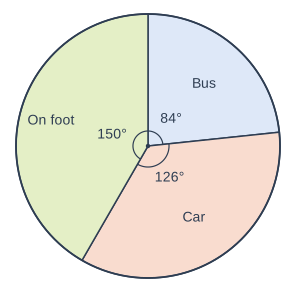
The pie chart shows how some students travel to school.

Write the ratio of the number of students who travel by bus : by car : on foot in its simplest form.

Pie chart. A circle divided into sectors, drawn clockwise from the top (12 o'clock): Bus, 84° (printed); Car, 126° (printed); On foot, 150° (printed). Each printed angle is marked with a small arc at the centre.

Model answer

The angles are in the same ratio as the numbers of students.
84 : 126 : 150
The highest common factor is 6.
84 : 126 : 150 = 14 : 21 : 25

Explanation

The angle of each sector is proportional to the number of students, so the ratio of the angles is the ratio of the numbers. Divide all three angles by their highest common factor, 6.

Mark scheme
  1. 1 mark

    M1 for 84 : 126 : 150, or a correct partial simplification, e.g. 42 : 63 : 75

    correct answer with no working scores full marks

  2. 1 mark

    A1 for 14 : 21 : 25

    cao

Question 3

3 marks

The exchange rate is £1 = €1.16

Write the ratio £45 : €67.86 in its simplest form.

Model answer

€67.86 = \(67.86 \div 1.16 = £58.50\)
45 : 58.5
Multiply by 2: 90 : 117
Divide by 9: 10 : 13

Explanation

A ratio compares amounts in the same unit, so convert both amounts to pounds (or both to euros) first. Then clear the decimal and divide by the highest common factor.

Mark scheme
  1. 1 mark

    M1 for converting one amount into the other currency, e.g. \(67.86 \div 1.16\) (= £58.50) or \(45 \times 1.16\) (= €52.20)

    correct answer with no working scores full marks

  2. 1 mark

    M1 for 45 : 58.5 or 52.2 : 67.86, or a correct partial simplification

  3. 1 mark

    A1 for 10 : 13

    cao

Question 4

4 marks

A council has a target for its schools.
The ratio of teachers to students in each school should be 1 : 17 or better (no more than 17 students for each teacher).

School A has 1350 students and 81 teachers.
School B has 920 students and 58 teachers.
School C has 1610 students and 92 teachers.

Which of the schools meet the target?
You must show your working.

Model answer

A: 81 : 1350 = 1 : \(1350 \div 81\) = 1 : 16.66...
B: 58 : 920 = 1 : \(920 \div 58\) = 1 : 15.86...
C: 92 : 1610 = 1 : \(1610 \div 92\) = 1 : 17.5
A and B have no more than 17 students for each teacher, so they meet the target.
C has 17.5 students for each teacher, so it does not meet the target.

Explanation

Write each ratio in the form 1 : \(n\) by dividing the number of students by the number of teachers; \(n\) is the number of students for each teacher. A school meets the target when \(n\) is 17 or less.

Mark scheme
  1. 1 mark

    M1 for one ratio in the form 1 : \(n\), e.g. A \(1350 \div 81\) (= 16.6...)

  2. 1 mark

    M1 for all three ratios in the form 1 : \(n\)

    or 17 × number of teachers compared with students: A 1377, B 986, C 1564

  3. 1 mark

    A1 for A 1 : 16.7, B 1 : 15.9, C 1 : 17.5

    accept 16.6 to 16.7, 15.8 to 15.9, 17.5

  4. 1 mark

    C1 for A and B meet the target, C does not

Ready to try the rest? Every answer you write is marked against the mark scheme, so you can see exactly where the marks are.

AI Tutor Hints first, answers after you try

Hi! Stuck? Ask me for a hint and I’ll help you work it out. Once you’ve checked your answer I can explain exactly where the marks are.