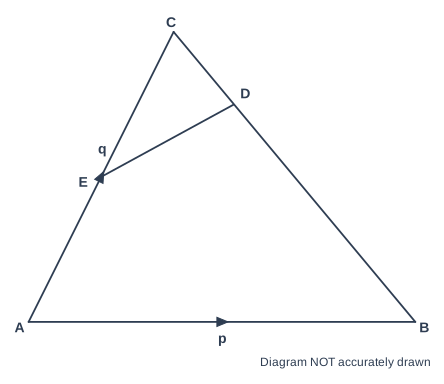
Question 1
2 marks\(\mathbf{p} = \begin{pmatrix}4\\-3\end{pmatrix}\) and \(\mathbf{q} = \begin{pmatrix}-2\\5\end{pmatrix}\)
Work out \(2\mathbf{p} - 3\mathbf{q}\) as a column vector.
Model answer
\(2\mathbf{p} = \begin{pmatrix}8\\-6\end{pmatrix}\), \(3\mathbf{q} = \begin{pmatrix}-6\\15\end{pmatrix}\)
\(2\mathbf{p} - 3\mathbf{q} = \begin{pmatrix}8 - (-6)\\-6 - 15\end{pmatrix} = \begin{pmatrix}14\\-21\end{pmatrix}\)
Explanation
Multiplying a vector by a scalar multiplies both components. Then subtract component by component. The most common mistake is with signs: subtracting −6 is the same as adding 6.
Mark scheme
-
1 mark
M1 for \(2\mathbf{p} = \begin{pmatrix}8\\-6\end{pmatrix}\) or \(3\mathbf{q} = \begin{pmatrix}-6\\15\end{pmatrix}\)
or for one correct component in the final answer; correct answer with no working scores full marks
-
1 mark
A1 for \(\begin{pmatrix}14\\-21\end{pmatrix}\)
cao