Practise 31 exam-style questions on Comparing lengths, areas and volumes with ratio for Edexcel GCSE Maths (Calculator). Write your answer as you would in the exam and get it marked in seconds against the mark scheme, point by point, with an AI tutor on hand if you get stuck.
31 questions
1–5 marks each
Instant marking
No sign-up needed
20 questions, marked as you go
Sample questions with model answers
Here are 4 of the questions in this topic, each with a model answer, an explanation of why it earns the marks and the mark scheme an examiner would use.
Question 1
2 marks
Circle A has radius 3.6 cm. Circle B has radius 4.8 cm.
Find the ratio area of circle A : area of circle B. Give your answer in its simplest form.
Model answer
Ratio of radii = 3.6 : 4.8 = 3 : 4 All circles are similar, so ratio of areas = \(3^2 : 4^2\) = 9 : 16
Explanation
All circles are mathematically similar, so the ratio of their areas is the ratio of their radii squared. Simplify the ratio of the radii first (3.6 : 4.8 = 3 : 4), then square both parts. You can also work out both areas, but π cancels, so it is not needed.
Mark scheme
1 mark
M1 for squaring the ratio of the radii, e.g. \(3^2 : 4^2\), or for 12.96 : 23.04, or \(\pi \times 3.6^2 : \pi \times 4.8^2\) (= 40.7... : 72.3...)
oe; correct answer with no working scores full marks
1 mark
A1 for 9 : 16
cao
Question 2
3 marks
A model of a car is made to a scale of 1 : 43 The roof of the real car has an area of 3.1 m².
Work out the area of the roof of the model. Give your answer in cm², correct to 3 significant figures.
Model answer
Length scale factor = 43, so area scale factor = \(43^2\) = 1849 3.1 m² = 3.1 × 10 000 = 31 000 cm² Area of model roof = 31 000 ÷ 1849 = 16.76... cm² Area = 16.8 cm² (3 s.f.)
Explanation
A length scale of 1 : 43 means areas are in the ratio \(1 : 43^2\). There are two traps: dividing by 43 instead of 1849, and converting m² to cm² by multiplying by 100 instead of 10 000 (1 m² = 100 cm × 100 cm).
Mark scheme
1 mark
M1 for an area scale factor of \(43^2\) (= 1849)
1 mark
M1 for converting 3.1 m² to 31 000 cm² (or converting an area in m² to cm² by × 10 000)
1 mark
A1 for 16.8 cm²
awrt 16.8 (16.76...); correct answer with no working scores full marks
Question 3
3 marks
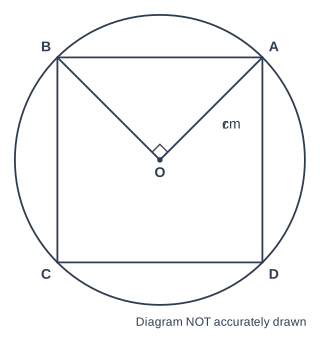
The diagram shows a square ABCD inside a circle with centre O. The vertices of the square lie on the circle. The radius of the circle is r cm.
Show that area of the square : area of the circle = 2 : π
Model answer
OA and OB are radii, and the diagonals of a square are equal and meet at right angles, so angle AOB = 90°. \(AB^2 = r^2 + r^2 = 2r^2\), so the area of the square = \(AB^2 = 2r^2\) Area of the circle = \(\pi r^2\) Area of square : area of circle = \(2r^2 : \pi r^2\) Dividing both parts by \(r^2\) gives 2 : π
Explanation
The square's diagonals are diameters of the circle, so the square splits into four right-angled isosceles triangles with legs r. Each has area \(\frac{1}{2}r^2\), so the square has area \(2r^2\). Because both areas contain \(r^2\), it cancels and the ratio is the same for every size of circle.
Mark scheme
1 mark
M1 for a correct method for the area of the square in terms of r, e.g. side² = \(r^2 + r^2\), or 4 × \(\frac{1}{2}r^2\), or diagonal 2r so area = \(\frac{1}{2}(2r)^2\)
1 mark
M1 for area of square = \(2r^2\) and area of circle = \(\pi r^2\)
1 mark
C1 for a complete argument, e.g. \(2r^2 : \pi r^2\) = 2 : π
answer only scores 0
Question 4
5 marks
Rectangle A has length : width = 3 : 2 The area of rectangle A is 150 cm².
Rectangle B is mathematically similar to rectangle A. The area of rectangle B is 384 cm².
Work out the perimeter of rectangle B.
Model answer
For A: 3x × 2x = 150, so \(6x^2 = 150\), \(x^2 = 25\), x = 5 A measures 15 cm by 10 cm. Area scale factor = 384 ÷ 150 = 2.56 Length scale factor = \(\sqrt{2.56}\) = 1.6 B measures 15 × 1.6 = 24 cm by 10 × 1.6 = 16 cm. Perimeter of B = 2 × (24 + 16) = 80 cm
Explanation
Use the ratio to write the sides as 3x and 2x, then the area gives x. The area scale factor 2.56 must be square rooted to get the length scale factor 1.6. (You could also write B's sides as 3y and 2y and solve \(6y^2 = 384\) directly.) A check: 24 × 16 = 384.
Mark scheme
1 mark
P1 for setting up 3x × 2x = 150 or \(6x^2 = 150\)
oe; correct answer with no working scores full marks
1 mark
P1 for the dimensions of A, 15 cm and 10 cm
1 mark
P1 for the area scale factor 384 ÷ 150 (= 2.56)
oe, or for 3y × 2y = 384
1 mark
P1 for the length scale factor \(\sqrt{2.56}\) (= 1.6) and dimensions of B, 24 cm and 16 cm
or y = 8
1 mark
A1 for 80 cm
cao
Ready to try the rest? Every answer you write is marked against the mark scheme, so you can see exactly where the marks are.
Ctrl + Enter to check
AI TutorHints first, answers after you try
Hi! Stuck? Ask me for a hint and I’ll help you work it out. Once you’ve checked your answer I can explain exactly where the marks are.