Level:
Correct: 0
Incorrect: 0
Marks: 0/0
Exam Practice
Subject:
Topics:
Edexcel GCSE Maths (Calculator) Smart practice A mixed round aimed at your weak spots
Unit 1
Number
Unit 2
Algebra
Unit 3
Ratio, proportion and rates of change
Unit 4
Geometry and measures
Unit 5
Probability
Unit 6
Statistics
Avg
score:
–
Topics
done:
0/97

Geometric reasoning and proof

Practise 28 exam-style questions on Geometric reasoning and proof for Edexcel GCSE Maths (Calculator). Write your answer as you would in the exam and get it marked in seconds against the mark scheme, point by point, with an AI tutor on hand if you get stuck.

  • 28 questions
  • 1–5 marks each
  • Instant marking
  • No sign-up needed
20 questions, marked as you go

Sample questions with model answers

Here are 4 of the questions in this topic, each with a model answer, an explanation of why it earns the marks and the mark scheme an examiner would use.

Question 1

2 marks

A triangle has sides of length 6.5 cm, 7.2 cm and 9.7 cm.

Show that the triangle is right-angled.

Model answer

\(6.5^2 + 7.2^2 = 42.25 + 51.84 = 94.09\)
\(9.7^2 = 94.09\)
The sum of the squares of the two shorter sides equals the square of the longest side, so by the converse of Pythagoras' theorem the triangle is right-angled (the right angle is opposite the 9.7 cm side).

Explanation

Pythagoras' theorem works both ways: if \(a^2 + b^2 = c^2\) for the longest side c, the angle opposite c must be 90°. Use the longest side as c; any other choice cannot work.

Mark scheme
  1. 1 mark

    M1 for \(6.5^2 + 7.2^2 = 94.09\) and \(9.7^2 = 94.09\)

    oe, e.g. \(\sqrt{6.5^2 + 7.2^2} = 9.7\)

  2. 1 mark

    C1 for a conclusion: the squares of the two shorter sides add up to the square of the longest side, so the triangle is right-angled

    answer only scores 0
Question 2

3 marks

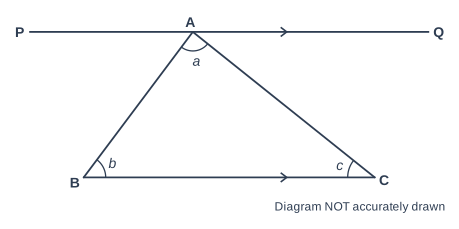
The diagram shows triangle ABC. The line PAQ is parallel to BC.
The angles of the triangle are a, b and c, as shown.

Prove that a + b + c = 180°.

Geometry diagram, marked "Diagram NOT accurately drawn". Triangle ABC. Line segment PQ is drawn. A lies on PQ. Angle BAC is marked a. Angle ABC is marked b. Angle ACB is marked c. PQ and BC are each marked with an arrowhead (parallel lines).

Model answer

PQ is parallel to BC.
Angle PAB = angle ABC = b (alternate angles)
Angle QAC = angle ACB = c (alternate angles)
PAQ is a straight line, so angle PAB + angle BAC + angle QAC = 180° (angles on a straight line).
So b + a + c = 180°, i.e. a + b + c = 180°.

Explanation

The parallel line through A lets you move the angles at B and C up to A using alternate angles. There the three angles sit side by side on a straight line, so they add up to 180°.

Mark scheme
  1. 1 mark

    B1 for angle PAB = b, with the reason "alternate angles" (PQ parallel to BC)

  2. 1 mark

    B1 for angle QAC = c, with the reason "alternate angles"

  3. 1 mark

    C1 for a complete proof: angles PAB, BAC and QAC lie on the straight line PAQ, so b + a + c = 180°

    needs all three reasons

Question 3

3 marks

PQR is an isosceles triangle with PQ = PR.
The side QR is extended beyond R to the point S.

Prove that angle PRS = 90° + \(\frac{1}{2}\) × angle QPR.

Model answer

Let angle QPR = 2y.
PQ = PR, so angle PQR = angle PRQ (base angles of an isosceles triangle).
Angles in a triangle add up to 180°: 2y + 2 × angle PRQ = 180°, so angle PRQ = 90° − y.
QRS is a straight line, so angle PRS = 180° − (90° − y) = 90° + y (angles on a straight line).
y = ½ × angle QPR, so angle PRS = 90° + ½ × angle QPR.

Explanation

Using a letter for the apex angle keeps the algebra simple: the two equal base angles share what is left of 180°. The exterior angle at R then makes a straight line with the base angle.

Mark scheme
  1. 1 mark

    M1 for angle PQR = angle PRQ = \(\frac{180 - \text{angle } QPR}{2}\) (= 90 − ½ angle QPR), using base angles of an isosceles triangle and the angle sum

    e.g. with angle QPR = 2y, each base angle = 90 − y

  2. 1 mark

    M1 for angle PRS = 180° − angle PRQ (angles on a straight line)

  3. 1 mark

    C1 for a complete proof reaching angle PRS = 90° + ½ angle QPR, with reasons

Question 4

5 marks

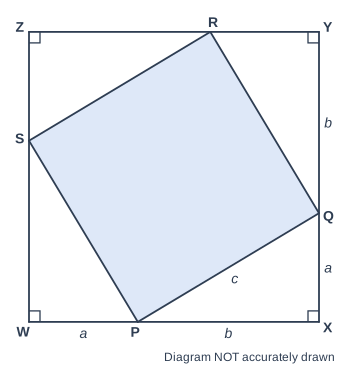
The diagram shows a square WXYZ with sides of length a + b.
Four congruent right-angled triangles, each with shorter sides a and b and hypotenuse c, are drawn in the corners of the square. Their hypotenuses form the quadrilateral PQRS.

Use the diagram to prove Pythagoras' theorem, \(a^2 + b^2 = c^2\).

Geometry diagram, marked "Diagram NOT accurately drawn". Square WXYZ. Quadrilateral PQRS (shaded). P lies on side WX. Q lies on side XY. R lies on side YZ. S lies on side WZ. Side WP is labelled a. Side PX is labelled b. Side XQ is labelled a. Side QY is labelled b. Side PQ is labelled c. Angle SWP is marked as a right angle (90°). Angle PXQ is marked as a right angle (90°). Angle QYR is marked as a right angle (90°). Angle RZS is marked as a right angle (90°).

Model answer

Each side of PQRS is a hypotenuse, so PQRS has four sides of length c.
At P, angle WPS + angle XPQ = 90° (they are the two acute angles of congruent right-angled triangles, which add up to 90°), so angle SPQ = 180° − 90° = 90°. The same is true at Q, R and S, so PQRS is a square of area \(c^2\).
Area of WXYZ = \((a + b)^2 = a^2 + 2ab + b^2\)
Area of WXYZ = 4 triangles + square PQRS = \(4 \times \frac{1}{2}ab + c^2 = 2ab + c^2\)
So \(a^2 + 2ab + b^2 = 2ab + c^2\)
\(a^2 + b^2 = c^2\)

Explanation

Work out the area of the big square in two ways and set them equal. You must also justify that the inner shape is a square: its sides are all c, and its angles are 90° because the two acute angles of each right-angled triangle add up to 90°.

Mark scheme
  1. 1 mark

    C1 for explaining why PQRS is a square: all its sides are c, and each angle is 180° − (the two acute angles of a triangle) = 180° − 90° = 90°

    oe, e.g. angle SPQ = 180 − (x + y) where x + y = 90 (angle sum of a right-angled triangle)

  2. 1 mark

    M1 for the area of WXYZ = \((a + b)^2\)

  3. 1 mark

    M1 for the area of WXYZ = \(4 \times \frac{1}{2}ab + c^2\)

  4. 1 mark

    M1 for \((a + b)^2 = a^2 + 2ab + b^2\) and equating, e.g. \(a^2 + 2ab + b^2 = 2ab + c^2\)

  5. 1 mark

    C1 for a complete proof concluding \(a^2 + b^2 = c^2\)

Ready to try the rest? Every answer you write is marked against the mark scheme, so you can see exactly where the marks are.

AI Tutor Hints first, answers after you try

Hi! Stuck? Ask me for a hint and I’ll help you work it out. Once you’ve checked your answer I can explain exactly where the marks are.