Practise 20 exam-style questions on Parts of a circle for Edexcel GCSE Maths (Calculator). Write your answer as you would in the exam and get it marked in seconds against the mark scheme, point by point, with an AI tutor on hand if you get stuck.
20 questions
1–5 marks each
Instant marking
No sign-up needed
20 questions, marked as you go
Sample questions with model answers
Here are 4 of the questions in this topic, each with a model answer, an explanation of why it earns the marks and the mark scheme an examiner would use.
Question 1
2 marks
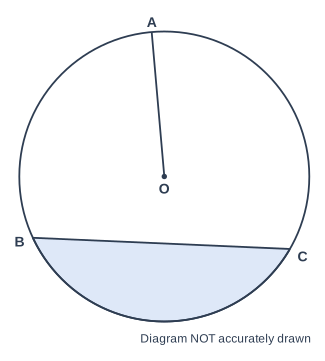
The diagram shows a circle with centre O. A, B and C are points on the circle. The region between the straight line BC and the minor arc BC is shaded.
Write down the mathematical name of the straight line BC, the shaded region.
Model answer
BC is a chord. The shaded region is a segment (the minor segment).
Explanation
A chord is a straight line joining two points on the circumference. The region between a chord and an arc is a segment. Do not confuse a segment with a sector: a sector is bounded by two radii and an arc, like a slice of pizza.
Mark scheme
1 mark
B1 for chord (for the line BC)
correct answer with no working scores full marks
1 mark
B1 for segment (for the shaded region)
accept "minor segment"; do not accept "sector"
Question 2
3 marks
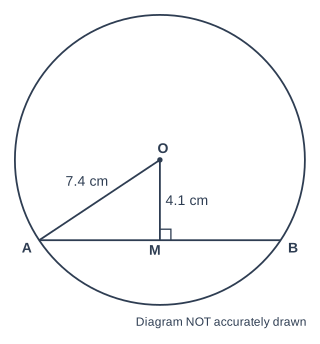
The diagram shows a circle with centre O and radius 7.4 cm. AB is a chord of the circle. M is the point on AB such that OM is perpendicular to AB. OM = 4.1 cm.
Work out the length of the chord AB. Give your answer correct to 3 significant figures.
Model answer
Triangle OMA is right-angled at M and OA = 7.4 cm (a radius). \(AM^2 = 7.4^2 - 4.1^2 = 54.76 - 16.81 = 37.95\) \(AM = 6.1603...\) The perpendicular from the centre bisects the chord, so \(AB = 2 \times 6.1603... = 12.320...\) AB = 12.3 cm (3 s.f.)
Explanation
OA is a radius, so it is 7.4 cm long, and triangle OMA is right-angled, so use Pythagoras to find AM. The perpendicular from the centre to a chord bisects the chord, so double AM. A common mistake is to forget to double.
Mark scheme
1 mark
M1 for \(7.4^2 - 4.1^2\) (= 37.95)
oe, e.g. \(AM^2 + 4.1^2 = 7.4^2\)
1 mark
M1 for \(2 \times \sqrt{7.4^2 - 4.1^2}\)
AM = 6.16...
1 mark
A1 for 12.3 cm
awrt 12.3 (12.32...); correct answer with no working scores full marks
Question 3
3 marks
A sector of a circle has an area of 45 cm². The radius of the circle is 7 cm.
Work out the angle at the centre of the sector. Give your answer correct to 1 decimal place.
Model answer
Area of the whole circle \(= \pi \times 7^2 = 153.938...\) cm² \(\dfrac{\theta}{360} \times 153.938... = 45\) \(\theta = \dfrac{45}{153.938...} \times 360 = 105.237...\) Angle = 105.2° (1 d.p.)
Explanation
A sector is a fraction of the whole circle, and that fraction is \(\frac{\theta}{360}\). Find what fraction 45 cm² is of the area of the whole circle, then multiply by 360°. A common mistake is to use the circumference \(2\pi r\) instead of the area \(\pi r^2\).
Mark scheme
1 mark
M1 for \(\dfrac{\theta}{360} \times \pi \times 7^2 = 45\)
oe, e.g. area of circle = 153.93...
1 mark
M1 for \(\theta = \dfrac{45 \times 360}{\pi \times 49}\)
oe, e.g. \(\dfrac{45}{153.93...} \times 360\)
1 mark
A1 for 105.2°
awrt 105.2 (105.237...); correct answer with no working scores full marks
Question 4
4 marks
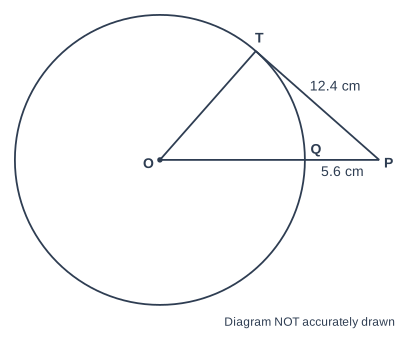
The diagram shows a circle with centre O. P is a point outside the circle. PT is a tangent to the circle at T. The straight line PO meets the circle at Q. PT = 12.4 cm and PQ = 5.6 cm.
Work out the radius of the circle. Give your answer correct to 3 significant figures.
Model answer
Let the radius be r cm. OT = r and OQ = r, so OP = r + 5.6. The tangent is perpendicular to the radius, so angle OTP = 90°. \((r + 5.6)^2 = r^2 + 12.4^2\) \(r^2 + 11.2r + 31.36 = r^2 + 153.76\) \(11.2r = 122.4\) \(r = 10.928...\) Radius = 10.9 cm (3 s.f.)
Explanation
Join O to T: this radius is perpendicular to the tangent, so triangle OTP is right-angled with hypotenuse OP = r + 5.6. Pythagoras gives an equation in r; the \(r^2\) terms cancel, leaving a linear equation. A common mistake is to expand \((r + 5.6)^2\) as \(r^2 + 5.6^2\).
Mark scheme
1 mark
P1 for using angle OTP = 90° with OT = r and OP = r + 5.6
may be implied by later working
1 mark
P1 for \((r + 5.6)^2 = r^2 + 12.4^2\)
oe
1 mark
P1 for simplifying to a linear equation, e.g. \(11.2r + 31.36 = 153.76\)
oe, e.g. \(11.2r = 122.4\)
1 mark
A1 for 10.9 cm
awrt 10.9 (10.928...)
Ready to try the rest? Every answer you write is marked against the mark scheme, so you can see exactly where the marks are.
Ctrl + Enter to check
AI TutorHints first, answers after you try
Hi! Stuck? Ask me for a hint and I’ll help you work it out. Once you’ve checked your answer I can explain exactly where the marks are.