
Level:
Correct: 0
Incorrect: 0
Marks: 0/0
Exam Practice
Subject:
Topics:
Edexcel GCSE Maths (Calculator) Smart practice A mixed round aimed at your weak spots
Unit 1
Number
Unit 2
Algebra
Unit 3
Ratio, proportion and rates of change
Unit 4
Geometry and measures
Unit 5
Probability
Unit 6
Statistics
Avg
score:
–
Topics
done:
0/97

Translations as vectors

Practise 19 exam-style questions on Translations as vectors for Edexcel GCSE Maths (Calculator). Write your answer as you would in the exam and get it marked in seconds against the mark scheme, point by point, with an AI tutor on hand if you get stuck.

  • 19 questions
  • 1–5 marks each
  • Instant marking
  • No sign-up needed
19 questions, marked as you go

Sample questions with model answers

Here are 4 of the questions in this topic, each with a model answer, an explanation of why it earns the marks and the mark scheme an examiner would use.

Question 1

2 marks

The diagram shows shape A and shape B on a coordinate grid.

Describe fully the single transformation that maps shape A onto shape B.
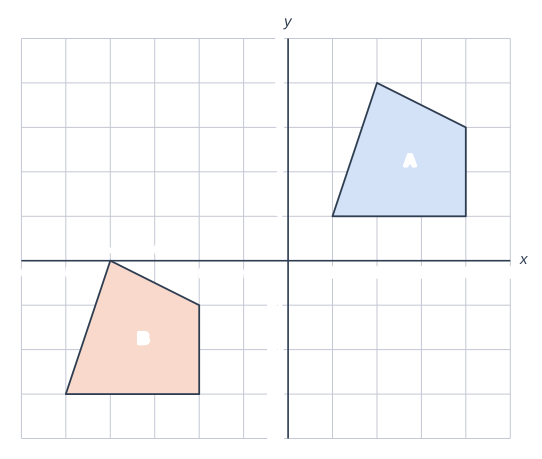
A coordinate grid with x from −6 to 5 and y from −4 to 5; each grid square is 1 unit across, and the axes cross at the origin O. Shape A is a shaded quadrilateral with vertices (1, 1), (4, 1), (4, 3) and (2, 4). Shape B is a shaded quadrilateral with vertices (−5, −3), (−2, −3), (−2, −1) and (−4, 0).

Model answer

Each vertex of A moves 6 units left and 4 units down, e.g. (1, 1) → (−5, −3) and (4, 3) → (−2, −1).
The transformation is a translation by the vector \(\begin{pmatrix}-6\\-4\end{pmatrix}\).

Explanation

Shape B is the same way up and the same size as shape A, so it is a translation. Pick one vertex of A and its matching vertex on B, and count how far it moves across (negative for left) and up (negative for down). "Describe fully" means you must name the transformation and give the column vector.

Mark scheme
  1. 1 mark

    B1 for translation

    do not accept a combination of transformations

  2. 1 mark

    B1 for \(\begin{pmatrix}-6\\-4\end{pmatrix}\)

    accept 6 left and 4 down; B0 for this mark if the vector is given as coordinates (−6, −4)

Question 2

2 marks

Show that the translation \(\begin{pmatrix}1\\2\end{pmatrix}\) maps the line \(y = 2x + 1\) onto itself.

Model answer

Take any point on the line: \((t, 2t + 1)\).
Its image is \((t + 1, 2t + 1 + 2) = (t + 1, 2t + 3)\).
Substitute \(x = t + 1\) into \(y = 2x + 1\): \(y = 2(t + 1) + 1 = 2t + 3\), which is the y-coordinate of the image.
So every point of the line is mapped to a point on the same line: the line is mapped onto itself.

Explanation

A translation slides every point by the same vector. The vector \(\begin{pmatrix}1\\2\end{pmatrix}\) goes 1 across and 2 up, which is exactly the gradient of the line, so each point slides along the line. To prove it, show that the image of a general point still satisfies the equation, not just one particular point.

Mark scheme
  1. 1 mark

    M1 for translating a general point on the line, e.g. \((t, 2t + 1) \to (t + 1, 2t + 3)\)

    or for showing that the vector is in the direction of the line (gradient 2 ÷ 1 = 2, the same as the line)

  2. 1 mark

    C1 for a complete argument, e.g. \(2(t + 1) + 1 = 2t + 3\), so every image point is on the line

    for the gradient method, must also state that a point on the line moves to a point on the line, e.g. (0, 1) → (1, 3), and 3 = 2 × 1 + 1

Question 3

3 marks

A robot starts at the point (−10, −5).
Each move the robot makes is the translation \(\begin{pmatrix}3\\2\end{pmatrix}\).

Ella says, "If the robot keeps making this move, it will reach the point (50, 36)."

Is Ella correct?
You must show how you get your answer.

Model answer

After \(n\) moves the robot is at \((-10 + 3n, -5 + 2n)\).
For x = 50: \(-10 + 3n = 50\), so \(n = 20\).
After 20 moves: y = −5 + 2 × 20 = 35.
The robot is at (50, 35) when x = 50, so it never reaches (50, 36).
Ella is not correct.

Explanation

Each move adds 3 to the x-coordinate and 2 to the y-coordinate, so after \(n\) moves the position is \((-10 + 3n, -5 + 2n)\). The x-coordinate tells you how many moves would be needed, and then the y-coordinate must match too. Checking only one coordinate is a common mistake.

Mark scheme
  1. 1 mark

    M1 for finding the number of moves to reach x = 50, e.g. \(-10 + 3n = 50\) giving \(n = 20\)

    oe, e.g. 60 ÷ 3 = 20; or for the position after \(n\) moves, \((-10 + 3n, -5 + 2n)\)

  2. 1 mark

    M1 for the y-coordinate after 20 moves: \(-5 + 2 \times 20 = 35\)

    oe, e.g. the robot is at (50, 35)

  3. 1 mark

    C1 for No, with correct supporting figures, e.g. when x = 50 the robot is at (50, 35), not (50, 36)

    accept: the y-coordinate is always odd, so it can never be 36, with a correct reason

Question 4

4 marks

The point P(4, 3) is translated by the vector \(\begin{pmatrix}k\\-2k\end{pmatrix}\) to give the point Q.
Q lies on the line with equation \(y = 2x - 7\).

Find the coordinates of Q.

Model answer

Q = \((4 + k, 3 - 2k)\)
Q lies on \(y = 2x - 7\), so \(3 - 2k = 2(4 + k) - 7\)
\(3 - 2k = 1 + 2k\)
\(2 = 4k\), so \(k = 0.5\)
Q = (4 + 0.5, 3 − 1) = (4.5, 2)
Check: 2 × 4.5 − 7 = 2 ✓

Explanation

Write the image point in terms of \(k\) by adding the vector to P. A point lies on a line when its coordinates satisfy the equation, so substitute the x- and y-coordinates of Q into \(y = 2x - 7\) and solve for \(k\). Remember to finish by giving the coordinates of Q, not just \(k\).

Mark scheme
  1. 1 mark

    M1 for the coordinates of Q in terms of \(k\): \((4 + k, 3 - 2k)\)

    correct answer with no working scores full marks

  2. 1 mark

    M1 for substituting into the equation of the line: \(3 - 2k = 2(4 + k) - 7\)

    oe

  3. 1 mark

    A1 for \(k = 0.5\)

    cao; accept \(\frac{1}{2}\)

  4. 1 mark

    A1 for (4.5, 2)

    cao

Ready to try the rest? Every answer you write is marked against the mark scheme, so you can see exactly where the marks are.

AI Tutor Hints first, answers after you try

Hi! Stuck? Ask me for a hint and I’ll help you work it out. Once you’ve checked your answer I can explain exactly where the marks are.